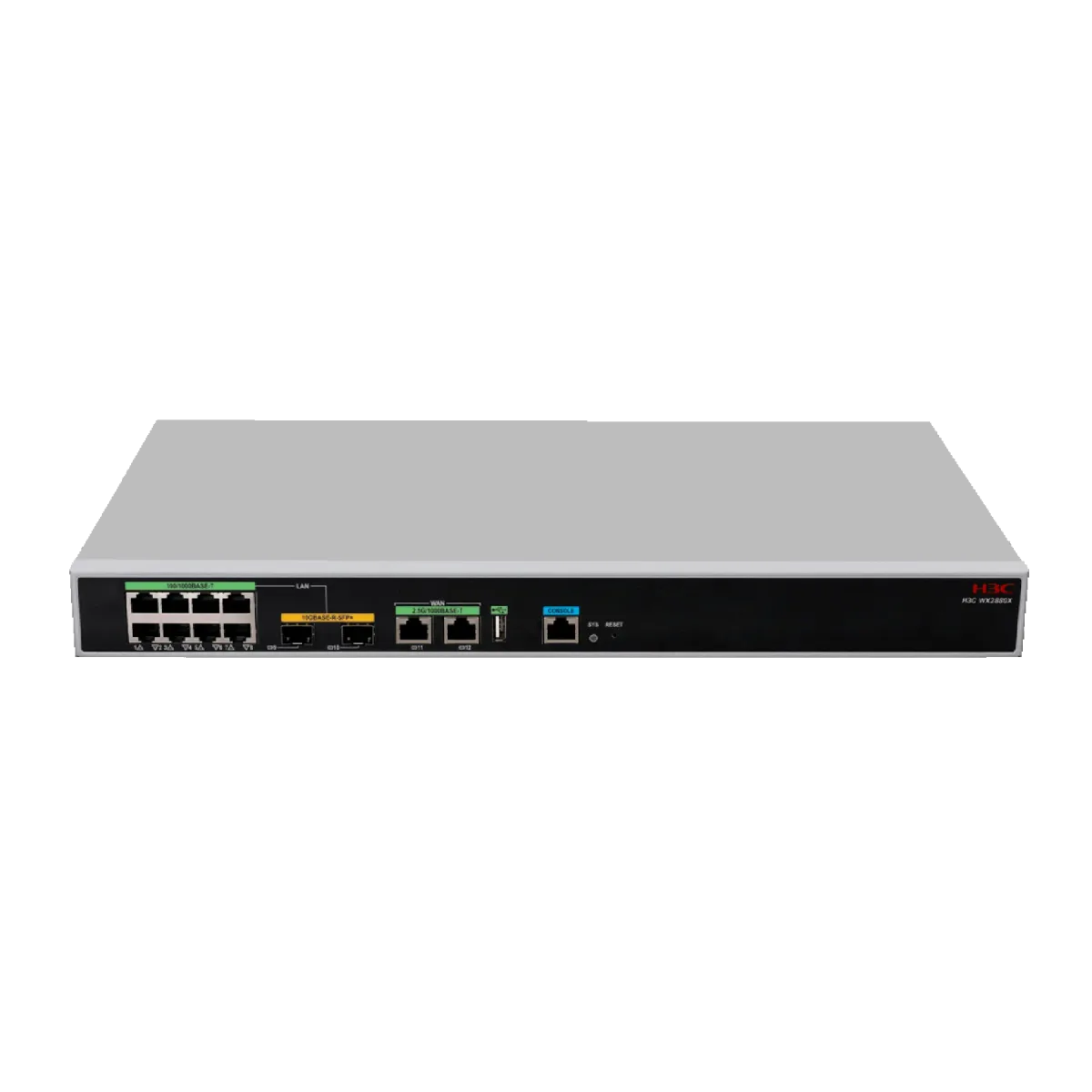
| Port console | 1 x Console port |
| Data rates (Mbps) | 802.11b: 1, 2, 5.5, 11; 802.11a/g: 6, 9, 12, 18, 24, 36, 48, 54; 802.11n: 6.5 to 600 (NSS = 1 to 4, HT20 to HT40); 802.11ac: 6.5 to 6,933 (MCS0 to MCS9, NSS = 1 to 8, VHT20 to VHT160); 802.11ax: 7.3 to 9,608 (MCS0 to MCS11, NSS = 1 to 8, HE20 to HE160); 802.11be: 7.3 to 23,059 (MCS0 to MCS13, NSS = 1 to 8, EHT20 to EHT320) |
| Dimensions (W/D/H) | 440 mm × 250 mm × 43.6 mm |
| EMC standards | EN 55032; EN 55035; EN IEC 61000-3-2; EN 61000-3-3 |
| EWP-WX2880X | H3C WX2880X Access Controller |
| Fan | Internal fans |
| High availability (HA) — Dual-link backup | 1:1 Master/backup; To ensure high availability, deploy two ACs in a master-backup configuration: assign a higher AP connection priority to the master AC for APs, and enable tunnel preemption on the master AC. This deployment enables automatic AC failover and service switchback, making it suitable for scenarios that require a certain level of service availability but not extreme zero-interruption |
| High availability (HA) — N+1 backup | N+1 backup is an extension of master/backup. It requires two to four ACs |
| High availability (HA) — Remote AP | The Remote AP feature enables the AP to continue providing services for clients after the tunnel between the AP and AC is disconnected |
| Humidité | Operating humidity: 5% to 95% (non-condensing); Storage humidity: 5% to 95% (non-condensing) |
| IEEE standards — 802.11 | IEEE 802.11a/b/g/n/ac/ac Wave 2/ax/be; IEEE 802.11d/e/h/i/w/u; IEEE 802.11k/v/r |
| Indicators — LED | LEDs corresponding to different operating states indicate the boot loader status, system status, port status, power module status, and system fault status |
| Interface | LAN:; 8 × GE ports; 2 × SFP+ ports; WAN:; 2 × 2.5GE ports |
| Layer 2 and Layer 3 — ACL | Basic ACL, Advanced ACL, Layer 2 ACL |
| Layer 2 and Layer 3 — ARP | Static ARP, Dynamic ARP, Gratuitous ARP; Proxy ARP, ARP snooping, ARP fast-reply, ARP suppression |
| Layer 2 and Layer 3 — DHCP | DHCP server, DHCP Relay, DHCP Client, DHCP Snooping |
| Layer 2 and Layer 3 — DNS | DNS client, DNS proxy, DNS fast-reply, DNS Snooping |
| Layer 2 and Layer 3 — Ethernet | Link aggregation, Port isolation, Loop detection, Port mirroring, Storm suppression |
| Layer 2 and Layer 3 — IP address configuration | Static IP, DHCP assigned IP |
| Layer 2 and Layer 3 — IP Multicast | MLD Snooping, IGMP Snooping |
| Layer 2 and Layer 3 — IP routing | Static routing, OSPFv2, Policy-based routing |
| Layer 2 and Layer 3 — IPv4 | ICMP/ACL/DHCP/TFTP/FTP/DNS |
| Layer 2 and Layer 3 — IPv6 | ICMP/ACL/DHCP/TFTP/FTP/DNS |
| Layer 2 and Layer 3 — LLDP | Link Layer Discovery Protocol, discovering and identifying other LLDP enabled devices and neighboring devices in the network |
| Layer 2 and Layer 3 — MAC | Static MAC, Dnamic MAC, Blackhole MAC |
| Layer 2 and Layer 3 — NAT | Static NAT, NAT66, NAT LOG |
| Layer 2 and Layer 3 — QoS | Qos policy, Priority mapping, Traffic policing, Priority marking |
| Layer 2 and Layer 3 — STP | Spanning Tree Protocol; STP, RSTP, PVST, MSTP |
| Layer 2 and Layer 3 — VLAN | Default VLAN, Port-based VLAN; Access mode, trunk mode, and hybrid mode |
| Layer 2 and Layer 3 — VLAN Pool | A VLAN group supports adding multiple VLAN lists |
| Layer 2 and Layer 3 — VPN | Gre, L2TP, SSL VPN, IPsec VPN |
| LIS-WX-128-BE | Enhanced Access Controller License,128 APs |
| LIS-WX-16-BE | Enhanced Access Controller License,16 APs |
| LIS-WX-1-BE | Enhanced Access Controller License, 1 AP |
| LIS-WX-32-BE | Enhanced Access Controller License,32 APs |
| LIS-WX-4-BE | Enhanced Access Controller License,4 APs |
| LIS-WX-64-BE | Enhanced Access Controller License,64 APs |
| LIS-WX-8-BE | Enhanced Access Controller License,8 APs |
| LSWM3STK | SFP+ Cable 3m |
| Management and maintenance — GUI | Support WEB management via HTTP/HTTPS |
| Management and maintenance — Information maintenance | Support Syslog |
| Management and maintenance — Local debugging | Support CLI |
| Management and maintenance — MIB | RFC 1213 MlB-II Stands for Management Information Base; RFC 3418 Management Information Base (MlB) for the Simple Network Management; Protocol (SNMP); H3C private MIBs |
| Management and maintenance — Netconf | Support Netconf provides programmable and scalable methods to manage network devices |
| Management and maintenance — Remote debugging | SSH V2.0/Telnet/FTP/TFTP |
| Management and maintenance — RESTful | Support RESTful via HTTP/HTTPS |
| Management and maintenance — Secure boot | Supporting firmware protection, ensuring the integrity of the subsequent running program codes through the trusted Boot-Loader, forming a trusted device boot chain |
| Management and maintenance — SNMP | Support SNMP V1/V2c/V3 |
| Modulation Mode | 11b: BPSK, QPSK, CCK; 11a/g/n: BPSK, QPSK, 16QAM, 64QAM; 11ac: BPSK, QPSK, 16QAM, 64QAM, 256QAM; 11ax: BPSK, QPSK, 16QAM, 64QAM, 256QAM, 1024QAM; 11be: BPSK, QPSK, 16QAM, 64QAM, 256QAM, 1024QAM, 4096QAM |
| Modulation Technology | 802.11b: Direct-sequence spread spectrum (DSSS); 802.11a/g/n/ac: Orthogonal frequency-division multiplexing (OFDM); 802.11ax/be: Orthogonal frequency-division multiple access (OFDMA) |
| MTBF (25°C) | 145 years |
| MTTR | 1 hours |
| Operating Altitude | 5000 meters |
| Consommation | 14.1W to 31.3W |
| Alimentation | Built in dual power supply |
| Product capabilities — AC Operating Mode | AC Mode, managed by H3C intelligent O&M platform |
| Product capabilities — Basic information | Support 802.11a/b/g/n/ac/ac Wave 2/ax/be |
| Product capabilities — Maximum throughput | Up to 10 Gbps |
| Product capabilities — Supported Wireless AP | H3C WA6300, WA6500, WA6600, WA7600, WA7500, WA7300, WA7200 Series AP |
| Classe de protection | IP20 |
| Bouton de réinitialisation | Restoration to factory default |
| Safety Standards | FDA 21 CFR Subchapter J; GB 4943.1; UL 62368-1; CAN/CSA C22.2 No 62368-1; IEC 62368-1; EN 62368-1; AS/NZS 62368-1 |
| Service assurance — Actively triggering client relinking | AP actively sends messages to allow wireless clients to reconnect or roam actively |
| Service assurance — Adjust channel reuse between APs | RF chip adjusts the environmental noise perceived by the device to improve AP transmission efficiency |
| Service assurance — Broadcast suppression | Discard ARP request and response packets from wireless clients during the suppression cycle |
| Service assurance — Doctor AP* | Fit AP mode support Doctor AP, simulates wireless client access process, diagnoses network issues, and improves network experience |
| Service assurance — Fast forwarding function for client data services | Intelligent optimization of RF chip business processing can improve performance |
| Service assurance — Intelligent bandwidth guarantee | Ensure that different wireless services can obtain the lowest guaranteed bandwidth during network congestion |
| Service assurance — Only 802.11ax accessing | Only wireless clients that support 802.11ax can access the network, improving the network experience |
| Service assurance — Port Aggregation | Multiple uplink ports for port aggregation to increase uplink bandwidth (only applicable to multiple uplink port APs) |
| Service assurance — Prohibit weak signal client access | AP prohibits wireless clients with signals below the threshold from accessing, to avoid low-signal clients occupying more channel resources |
| Service assurance — Remote AP | After the tunnel between AC and AP is disconnected, AP continues to provide services to clients |
| Service assurance — Shorten client sleep time | RF chips shorten client sleep time and improve transmission efficiency through beacons |
| Service assurance — Software version anomaly repairing | After the software version is damaged due to abnormal circumstances, AP can automatically download the available software version through AC or cloud platform |
| Service assurance — Spectrum Analysis | Displaying the non-Wi-Fi interference sources through the H3C intelligent O&M platform |
| Service assurance — Terminal roaming navigation | Adjust the AP transmission power to create more roaming conditions and improve the roaming experience |
| Service quality — Application Identification | SQA (Software Quality Assurance), identifies audio and video services based on SIP protocol, prioritizing service quality assurance; UCC (Unified Communications and Collaboration), increase the processing priority of audio and video services and prioritize ensuring service quality |
| Service quality — ATF | Air Time Fairness, by allocating an equal amount of RF usage time, reducing wireless channel congestion and improving the efficiency and fairness of wireless networks |
| Service quality — CAC | Call Admission Control, improve the quality of service for wireless clients that have already received high priority by limiting the number of wireless clients that have received high priority; Support number of users/Channel utilization based |
| Service quality — User bandwidth management | Allocate available bandwidth per STA; Allocate total bandwidth for all STA shares based on SSID; Dynamically adjust the available bandwidth of STA based on business |
| Service quality — WMM | Wi-Fi Multimedia, Improve the service quality of audio and video transmission in wireless networks through EDCA scheduling algorithm |
| SFP-GE-LX-SM1310-A | 1000BASE-LX SFP Transceiver, Single Mode (1310nm, 10km, LC) |
| SFP-GE-LX-SM1310-D | 1000BASE-LX SFP Transceiver, Single Mode (1310nm, 10km, LC) |
| SFP-GE-SX-MM850-A | 1000BASE-SX SFP Transceiver, Multi-Mode (850nm, 550m, LC) |
| SFP-GE-SX-MM850-D | 1000BASE-SX SFP Transceiver, Multi-Mode (850nm, 550m, LC) |
| SFP-XG-LX-SM1310-D | SFP+ Module (1310nm,10km, LC) |
| SFP-XG-SX-MM850-D | SFP+ Module (850nm,300m, LC) |
| Température | Operating temperature: 0°C to +45°C; Storage temperature: –40°C to +70°C |
| Throughput | 10Gbps |
| Tunnel management — CAPWAP tunnel | Unicast/broadcast/DNS/DHCP/static IP method for discovering AC |
| Tunnel management — DTLS | Tunnel between AC and AP support DTLS encryption |
| Tunnel management — Dual tunnel | Establishing CAPWAP tunnels with two ACs |
| Tunnel management — IPv4/IPv6 | Tunnel between AC and AP support IPv4 and IPv6 |
| Tunnel management — NAT | NAT between AC and AP |
| Tunnel management — Time synchronization | Synchronizing clock information from AC |
| USB port | 1 x USB 2.0 |
| User authentication — 802.1X authentication | Local and remote 802.1X authentication |
| User authentication — Extensible Authentication Protocol (EAP) | EAP-Transport Layer Security (EAP-TLS); EAP-Tunneled TLS (EAP-TTLS); Protected EAP (PEAP) v0 or EAP-MSCHAP v2; EAP-Challenge Handshake Authentication Protocol (EAP-CHAP); EAP-Subscriber Identity Module (EAP-SIM); EAP-Authentication and Key Agreement (EAP-AKA); PEAP v1 or EAP-Generic Token Card (EAP-GTC); EAP-Flexible Authentication via Secure Tunneling (EAP-FAST); EAP-MD5; Microsoft Challenge Handshake Authentication Protocol (MSCHAP) v2; EAP-Pre-Shared Key (EAP-PSK) |
| User authentication — MAC authentication | Local and remote MAC authentication |
| User authentication — Portal authentication | Local and remote Portal authentication; Guest/Captive portal; Portal mac-trigger |
| User authentication — PPSK | Fit AP mode support Private Pre-Shared Key, obtain passwords to access wireless networks through the H3C intelligent O&M platform |
| User authentication — PSK | Support PSK and Private-PSK; Support Multiple SSIDs and multiple PSKs; Each SSID use a unique PSK password |
| User authentication — Social Media APPs Authentication | Support Google/Facebook/Twitter through the H3C intelligent O&M platform |
| Poids | 3.3kg (installed with dual power supplies) |
| Wi-Fi certified | Wi-Fi Alliance:Wi-Fi 7, Wi-Fi 6E, Wi-Fi 6, WMM, WPA, WPA2 and WPA3 – Enterprise, Personal (SAE), Enhanced Open (OWE) |
| Wireless security — Encryption | TKIP, CCMP; WEP40, WEP104; WPA2-Personal (802.11i); WPA2-Enterprise with 802.1X; WPA3-Personal, WPA3-Enterprise; WPA3-Enhanced Open (OWE); Advanced Encryption Standard (AES) |
| Wireless security — Forwarding security | Packet filtering; MAC address filtering; Broadcast storm suppression |
| Wireless security — IPSG | IP source guard (IPSG) prevents spoofing attacks by using an IPSG binding table to filter out illegitimate packets |
| Wireless security — Management frame protection | Provide management frame protection for wireless clients to enhance wireless network security |
| Wireless security — WIPS | Wireless Intrusion Prevention System, protect the network from unauthorized access, such as Rogue AP, Rogue client, Rogue Wireless Bridge, Ad-hoc |
| Wireless security — Wireless EAD | Coupled with EAD (End user Admission Domination) solution, implement security policies for terminals accessing the network to improve wireless network security |
| Wireless security — WPA/WPA2 authentication and encryption | WPA/WPA2-PSK+TKIP; WPA/WPA2-PSK+CCMP; WPA/WPA2-802.1X+TKIP; WPA/WPA2-802.1X+CCMP; WPA/WPA2-PSK+TKIP-CCMP; WPA/WPA2-802.1X+TKIP-CCMP |
| WLAN extension — Band steering | Help 6G capable clients migrate from 5G to 6G radios. Wi-Fi 6E and Wi-Fi 7 clients are automatically directed to the 6G radio to leverage its benefits, while freeing up 2.4G and 5G radios for legacy clients |
| WLAN extension — Bonjour gateway | Forwarding mDNS packets across VLANs |
| WLAN extension — BYOD | Identifies device types according to the OUI in the MAC address; Identifies device types according to the user agent (UA) field in an HTTP packet; Identifies device types according to DHCP Option information |
| WLAN extension — Forwarding mode | Centralized forwarding/local forwarding/policy forwarding |
| WLAN extension — Hotspot 2.0 | Fit AP mode support Hotspot 2.0 |
| WLAN extension — Limit the number of connected users | User access count restriction based on SSID and RF |
| WLAN extension — Load balancing | Traffic-based load balancing; User-based load balancing; Frequency band-based load balancing, dual-5G devices only |
| WLAN extension — Local forwarding | Local forwarding based on SSID and VLAN |
| WLAN extension — Mesh | Mesh link; Mesh link security; Multi-hop Mesh |
| WLAN extension — Multicast enhancement | IPv4/IPv6 MLD Snooping/IGMP Snooping; Convert multicast data into unicast data for transmission, reducing network congestion |
| WLAN extension — RF adjustment | Automatic channel/power/bandwidth adjustment |
| WLAN extension — Roaming | 802.11k and 802.11v smart roaming; 802.11r fast transition roaming |
| WLAN extension — SSID hiding | Restrict access and improve wireless network security by SSID hiding |
| WLAN extension — User isolation | VLAN-based user isolation; SSID-based user isolation |
| WLAN extension — VLAN binding | Binding VLAN based on interface/SSID/MAC |
| WLAN extension — Wireless location | Fit AP mode support BLE location; Fit AP mode support RSSI location |
| WLAN extension — Wireless probing | Monitor the wireless network environment by monitoring wireless network messages |