
RTK GNSS positioning architecture between base station and mobile rover
Real-Time Kinematic positioning relies on differential carrier measurements between a stationary base station at surveyed coordinates and a moving rover receiver. Because both receivers track the same satellite constellation simultaneously over a local baseline, they experience nearly identical orbital, satellite clock, tropospheric, and ionospheric biases. Differencing these shared errors reduces positioning uncertainty from meter-grade standalone fixes down to the centimeter scale in real time.
Across autonomous machinery, robotic mowers, and industrial vehicles, the rover continuously ingests raw observations from the base to compute its relative vector at high update rates. Reliable operation depends on an unobstructed sky view toward the horizon and deterministic packet timing so that kinematic latency never degrades trajectory tracking during rapid turns, acceleration, or variable field speeds.
Single-band GNSS receivers versus dual-band L1, L2, and L5 architectures
A single-band receiver tracks only the L1 frequency, leaving it exposed to unmodeled ionospheric delays as baseline length grows or during elevated solar activity. Dual-band architectures combining L1 with L2 or L5 measure the dispersive delay between two frequencies to cancel first-order ionospheric error directly. In addition, wider L5 modulation chip rates sharpen correlation peaks and suppress multipath reflections around metallic structures and industrial yards.
Within the GPS Modules family, the Unicore UC6580 illustrates dual-frequency integration with 96 channels supporting GPS L1C/A and L5 signals alongside RTCM V3.X differential data in NMEA-0183 and Unicore formats. Before layout freeze, engineers must check the datasheet for supported constellations, front-end out-of-band rejection requirements, and RF sensitivity margins under local electromagnetic interference.
Carrier-phase integer ambiguity resolution and maintaining a fixed state
Unlike code-based positioning, RTK evaluates the phase of the RF carrier wave, whose wavelength is roughly nineteen centimeters on L1. The solver must determine the exact integer number of full cycles between the antenna and each tracked satellite. Until integer resolution converges, the receiver outputs a float solution before locking into a centimeter-accurate fixed state.
Tree canopies and overhead gantries trigger cycle slips that interrupt phase lock, making inertial aiding valuable during short outages. In GPS Modules, the Unicore UM220-INS pairs GNSS with inertial navigation across 64 channels in a 12.2 x 16.0 x 2.6 mm 24-pin SMD package rated at -40 °C or lower. Alternatively, the Sintrones VDB-810DR full-size PCIe Mini Card integrates a second I2C accelerometer and 3 s aided start.
Delivering RTCM 3 correction streams over 4 G NTRIP or UHF radio
Differential base data normally travels in standardized RTCM 3 frames carrying carrier-phase observables, pseudoranges, and station coordinates. When cellular coverage is present, NTRIP streams these RTCM 3 packets over IP via a 4 G modem from a private base mountpoint or a regional network of virtual reference stations. This avoids deploying dedicated radio towers while requiring stable cellular backhaul and controlled network latency.
In remote quarries or off-grid sites without cellular service, a point-to-multipoint UHF radio link provides autonomous correction broadcast whose range depends on terrain clearance, antenna elevation, and local RF regulations. Whichever transport is chosen, integrators should confirm RTCM V3.X message compatibility, baud rate headroom, and link-budget latency in the module datasheet, as specified on the Unicore UC6580.
Ground plane requirements and RF design for active GNSS antennas
Centimeter-level repeatability starts at the RF front end before any digital correlation occurs. An active ceramic patch or helical antenna typically requires a continuous metallic ground plane, often spanning 70 to 100 mm in diameter, to stabilize its phase center, shape the upper-hemisphere radiation pattern, and attenuate ground-reflected multipath signals that otherwise bias carrier-phase measurements near low elevation angles.
On the host PCB, the DC bias-tee feeding the antenna internal low-noise amplifier needs clean power filtering and physical isolation from switching regulators and adjacent 4 G or UHF transmitters. Designers must verify 50 ohm trace impedance, LNA voltage and current limits, axial ratio, and coaxial insertion loss in both the antenna and receiver datasheets prior to fabrication.
Selecting GNSS modules on quotation by interface and operating environment
Atlas Electronics handles supply on quotation for positioning modules matched to host bus, thermal envelope, and power constraints. For compact surface-mount designs, GPS Modules includes the automotive-grade 64-channel Unicore UM220-IV measuring 12.2 x 16.0 x 2.4 mm at -40 °C or lower, whereas GNSS Receiver Modules offers the low-power 64-channel Unicore UC6226 featuring Flash firmware and a 1 Hz data update rate.
The Unicore UC6226 outputs NMEA0183 and Unicore protocols for energy-constrained trackers, while industrial embedded computers can adopt PCIe Mini Card options such as the Sintrones VDB-810DR rated from -40 to 85 °C under 0.6 m/s airflow. Buyers should check exact power rails, serial or PCIe pinouts, NMEA 0183 variants, and RTCM V3.X support in each datasheet before requesting a quotation.
Frequently asked questions
Why choose a dual-band L1/L5 receiver instead of a single-band L1 module for RTK positioning?
Single-band L1 receivers remain sensitive to unmodeled ionospheric dispersion when baseline distance exceeds a few kilometers, which slows integer ambiguity resolution. Dual-frequency architectures such as L1/L5 measure the frequency-dependent delay to cancel ionospheric error and leverage wider L5 modulation to improve multipath rejection and time-to-fix.
When should RTCM 3 corrections be transported via 4 G NTRIP rather than a UHF radio link?
NTRIP delivers RTCM 3 streams over a 4 G cellular IP connection from a private base or virtual network, simplifying wide-area coverage wherever mobile data is available. UHF radio operates independently of cellular networks in remote sites, though range depends on terrain clearance and regulatory power limits. Check RTCM V3.X support and serial baud rates in the module datasheet, such as on the Unicore UC6580.
What ground plane dimensions are required for an active centimeter-level GNSS antenna?
Active ceramic patch and helical antennas rely on a continuous metallic ground plane, typically 70 to 100 mm across, to stabilize the electrical phase center, shape gain toward the zenith, and reject ground-reflected multipath. Integrators should check antenna ground-plane specifications, 50 ohm matching, and LNA bias-tee requirements in the datasheet before PCB layout.
How does inertial aiding help when carrier-phase lock drops under foliage or gantries?
Overhead structures and tree canopies cause carrier-phase cycle slips that momentarily interrupt fixed RTK solutions. Modules combining GNSS with inertial sensors, such as the 64-channel Unicore UM220-INS or the Sintrones VDB-810DR PCIe Mini Card with an I2C accelerometer, bridge brief outages until satellite phase lock recovers.
Products mentioned
VDB-810DR
GPS Modules
PCIe Mini Card GNSS module with accelerometer and dead reckoning · Ref. : VDB-810DR
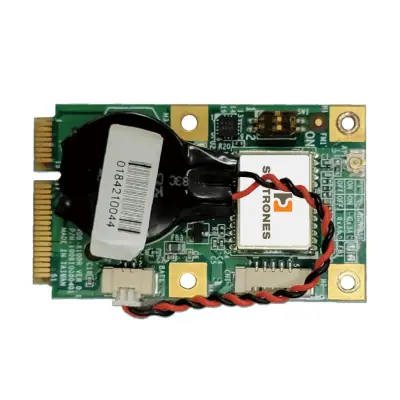
- I2C
- 3s
Price on request
UM220-IV NV
GPS Modules
Automotive-grade multi-GNSS positioning module, 64 channels · Ref. : UM220-IV
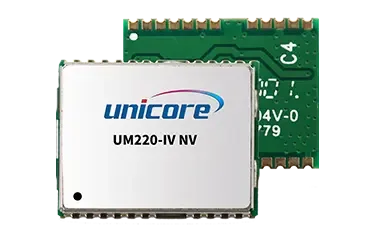
- NMEA 0183, Unicore
- 12.2 x 16.0 x 2.4 mm
- GPS L1
Price on request
UC6226
GNSS Receiver Modules
Low-power multi-constellation GNSS module, 64 channels · Ref. : UC6226
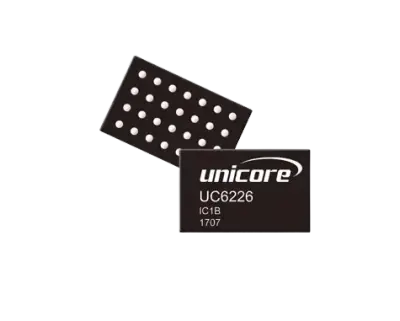
- 64 channels
- NMEA0183, Unicore
Price on request
UM220-INS NL
GPS Modules
Integrated GNSS and INS navigation module, 64 channels, 24-pin SMD · Ref. : UM220-INS
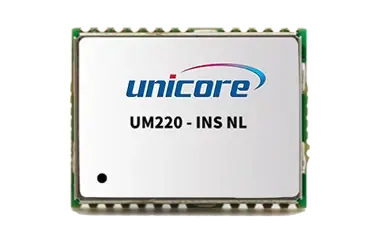
- NMEA-0183, Unicore
- RTCM V3.X
- 12.2 x 16.0 x 2.6 mm
Price on request
UC6580
GPS Modules
Dual-frequency multi-constellation GNSS module L1/L5, 96 channels · Ref. : UC6580
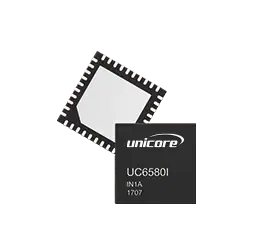
- 96 channels
- GPS L1C/A, L5
- NMEA-0183, Unicore
Price on request
A project? Our engineers build the solution with you.
Send your requirements: Atlas proposes the architecture, the bill of materials and a quotation, then follows the supply.
Request a quotationRelated pages
 ProjectMulti-Band GNSS & Centimeter-Level RTK ModulesCompare multi-band GNSS modules and RTK receivers by acquisition time, RTCM 3 NTRIP correction streams, IMU dead reckoning, and antenna bias.
 Use caseDrone and Thermal Inspection in Aerospace, Space & DefenceHardware architecture and field deployment guide addressing operational requirements. Certified industrial hardware, custom integration, and supply on quotation.
 OfferDrone and Thermal Inspection kit for Aerospace, Space & DefenceComplete hardware package ready for industrial deployment. Verified components, architecture review by Atlas engineering desk, and procurement on quotation.
 ProjectHardware for Aerospace, Space & Defence projectsSource the right industrial hardware for your deployment. Validated architectures, rugged components, bill of materials review, and full supply on quotation.
 ArticleHow to choose hardware for Aerospace, Space & DefenceTechnical buying guide for selecting GNSS receivers, thermal cameras, and propulsion hardware for aerospace, space, and defence systems.
 Use caseRTK GNSS Surveying in Aerospace, Space & DefenceHardware architecture and field deployment guide addressing operational requirements. Certified industrial hardware, custom integration, and supply on quotation.
 OfferRTK GNSS Surveying kit for Aerospace, Space & DefenceComplete hardware package ready for industrial deployment. Verified components, architecture review by Atlas engineering desk, and procurement on quotation.
 Use caseSatellite Connectivity for Remote Sites in Aerospace, Space & DefenceHardware architecture and field deployment guide addressing operational requirements. Certified industrial hardware, custom integration, and supply on quotation.