
Deterministic control architecture across PLCs, servo drives, and fieldbus networks
In an automated workcell, trajectory accuracy relies on tight synchronization between Programmable Logic Controllers (PLC) and Servo Drives Systems. To minimize jitter during multi-axis interpolation, a real-time Ethernet fieldbus such as EtherCAT updates position setpoints and encoder feedback at a fixed cycle rate. A CAN bus remains well suited for auxiliary actuators, grippers, and distributed sensors requiring strong noise immunity across noisy cabinet and machine-frame wiring.
Standard Ethernet handles supervisory data exchange, image transfers, and non-critical telemetry, yet should be segmented from deterministic motion traffic to prevent packet-delay spikes. Before locking the control schematic, buyers must check each datasheet for minimum cycle time, supported motion profiles, allowed network topology, and galvanic port isolation to ensure predictable machine behavior under peak load.
Sizing collaborative robot arms and servo axes for industrial workcells
Selecting Collaborative Robot Arms starts with total payload mass, including the end-of-arm tooling, dress pack, and workpiece, together with the exact center-of-gravity offset. Working reach must cover every pick and place coordinate without approaching kinematic singularities, while maintaining the repeatability and path accuracy demanded by assembly, screwdriving, or palletizing tasks under continuous industrial shift schedules.
When throughput exceeds cobot joint speed limits, linear tracks or rotary indexers driven by Servo Drives Systems extend workcell capacity. Mechanical engineering requires checking the load-to-motor inertia ratio, holding-brake torque upon power removal, and continuous thermal duty rating in the datasheet so the drive stage avoids following-error alarms, thermal derating, or mechanical resonance during sustained multi-shift production runs.
Machine vision optics, lighting, frame rate, and embedded edge compute
GigE & USB3 Machine Vision Industrial Cameras must be matched to conveyor line speed, target spatial resolution, and maximum exposure time before motion blur degrades edge detection. Controlled illumination and lens selection establish usable contrast long before software filtering. The Sunell SN-MV1040HAN-F provides one PoE Ethernet port, RS-485 connectivity, a 152.9 × 74.4 × 69.7 mm housing, IP-based access control with auto logout, and operation down to -30 °C.
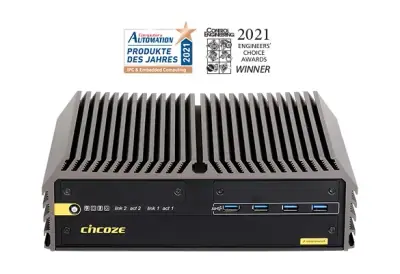
For edge AI inference and multi-camera inspection, an industrial compute node relieves the PLC of heavy image processing. The Cincoze 9TH/8TH embedded GPU computer features three to four Ethernet ports with PoE, CAN bus, DIN rail mounting, 4 G LTE with Dual SIM, and one MXM 3.1 GPU expansion socket. Integrators should check power budgets, enclosure airflow, and sustained bus bandwidth across simultaneous camera streams.
LiDAR sensing and ranging for mobile robotics and obstacle detection
Across autonomous mobile platforms and high-speed gantries, LiDAR Sensors deliver non-contact distance measurement, obstacle profiling, and early deceleration triggers ahead of collision zones. Technical selection focuses on maximum detection range, measurement update rate, immunity to ambient factory lighting, and enclosure sealing against conductive dust, washdown splashes, or airborne particulates inside demanding manufacturing cells.
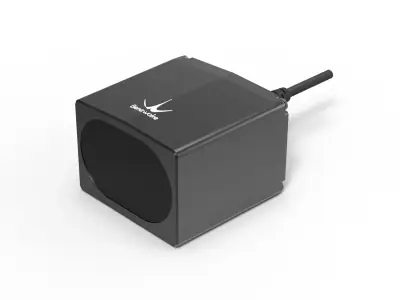
The Seeed Studio TF03-100 addresses long-range ranging up to 100 m inside a 44 × 43 × 32 mm IP67 enclosure rated down to -20 °C. It integrates a CAN bus interface, a 70 cm cable, and average current draw at or below 150 mA at 5 V, 80 mA at 12 V, or 50 mA at 24 V. Buyers must verify laser safety classification and angular field of view in the datasheet.
Industrial HMI touch panels, local supervision, and field connectivity
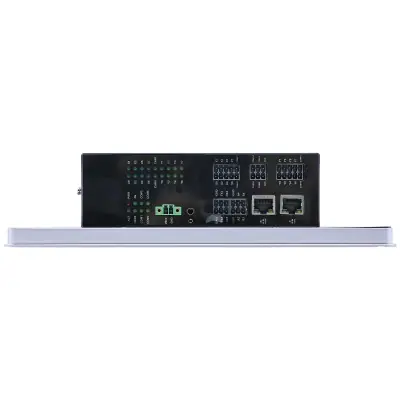
Industrial HMI Touch Panels, Keypads & Operator Interfaces centralize cell control, fault acknowledgment, and local diagnostics. The 10.1-inch EDATEC HMI2630 runs WEBICC SCADA and integrates CAN bus, RS-232, RS-485, Wi-Fi 5, and 4 G LTE down to -20 °C. For compact PoE stations requiring integrated imaging, the 10.1-inch Seeed Studio 114070221 adds a CAN-BUS terminal block, on-chip BLE, dual microphones, buzzer, audio jack, and a Sony IMX 219 CSI camera.
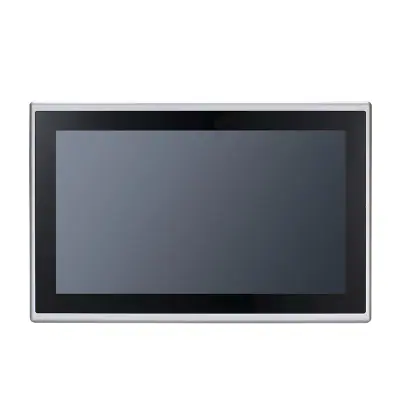
For cabinet doors exposed to dust and splashes, the fanless 15.6-inch FHD Axiomtek GOT315B-ADL-WCD offers an IP65 front rating, operation from -10 °C, one Ethernet port, RS-232, 4 G LTE, and up to 32 GB of DDR4 3200 MHz SO-DIMM memory. Buyers should check operating system compatibility, panel cutout dimensions, and rear-chassis sealing requirements against enclosure drawings.
Machine safety functions, risk assessment, and architecture trade-offs
Integrating robotic workcells requires separating standard motion logic from dedicated safety functions such as safe torque off, safe limited speed, and emergency-stop monitoring. Machine-level risk assessment, safety-circuit engineering, and compliance with applicable workplace directives remain strictly the integrator's responsibility, including collaborative installations where contact forces, workspace boundaries, and joint velocities must be engineered for every operating and maintenance mode.
Architecturally, centralizing vision and edge AI on an industrial GPU computer simplifies cabinet layout, whereas distributing servo axes and sensors over EtherCAT and CAN streamlines modular maintenance. Atlas Electronics supplies these automation components on quotation according to your bill of materials, after your team checks thermal envelopes, DC supply rails, and interface tolerances in each manufacturer datasheet.
Frequently asked questions
How should integrators choose between EtherCAT, CAN bus, and standard Ethernet in a robotic workcell?
EtherCAT suits deterministic multi-axis motion synchronization between PLCs and servo drives due to fixed cycle updates. CAN bus fits distributed sensors and auxiliary actuators in high-noise wiring paths, whereas standard Ethernet should be segmented for vision streams, telemetry, and HMI supervision.
Which parameters must be checked to match a machine vision camera to conveyor line speed?
Integrators should match maximum exposure time to part travel speed to avoid motion blur, then size optics, illumination, and frame rate accordingly. For a PoE network camera such as the Sunell SN-MV1040HAN-F, also check switch bandwidth and power budget.
What remains the integrator's responsibility regarding collaborative robot safety?
Selecting a collaborative robot arm never removes the need for a machine-level risk assessment. The integrator remains responsible for engineering safety functions, configuring speed and force limits, and verifying compliance of the end-of-arm tooling and surrounding perimeter sensors.
How do you select an industrial HMI panel for harsh environments and fieldbus connectivity?
Check front ingress protection, minimum operating temperature, and native serial or fieldbus ports in the datasheet. For instance, the Axiomtek GOT315B-ADL-WCD provides IP65 protection down to -10 °C, while the EDATEC HMI2630 operates from -20 °C with CAN, RS-232, and RS-485.
Products mentioned
GOT315B-ADL-WCD
Industrial HMI Touch Panels, Keypads & Operator Interfaces
15.6-inch FHD fanless industrial touch panel PC · Ref. : GOT315B-ADL-WCD
- 1 x Line-out
- AMI
- Intel® H610
Price on request
9TH/8TH
GigE & USB3 Machine Vision Industrial Cameras
Embedded GPU computer Intel Xeon/Core, MXM 3.1 socket
- CB-DP05/UB1336
Price on request
ED-HMI2630-101C
Industrial HMI Touch Panels, Keypads & Operator Interfaces
Industrial 10.1-inch touch HMI panel with WEBICC SCADA · Ref. : HMI2630
- LED
Price on request
TF03-100
LiDAR Sensors
Industrial long-range LiDAR distance sensor 100 m · Ref. : TF03-100
- 70cm
- UART/CAN
- LVTTL(3.3V)
Price on request
reTerminal DM
Industrial HMI Touch Panels, Keypads & Operator Interfaces
10.1-inch industrial touch panel PC with camera and PoE · Ref. : 114070221
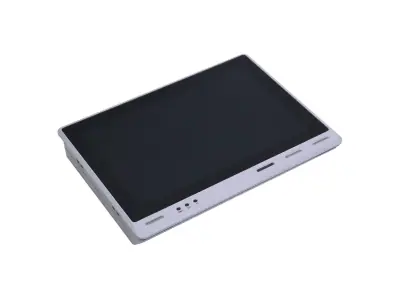
- On-chip BLE
- Sony IMX219
Price on request
SN-MV1040HAN-F
GigE & USB3 Machine Vision Industrial Cameras
4MP Machine Vision Network Camera with AI Analytics · Ref. : SN-MV1040HAN-F
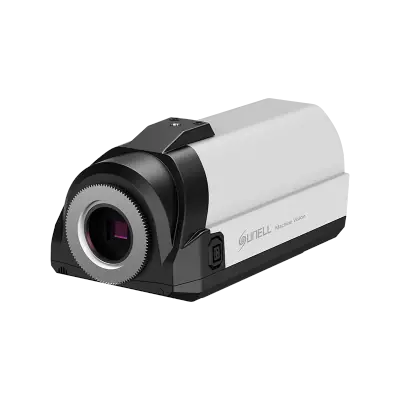
- 1 input, 1 output
Price on request
A project? Our engineers build the solution with you.
Send your requirements: Atlas proposes the architecture, the bill of materials and a quotation, then follows the supply.
Request a quotationRelated pages
 WikiEtherCAT: what it is and how it is usedTechnical definition, operating principles, industrial standards, and datasheet selection criteria for hardware integration projects supported by Atlas engineers.
 WikiLiDAR: what it is and how it is usedUnderstand LiDAR physics, 1D and 2D architectures, industrial and IoT applications, and key datasheet criteria for quotation sourcing.
 WikiCAN busTechnical definition, operating principles, industrial standards, and datasheet selection criteria for hardware integration projects supported by Atlas engineers.
 ProjectHardware for Robotics & Automation projectsSource the right industrial hardware for your deployment. Validated architectures, rugged components, bill of materials review, and full supply on quotation.
 Use caseSmart Building in Robotics & AutomationHardware architecture and field deployment guide addressing operational requirements. Certified industrial hardware, custom integration, and supply on quotation.
 Use caseMachine Vision in Robotics & AutomationHardware architecture and field deployment guide addressing operational requirements. Certified industrial hardware, custom integration, and supply on quotation.
 Use caseEnergy & Metering in Robotics & AutomationHardware architecture and field deployment guide addressing operational requirements. Certified industrial hardware, custom integration, and supply on quotation.
 Use caseSecure Remote Maintenance in Robotics & AutomationHardware architecture and field deployment guide addressing operational requirements. Certified industrial hardware, custom integration, and supply on quotation.
 Use caseAI Visual Inspection in Robotics & AutomationHardware architecture and field deployment guide addressing operational requirements. Certified industrial hardware, custom integration, and supply on quotation.