
LiDAR definition and optical ranging principles
Light Detection and Ranging, commonly known as LiDAR, is an active optical sensing technique that measures the distance to a target by projecting a laser beam and analyzing the backscattered light. Unlike passive vision cameras that depend on ambient illumination or ultrasonic transducers affected by soft materials and airflow, a LiDAR sensor delivers fast, directional distance measurements across dark, dusty, or optically complex industrial environments.
Two physical architectures dominate industrial LiDAR Sensors: direct time-of-flight and optical triangulation. Direct time-of-flight circuitry clocks the round-trip travel time of a short infrared pulse, enabling compact enclosures to measure across tens of meters. Optical triangulation projects a laser spot onto the target and tracks its lateral shift across a linear detector array, achieving fine angular and spatial resolution at short to medium distances.
Optoelectronic architecture and ambient light rejection
An industrial LiDAR module combines a pulsed or modulated near-infrared laser diode, collimating optics, a high-sensitivity photodetector, and a digital timing processor. Operating in the near-infrared spectrum avoids visible distraction on the factory floor while adhering to eye-safety limits. On the receiver side, a narrow optical bandpass filter isolates the returning laser wavelength from surrounding facility lighting and broadband thermal noise.
Outdoor deployments and sunlit loading bays impose strict demands on ambient light immunity, as intense solar radiation can saturate unfiltered receivers. Industrial datasheets specify this threshold explicitly, such as the 40,000 lux limit on the DFRobot DFR1138 and Orbbec MS200K. Internal signal processing also adjusts receiver gain dynamically to maintain reliable detection across both bright concrete walls and low-reflectance matte-black machinery.
Sensor classes from 1D rangefinders to 2D 360-degree scanners
Industrial systems primarily deploy two sensor classes: single-axis 1D rangefinders and 360-degree rotating 2D scanners. A 1D sensor measures distance along a fixed optical axis at high sampling rates, reaching 1 to 1000 Hz on the Benewake TFMINI-PLUS to track fast-moving targets without moving mechanical parts. This solid-state construction resists continuous shock and vibration on mobile machinery or overhead cranes.
By contrast, 2D scanners rotate a mirror or optical head through 360 degrees to generate a planar point cloud of surrounding obstacles. The DFRobot DFR0583 uses triangulation across a 0.2 to 25 meter range with 0.225 degree angular resolution at a typical 15 Hz scan rate, whereas dToF units such as the Orbbec MS200K and DFRobot DFR1138 maintain a smaller footprint.
Industrial robotics, automation, and IoT applications
In intralogistics and autonomous mobile robotics, 2D scanners feed simultaneous localization and mapping algorithms alongside real-time obstacle avoidance loops. Automated guided vehicles rely on planar range profiles to navigate dynamic warehouse aisles without floor markers. On fixed production lines and outdoor gantries, long-range 1D units handle vehicle presence detection, crane anti-collision, and bulk level monitoring in hoppers or silos.
Within industrial IoT architectures, low power consumption allows deployment on compact edge nodes and battery-assisted gateways. Drawing 550 mW, the Benewake TFMINI-PLUS fits easily into tight enclosures for people counting, gate clearance, or perimeter monitoring. On heavy vehicles and agricultural machinery, a CAN bus interface ensures deterministic, noise-immune communication with embedded controllers across electrically harsh harnesses.
Key datasheet parameters to check before sourcing a LiDAR sensor
Before specifying a sensor, engineers must inspect the usable detection range against actual target reflectance, because maximum distance ratings are typically established on high-reflectance reference targets. Buyers should also check acquisition rate, angular resolution for resolving narrow posts at distance, and stated accuracy, such as ±30 mm on the DFRobot DFR1138 or percentage-of-distance tolerances on longer-range triangulation scanners.
Environmental and electrical integration demands equal scrutiny in the datasheet. Check the ingress protection rating, such as IP65 or IP67 for dust and water jets, alongside minimum operating temperatures down to -20 °C for cold storage or outdoor yards. Confirm supply voltage range, average current draw, host protocol compatibility across UART, I²C, or CAN, cable length, and electromagnetic compliance markings such as CE or FCC.
Industrial LiDAR Sensors supplied on quotation by Atlas Electronics
Atlas Electronics supplies industrial LiDAR Sensors on quotation across short, medium, and long measurement ranges. For rugged outdoor 1D ranging, the Seeed Studio TF03-100 reaches 100 meters in an IP67 housing rated to -20 °C with a CAN bus interface and a 70 cm cable, drawing at most 80 mA at 12 V. For intermediate 40-meter installations, the Seeed Studio TF02 offers IP65 sealing and CAN connectivity at up to 70 mA at 12 V.
For space-constrained automation, the Benewake TFMINI-PLUS measures 0.1 to 12 meters inside a 35 mm × 18.5 mm × 21 mm IP65 package supporting UART, I/O, and I²C. For 360-degree planar mapping, the DFRobot DFR0583 covers up to 25 meters, while the Orbbec MS200K provides a 12-meter monoline dToF scan at 1.6 W average power consumption.
Frequently asked questions
What is the technical difference between a direct time-of-flight (dToF) LiDAR and a triangulation scanner?
A dToF LiDAR clocks the round-trip duration of a laser pulse, enabling compact housings and long ranges such as 100 meters on the Seeed Studio TF03-100 or 12 meters on the Orbbec MS200K. A triangulation scanner like the DFRobot DFR0583 derives distance from the lateral angle of the reflected spot on a detector array, achieving fine angular resolution at short to medium ranges.
How does ambient sunlight affect LiDAR performance in outdoor installations?
Strong solar radiation raises background optical noise on the photodetector and can reduce detection range on dark targets. Buyers should check the rated ambient illuminance limit in the datasheet, such as 40,000 lux on the DFRobot DFR1138 and Orbbec MS200K, alongside an IP65 or IP67 enclosure rating for dust and rain protection.
When should an industrial system use a CAN bus LiDAR instead of TTL UART or I²C?
TTL UART and I²C interfaces work well over short wiring runs inside compact robots or control boxes, as on the Benewake TFMINI-PLUS and DFRobot DFR1138. A differential CAN bus, available on the Seeed Studio TF02 and TF03-100, supports longer harnesses and resists electrical noise on industrial vehicles and heavy mobile equipment.
Which electrical and thermal ratings matter most when integrating LiDAR Sensors into mobile platforms?
Review supply voltage tolerances, average power or current draw, such as 550 mW on the Benewake TFMINI-PLUS, 1.6 W on the Orbbec MS200K, or up to 70 mA at 12 V on the Seeed Studio TF02, alongside the minimum operating temperature, which reaches -10 °C on the DFRobot DFR1138 and Orbbec MS200K and -20 °C on the Seeed Studio TF02 and TF03-100.
Products mentioned
TFmini Plus
LiDAR Sensors
Compact LiDAR Distance Sensor 0.1 to 12 m IP65 · Ref. : TFMINI-PLUS

Price on request
RPLIDAR A3
LiDAR Sensors
2D 360° Triangulation LiDAR Laser Scanner 25 m · Ref. : DFR0583
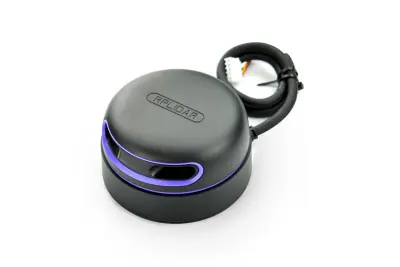
- 0.225°
- 0.2 - 25 meters
- 0~360 degrees
Price on request
RPLiDAR C1
LiDAR Sensors
Compact DTOF 360° laser range scanner · Ref. : DFR1138

- ±30mm
- 40000lux
- 0.72°@typical
Price on request
MS200k
LiDAR Sensors
360° monoline dToF LiDAR sensor, 12 m range · Ref. : MS200K

Price on request
TF03-100
LiDAR Sensors
Industrial long-range LiDAR distance sensor 100 m · Ref. : TF03-100

Price on request
TF02-i
LiDAR Sensors
Industrial LiDAR distance sensor 40 m with CAN interface · Ref. : TF02

Price on request
A project? Our engineers build the solution with you.
Send your requirements: Atlas proposes the architecture, the bill of materials and a quotation, then follows the supply.
Request a quotationRelated pages
 Use caseMobile Robotics and Cobots in Industrial Robotics and AutomationExplore technical architectures, deterministic buses, and sensor integration for mobile robots and cobots across automated manufacturing.
 ArticleHow to choose hardware for Robotics & AutomationTechnical buying guide for selecting PLCs, servo drives, cobots, LiDAR sensors, machine vision cameras, and HMIs for robotics automation.
 ArticleUnderstanding LiDAR: architecture, standards & hardwareTechnical LiDAR guide covering IEC 60825-1 and ISO 13849 standards, network topology, optical criteria, integration pitfalls and hardware.
 OfferMobile Robotics and Cobots kit for Robotics & AutomationQuotation-based kit architecture, chassis, arm and LiDAR bill of materials, and integration checks for automated industrial handling.
 ProjectHardware for Robotics & Automation projectsHardware families, engineering selection criteria, and quotation-based BOM sourcing to equip industrial robotics and automation lines.
 ProjectCollaborative Robot Arms, Mobile Robots & ActuatorsTechnical buyer guide to specify and quote collaborative robot arms, mobile robots, actuators, and educational STEM robotics kits.