
Laser safety under IEC 60825-1 Class 1 and functional safety under ISO 13849
Integrating an industrial LiDAR begins with optical eye safety governed by IEC 60825-1. Class 1 classification indicates that the emitted laser beam remains safe for the human eye under normal operating conditions, even during prolonged exposure. System integrators must inspect the manufacturer datasheet for emitted wavelength, peak pulse energy and duty cycle to confirm Class 1 compliance before deploying equipment near personnel.
When a sensor contributes to personnel protection or emergency stop functions on mobile robots and automated cells, ISO 13849 governs the functional safety of the complete control loop. Integrators must assess the required performance level, dual-channel hardware architecture and diagnostic coverage up to the safety controller. Standard navigation sensors without dedicated safety outputs do not fulfill ISO 13849 alone and require dedicated safety-rated LiDAR Components.
Electrical power distribution and industrial network topology for LiDAR arrays
On the electrical layer, a LiDAR installation requires strict separation between motor power rails and optical supply lines. Switching transients from drives introduce noise that degrades echo timing. Supply demands vary across hardware: the Seeed Studio TF03-100 draws up to 150 mA at 5 V, 80 mA at 12 V or 50 mA at 24 V via its 70 cm cable.
Network topology depends on node count, cable length and bandwidth needs toward the host controller. A CAN bus follows a linear daisy-chain topology with 120 ohm termination resistors at both ends and minimal stub lengths, whereas Ethernet UDP architectures rely on dedicated industrial switches. For short embedded serial links, a scanner such as the Orbbec MS200K requires a regulated rail sized for its 1.6 W average power consumption.
Field of view, detection distance, angular resolution and scanning mechanics
Selecting among LiDAR Sensors requires balancing field of view angle, detection range and angular resolution against scene dynamics. A single-point rangefinder like the Benewake TFMINI-PLUS measures from 0.1 to 12 m within a 35 x 18.5 x 21 mm housing. Conversely, the DFRobot DFR0583 triangulation scanner covers a 0 to 360 degree scanning angle from 0.2 to 25 m with 0.225° angular resolution at a 15 Hz typical scanning frequency adjustable from 10 to 20 Hz.
Scanning mechanics separate solid-state designs with no moving parts from motorized rotary heads. Solid-state modules eliminate bearing wear and offer higher resistance to continuous shock and mechanical vibration on mobile chassis. Rotary scanners provide full 360° planar mapping, so buyers must check mechanical vibration limits and minimum operating temperature in the datasheet, such as -10 °C on the DFRobot DFR1138.
Ambient light immunity, outdoor sunlight tolerance and IP ingress protection
In outdoor yards or near sunlit loading bays, solar infrared radiation saturates receiver photodiodes if optical bandpass filtering and dToF modulation are insufficient. Engineers must check the ambient illuminance limit expressed in lux on the datasheet before outdoor deployment. Both the Orbbec MS200K and DFRobot DFR1138 specify an ambient light limit of 40,000 lux, whereas the Seeed Studio 101090022 achieves 70,000 lux ambient light immunity with 1 cm distance resolution.
Ingress protection determines hardware longevity against abrasive dust and washdown jets. The IP65 enclosure of the Benewake TFMINI-PLUS resists dust ingress and water jets, while the IP54 to IP64 rating of the DFRobot DFR1138 suits sheltered or lightly exposed machinery. For permanent outdoor ranging up to 100 m down to -20 °C, the Seeed Studio TF03-100 provides IP67 sealing within 44 x 43 x 32 mm dimensions.
Data interfaces: Ethernet UDP streaming, CAN bus and industrial serial links
Data interface choice dictates usable throughput, maximum cable run and electromagnetic resilience. High-density multi-line scanners rely on Ethernet UDP streaming to push continuous point clouds at low latency without TCP retransmission overhead, provided network buffers and clock synchronization are properly configured. In mobile robotics and off-highway vehicles, CAN bus remains widely adopted for differential noise immunity and deterministic multi-node addressing.
Compact sensors typically expose embedded serial or industrial fieldbus interfaces that must match the target controller logic levels. Both the Seeed Studio TF03-100 and Seeed Studio 101090022 provide native CAN bus communication for PLC or vehicle ECU integration. For microcontroller boards, the Benewake TFMINI-PLUS supports UART, I/O and I²C at a 1 to 1000 Hz frame rate using 550 mW, while the DFRobot DFR1138 outputs over TTL UART with ±30 mm accuracy.
Common LiDAR integration mistakes and hardware sourcing criteria on quotation
Field failures frequently stem from optical and mechanical oversights during enclosure design. Placing an unangled or uncoated protective window in front of the emitter creates internal reflections inside the minimum blind zone. Similarly, matte black targets or transparent glass reduce effective range, and distance-dependent accuracy must be accounted for, such as ±6 cm from 0.1 to 6 m and 1% from 6 to 12 m on the Seeed Studio 101090022.
On the electrical side, routing TTL UART signals over long harnesses without differential transceivers causes frame corruption, while under-sized power supplies disrupt scanner motor speed regulation. Atlas Electronics supplies these LiDAR Sensors and LiDAR Components on quotation, and buyers should check every mechanical, optical, ambient light and bus parameter in the component datasheet against machine constraints.
Frequently asked questions
Why does an IEC 60825-1 Class 1 LiDAR not automatically meet ISO 13849 machine safety requirements?
IEC 60825-1 Class 1 only addresses eye safety of the emitted laser beam under normal viewing conditions. Machine functional safety under ISO 13849 evaluates the entire detection and stopping chain, including hardware redundancy, fault diagnostics and compliant safety outputs such as OSSD. A standard navigation LiDAR therefore needs to be paired with safety-rated components when personnel protection is required.
How should I compare solid-state and mechanical scanning LiDARs for vibrating industrial equipment?
Solid-state modules have no rotating mirrors or bearings, which increases tolerance to continuous mechanical shock and vibration on mobile platforms while keeping a fixed field of view. Mechanical rotary scanners like the DFRobot DFR0583 provide a full 0 to 360 degree planar scan at 10 to 20 Hz, requiring buyers to check vibration limits and operating temperature ratings in the datasheet.
Why is the ambient light limit in lux critical when selecting an outdoor LiDAR sensor?
Direct sunlight floods receiver photodiodes with broadband infrared energy that can mask the return pulse or trigger false readings. Checking the ambient illuminance limit in lux on the datasheet is essential: indoor or shaded units like the Orbbec MS200K or DFRobot DFR1138 handle up to 40,000 lux, whereas outdoor-oriented sensors such as the Seeed Studio 101090022 tolerate 70,000 lux.
When should an integration use Ethernet UDP, CAN bus or TTL UART for LiDAR data?
Ethernet UDP streaming suits high-density point clouds sent to industrial PCs over structured cabling. CAN bus is preferred on mobile machinery and PLC networks requiring differential noise immunity and multi-node wiring, as supported by the Seeed Studio TF03-100 and 101090022. Short-range embedded links such as TTL UART, I/O or I²C on the Benewake TFMINI-PLUS fit compact microcontroller boards.
Products mentioned
TFmini Plus
LiDAR Sensors
Compact LiDAR Distance Sensor 0.1 to 12 m IP65 · Ref. : TFMINI-PLUS

Price on request
RPLIDAR A3
LiDAR Sensors
2D 360° Triangulation LiDAR Laser Scanner 25 m · Ref. : DFR0583
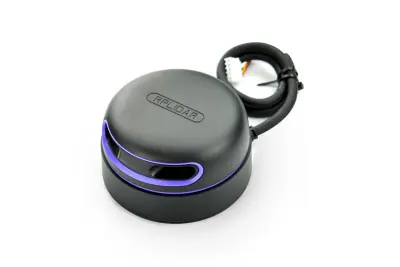
- 0.225°
- 0.2 - 25 meters
- 0~360 degrees
Price on request
RPLiDAR C1
LiDAR Sensors
Compact DTOF 360° laser range scanner · Ref. : DFR1138

- ±30mm
- 40000lux
- 0.72°@typical
Price on request
MS200k
LiDAR Sensors
360° monoline dToF LiDAR sensor, 12 m range · Ref. : MS200K

Price on request
TF03-100
LiDAR Sensors
Industrial long-range LiDAR distance sensor 100 m · Ref. : TF03-100

Price on request
TFmini-i
LiDAR Sensors
Short-range CAN LiDAR distance sensor, 12 m · Ref. : 101090022

- 70Klux
- 1cm
- ≤65mA@12V
Price on request
A project? Our engineers build the solution with you.
Send your requirements: Atlas proposes the architecture, the bill of materials and a quotation, then follows the supply.
Request a quotationRelated pages
 WikiLiDAR: what it is and how it is usedUnderstand LiDAR physics, 1D and 2D architectures, industrial and IoT applications, and key datasheet criteria for quotation sourcing.
 Use caseMobile Robotics and Cobots in Robotics & AutomationHardware architecture and field deployment guide addressing operational requirements. Certified industrial hardware, custom integration, and supply on quotation.
 OfferMobile Robotics and Cobots kit for Robotics & AutomationComplete hardware package ready for industrial deployment. Verified components, architecture review by Atlas engineering desk, and procurement on quotation.
 ProjectHardware for Robotics & Automation projectsSource the right industrial hardware for your deployment. Validated architectures, rugged components, bill of materials review, and full supply on quotation.
 ProjectCollaborative Robot Arms, Mobile Robots & ActuatorsTechnical buyer guide to specify and quote collaborative robot arms, mobile robots, actuators, and educational STEM robotics kits.
 ArticleHow to choose hardware for Robotics & AutomationTechnical buying guide for selecting PLCs, servo drives, cobots, LiDAR sensors, machine vision cameras, and HMIs for robotics automation.