
Cellular band compatibility and carrier requirements across deployment regions
Sizing an industrial cellular link starts by checking the frequency bands operated by local carriers in every target deployment country. Across Europe, North America and Asia-Pacific, 4 G LTE and 5 G NR allocations differ significantly between sub-gigahertz bands built for wide-area coverage and higher-frequency bands aimed at capacity. Buyers must inspect the modem datasheet for supported FDD and TDD bands along with mandatory regional carrier approvals.
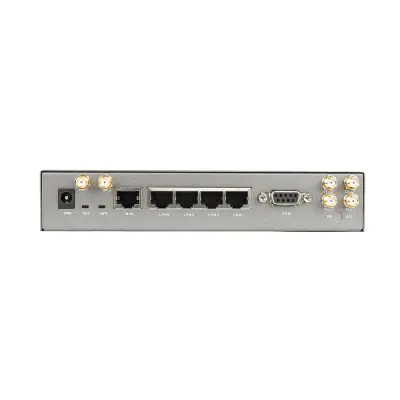
Multi-carrier deployments also require dual-SIM failover, encrypted tunneling and serial device bridging suited to private infrastructure. Within the 4 G LTE / LTE-A Industrial Routers family, the E-Lins H720TT-RS232 combines 4 G LTE connectivity, VPN support, GNSS / GPS positioning, PoE capability, and RS-232 and RS-485 serial ports. Teams should also confirm carrier APN policies, static routing tables and SIM lock retention before field installation.
Engineering trade-offs between 4 G LTE routers and 5 G NR gateways
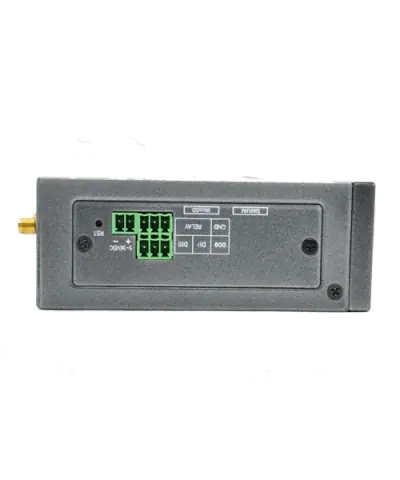
Choosing between 4 G LTE / LTE-A Industrial Routers and 5 G NR Industrial Routers hinges on required uplink throughput, latency budgets for automation traffic and cabinet power constraints. For SCADA telemetry, remote metering or DIN-rail serial device polling, a 4 G LTE router delivers predictable connectivity with modest power draw. The Four-Faith F-R100 integrates 4 G LTE access with DIN rail mounting, Modbus support, GNSS / GPS, RS-232 and RS-485 interfaces.
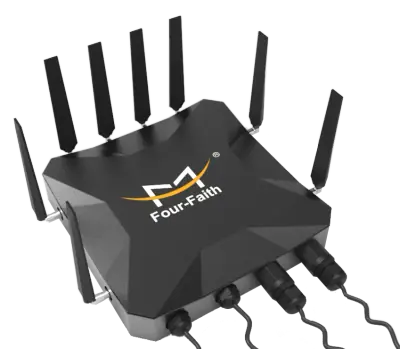
Conversely, high-definition video backhaul, multi-stream sensor aggregation or temporary site links justify moving up to 5 G NR Industrial Routers. In this category, the Four-Faith F-NR200 combines 5 G cellular connectivity, Wi-Fi 4, RS-232 and RS-485 ports, an IP68 enclosure and a -30 °C minimum operating temperature, while providing a fiber port to hand off traffic directly to a local aggregation switch.
Antenna selection, coaxial cable attenuation and field mounting constraints
Even a capable cellular router underperforms if the Antennas, RF Interconnect & Electromagnetic Components chain is poorly matched. Coaxial cable attenuation per meter rises sharply with frequency, especially across upper 4 G LTE and 5 G NR spectrum. Engineers must calculate the full RF link budget by subtracting cable loss over the required run length and connector insertion loss from the antenna gain specified across target bands.
Mechanical placement directly shapes radiation patterns and uptime in metallic cabinets or outdoor substations. A closed steel enclosure shields radio waves and requires extending an omnidirectional or directional antenna onto a mast or wall with weather sealing and surge grounding. Where exterior signal levels remain weak inside concrete structures, Cellular Signal Boosters and Repeaters compensate for building attenuation once carrier authorization is confirmed.
Industrial Ethernet switching, PoE power budgets and EMC immunity
Downstream of the cellular gateway or fiber trunk, Industrial Ethernet Switches, PoE & TSN Networking units aggregate field controllers and IP endpoints. Selecting between unmanaged and managed switches depends on requirements for VLAN segmentation, traffic prioritization or deterministic TSN timing. Buyers must check the datasheet for MAC address table depth, per-port PoE power budgets and fanless thermal dissipation across the full cabinet temperature range.
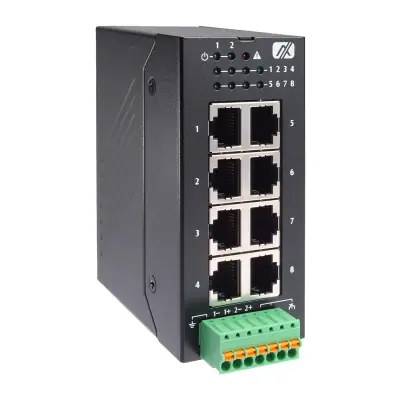
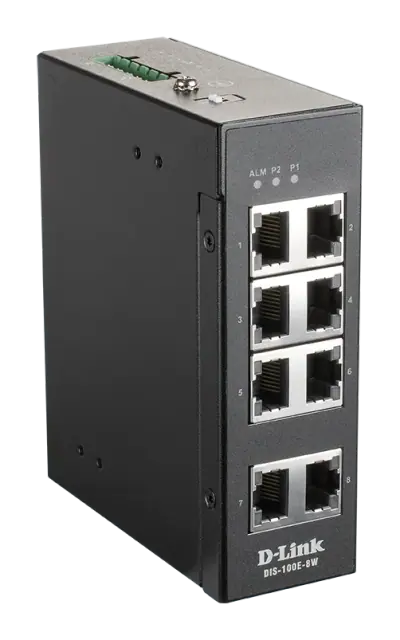
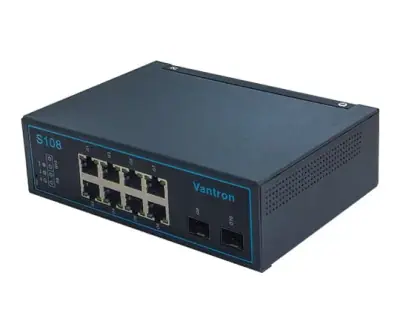
Substations and roadside cabinets expose switches to electrostatic discharge and fast electrical transients. The Vantron S108 is specified for IEC61000-4-2 ESD up to ±8 kV air, IEC61000-4-4 EFT and IEC61000-4-5 surge protection on power and data ports from -20℃ to +70℃. For extreme cold with PoE on DIN rail, the Axiomtek TEN300-0800-H operates at -40 °C or lower with a 4 K MAC address table, while the D-Link DIS-100E-8 W provides a fanless metal housing.
Optical uplinks using SFP and SFP+ transceivers for reach and isolation
Whenever cabinet-to-cabinet distances exceed copper twisted-pair limits or cable trays run alongside high-current power feeders, optical fiber becomes mandatory for reach and galvanic isolation. SFP and SFP+ Transceivers allow engineers to tailor each switch or router optical cage to the installed fiber plant, covering short-reach multimode links at 1 Gbps as well as long-haul single-mode backbones running at 10 Gbps.
Selecting an optical module requires checking three parameters on the datasheet: nominal wavelength, optical link budget in decibels and industrial operating temperature rating. Commercial transceivers capped at +70 °C internal case temperature risk premature link drops inside uncooled enclosures. Engineers should also confirm MSA coding compatibility and digital diagnostic monitoring support to track transmit and receive optical power levels continuously.
Multi-link redundancy, remote supervision and quotation specification checks
Telecom infrastructure resilience depends on combining at least two independent transport paths, such as a primary fiber or Ethernet uplink backed up by a 4 G LTE or 5 G NR cellular router with automated failover. On the operations side, teams should require remote supervision via SNMP, centralized event logs, hardware watchdogs and radio telemetry tracking RSRP and SINR metrics to detect link degradation early.
Integrating heterogeneous hardware requires electrical and mechanical alignment at the quotation stage. Procurement teams should standardize DC input voltage ranges, check shock and vibration ratings such as IEC60068-2-27 and IEC60068-2-6 on the D-Link DIS-100E-8 W, and document legacy RS-232 or RS-485 serial interfaces. All referenced hardware is supplied on quotation alongside manufacturer datasheets so integrators can complete electrical and radio qualification before site rollout.
Frequently asked questions
How do you assess 4 G LTE or 5 G NR router compatibility for multi-country deployments?
Check the router datasheet to match supported FDD and TDD cellular bands against carrier allocations in each target region, and favor dual-SIM hardware with VPN support such as the E-Lins H720TT-RS232 when operating across multiple public networks.
Why must RF coaxial cable losses be calculated before selecting an antenna?
Coaxial cable attenuation rises with both frequency and run length. Across higher 4 G LTE and 5 G NR bands, excessive cable loss can offset antenna gain, reducing uplink throughput and forcing the modem into lower modulation schemes.
When should SFP or SFP+ transceivers replace copper Ethernet links?
Optical fiber with 1 Gbps SFP or 10 Gbps SFP+ transceivers is required beyond the 100-meter copper limit, along cable trays shared with high-current power lines, or wherever galvanic isolation between telecom cabinets is mandatory.
Which electrical and thermal specifications matter for outdoor industrial PoE switches?
Review the datasheet for wide temperature ratings such as -40 °C or lower on the Axiomtek TEN300-0800-H, surge and ESD immunity under IEC61000-4-2, IEC61000-4-4 and IEC61000-4-5, fanless cooling and the total PoE power budget.
Products mentioned
TEN300-0800-H
Industrial Ethernet Switches, PoE & TSN Networking
Industrial Gigabit Ethernet switch
Price on request
DIS-100E-8W
Industrial Ethernet Switches, PoE & TSN Networking
Industrial unmanaged Fast Ethernet switch, 8 ports · Ref. : DIS-100E-8W
Price on request
H720tt-RS232
4G LTE / LTE-A Industrial Routers
Industrial 4G LTE dual-SIM router with DB9 serial port · Ref. : H720TT-RS232
Price on request
F-R100
4G LTE / LTE-A Industrial Routers
Industrial 4G LTE cellular router with serial ports and Wi-Fi · Ref. : F-R100
- CE, FCC
Price on request
F-NR200
5G NR Industrial Routers
5G NR Industrial CPE Router with Dual-Band Wi-Fi and Fiber Port · Ref. : F-NR200
Price on request
S108
Industrial Ethernet Switches, PoE & TSN Networking
Industrial Gigabit unmanaged switch, 8 ports
Price on request
A project? Our engineers build the solution with you.
Send your requirements: Atlas proposes the architecture, the bill of materials and a quotation, then follows the supply.
Request a quotationRelated pages
 WikiFiber optic and SFP: what it is and how it is usedTechnical definition, operating principles, industrial standards, and datasheet selection criteria for hardware integration projects supported by Atlas engineers.
 ProjectHardware for Telecom & Networks projectsSource the right industrial hardware for your deployment. Validated architectures, rugged components, bill of materials review, and full supply on quotation.
- Use caseRetail & Kiosks in Telecom & NetworksHardware architecture and field deployment guide addressing operational requirements. Certified industrial hardware, custom integration, and supply on quotation.
 Use casePrivate 4G/5G Network in Telecom & NetworksHardware architecture and field deployment guide addressing operational requirements. Certified industrial hardware, custom integration, and supply on quotation.
 Use caseTransportation & Fleet in Telecom & NetworksHardware architecture and field deployment guide addressing operational requirements. Certified industrial hardware, custom integration, and supply on quotation.
 Use caseRemote Device Fleet Management in Telecom & NetworksHardware architecture and field deployment guide addressing operational requirements. Certified industrial hardware, custom integration, and supply on quotation.
 Use caseSecure Remote Maintenance in Telecom & NetworksHardware architecture and field deployment guide addressing operational requirements. Certified industrial hardware, custom integration, and supply on quotation.
 Use caseTelecom & Remote Sites in Telecom & NetworksHardware architecture and field deployment guide addressing operational requirements. Certified industrial hardware, custom integration, and supply on quotation.
 Use caseDigital Signage and LED Walls in Telecom & NetworksHardware architecture and field deployment guide addressing operational requirements. Certified industrial hardware, custom integration, and supply on quotation.