
Optical transmission principles and electromagnetic interference immunity
Fiber optic transmission operates through the total internal reflection of light pulses within a core of pure silica glass. In industrial environments saturated with heavy machinery, variable frequency drives, and high-voltage switchgear, optical media provide complete immunity against electromagnetic interference. Because the dielectric glass fiber does not conduct electricity, it prevents ground loops between distant automation cabinets and eliminates inductive coupling from adjacent high-power conduits.
Optical transmission relies on standardized infrared wavelengths, predominantly 850 nm, 1310 nm, and 1550 nm, selected for their minimal attenuation profiles in silica glass. Signal degradation over distance is governed by Rayleigh scattering and material absorption rather than resistive losses. Industrial network designers leverage these dielectric properties to establish reliable data backbones across harsh manufacturing floors where copper cabling would suffer severe packet corruption.
Core geometry differences between single-mode and multi-mode fiber
Selecting between single-mode and multi-mode media depends on transmission distance and system budget. Multi-mode fiber features a relatively wide core diameter, typically 50 or 62.5 micrometers, which permits multiple light modes to propagate simultaneously. While this larger aperture simplifies connector alignment and lowers transceiver cost, differential mode delay causes modal dispersion that restricts multi-mode runs to short intra-building spans.
Single-mode fiber employs a narrow core of approximately 9 micrometers, permitting only a single optical mode to travel along its axis. By eliminating modal dispersion entirely, single-mode glass enables high-bandwidth communication across dozens of kilometers. System designers standardize on OM3 or OM4 multi-mode fiber for localized machinery connections and deploy OS2 single-mode cabling for campus-wide links and metropolitan infrastructure.
Pluggable optical transceiver form factors and network speeds
Modern networking hardware relies on standardized hot-swappable transceivers to adapt physical ports to diverse media. The Ubiquiti UACC-OM-MM-1 G-D transceiver belongs to the SFP and SFP+ Transceivers category, featuring a Duplex LC UPC connector, an Ambient Operating Temperature of 0 to 70° C (32 to 158° F), and an energy-efficient Max Power Consumption of 0.66 W for gigabit multi-mode links across high-density aggregation switches and edge gateways.
When system requirements escalate to ten-gigabit bandwidth, the enhanced SFP+ form factor becomes essential. The D-Link DEM-432XT single-mode module supports single-mode 9/125 um fiber up to a Distance Capacity of 10 Km. It complies with the Fibre Channel FC-PI standard 1200 SM-LL-L, features a distinctive Bail latch color Blue, and satisfies stringent electromagnetic compatibility standards including CE, FCC, VCCI.
Long-haul industrial topologies and bidirectional single-strand links
Industrial automation deployments across utility corridors or rail infrastructure require long transmission reach without active mid-span repeating stations and power generation facilities. The Oring SFP1G-EZX120-I provides an extended-reach solution operating at a Data Rate of 1 Gbps over Single-mode fiber. Classified as Grade: Industrial Grade, it delivers a Transmission Distance of 120 km at a Wavelength of 1550 nm for wide-area supervisory networks.
Where physical conduit availability is constrained, bidirectional optical modules transmit and receive across a single fiber strand using wavelength division multiplexing. The Oring SFP1GB3-LX60-I functions with a Data Rate of 1 Gbps in Fiber Mode Single-mode BIDI, achieving a Reach of 60 km with an RX Wavelength of RX 1550 nm. This configuration expands capacity when connecting Fiber Optic SFP Media Converters in distributed sub-stations.
Embedded host integration via specialized expansion modules
Industrial computers and edge artificial intelligence gateways frequently require direct optical interfaces without bulky intermediate switches in robotic controllers, machine vision rigs, and transport systems. The Innodisk EGPL-G2F1 expansion board introduces dual gigabit SFP connectivity through an internal bus interface, supporting Facteur de Forme M.2 2242 B+M Key and M.2 2280 B+M Key footprints for compact space-constrained computing enclosures.
System integrators optimize cabinet real estate by deploying the Main Board dimensions of -W1 : 22 x 80 x 3.75 or -W2 : 22 x 42 x 3.75 paired with the Daughter Board measuring 60 x 67 x 14.95 mm. This specialized format bridges compute engines directly to Industrial Media Converters, establishing high-speed noise-immune optical links directly from the local processor motherboard.
Optical budget calculation and diagnostic monitoring in datasheets
A rigorous review of an optical transceiver datasheet requires evaluating the power budget, calculated by subtracting receiver sensitivity from minimum transmitter optical launch power. The resulting figure must exceed total link losses, including fiber attenuation, connector insertions, and patch panel splices. If the received power exceeds the maximum input threshold, optical attenuators must be inserted to avoid saturating the receiving photodiode.
Thermal specifications demand equal scrutiny, especially in fanless industrial cabinets where ambient temperatures fluctuate widely. The datasheet must define an operating temperature envelope matching field conditions. Furthermore, transceivers equipped with Digital Diagnostic Monitoring enable real-time telemetry tracking of internal operating temperature, laser bias current, transmitted optical power, and received signal strength before physical degradation causes packet loss.
Frequently asked questions
What is the technical difference between single-mode and multi-mode optical fiber?
Single-mode fiber features a narrow 9 micrometer core carrying an isolated optical mode, which eliminates modal dispersion and supports transmission spans of tens of kilometers. Multi-mode fiber has a wider 50 or 62.5 micrometer core supporting multiple modes, which simplifies light injection but restricts transmission reach to several hundred meters.
Why is optical fiber preferred over copper cabling in industrial plant networking?
Optical fiber is constructed from non-conductive silica glass, providing complete immunity against electromagnetic interference, ground loops, and lightning-induced voltage surges. It also transmits data across much greater distances than the 100-meter electrical threshold of standard copper Ethernet.
How does bidirectional BiDi optical transmission function over a single fiber strand?
BiDi technology utilizes internal wavelength division multiplexing filters to transmit and receive optical signals at two distinct wavelengths over a single strand of fiber. This approach doubles the operational link capacity of existing cable runs without deploying additional physical fibers.
What telemetry metrics does Digital Diagnostic Monitoring DDM provide?
DDM provides continuous real-time diagnostic reporting on module operating temperature, supply voltage, transmitter laser bias current, transmitted optical power, and received optical power to detect transmission anomalies before link failure occurs.
Products mentioned
DEM-432XT
SFP and SFP+ Transceivers
10GBase-LR SFP+ single-mode optical transceiver 10 km · Ref. : DEM-432XT

- Blue
- 10Km
- CE, FCC, VCCI
Price on request
EGPL-G2F1
SFP and SFP+ Transceivers
Dual GbE SFP fiber optical M.2 expansion card · Ref. : EGPL-G2F1

Price on request
SFP1G-EZX120-I
SFP and SFP+ Transceivers
1 Gbps single-mode SFP transceiver 120 km industrial grade · Ref. : SFP1G-EZX120-I

- 1Gbps
- Single-mode
- Industrial Grade
Price on request
SFP1GB3-LX60-I
SFP and SFP+ Transceivers
Single-mode BIDI 1 Gbps optical SFP transceiver, 60 km, industrial grade · Ref. : SFP1GB3-LX60-I
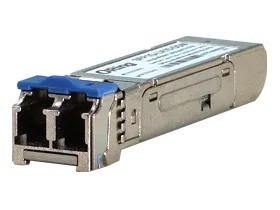
- 1Gbps
- Single-mode BIDI
- Industrial Grade
Price on request
UACC-OM-MM-1G-D
SFP and SFP+ Transceivers
Multi-mode 1G SFP optical module, duplex LC connector · Ref. : UACC-OM-MM-1G-D

Price on request
A project? Our engineers build the solution with you.
Send your requirements: Atlas proposes the architecture, the bill of materials and a quotation, then follows the supply.
Request a quotationRelated pages
 Use caseVehicular Telecom and Industrial Networks for Transport FleetsLearn how to design robust vehicular telecom architectures combining rugged routers, multi-uplink failover, and secure remote supervision.
 Use caseRetail & Kiosks in Telecom & NetworksThis guide details cellular routing, antenna integration, and ARM compute to ensure robust connectivity for retail kiosks and branch sites.
 Use casePrivate 4 G and 5 G Cellular Networks in Telecom and NetworkingExplore private 4 G and 5 G cellular network architectures for telecom networks, covering frequency bands, mast cabling, and remote monitoring.
 Use caseMachine Vision in Data Centres & IT InfrastructureThis guide details machine vision deployment in data centres to monitor rack cabling, thermal states, and remote infrastructure.
 Use caseEdge AI in Data Centres & IT InfrastructureThis technical guide explains how edge artificial intelligence resolves power, cooling and network density challenges across IT data centres.
 ArticleHow to choose hardware for Telecom & NetworksThis guide details cellular band checks, RF link budgets, uplink redundancy and hardware families for sizing industrial telecom networks.
 ArticleHow to choose hardware for Data Centres & IT InfrastructureEngineering guide to sizing switching, optical links, rack power, edge security, and NVMe storage for data centres and IT infrastructure.
- ProjectHardware for Telecom & Networks projectsThis guide helps Telecom & Networks buyers select routers, switches, RF links, and optics on quotation through Atlas Electronics.