
PROFINET operating principles and IEC standardization
PROFINET is standardized under IEC 61158 and IEC 61784-2, maintained through the PI (PROFIBUS & PROFINET International) technical specification. Unlike legacy serial fieldbuses, it runs over full-duplex IEEE 802.3 industrial Ethernet at 100 Mbit/s or 1 Gbit/s. The architecture defines three logical roles on the plant network: the IO-Controller executing automation logic, the IO-Device exchanging field signals, and the IO-Supervisor handling commissioning, diagnostics, and topology monitoring.
Three communication channels share the same physical Ethernet medium simultaneously. Standard TCP/IP and UDP/IP transport handles acyclic parameterization, diagnostic records, and IT-level integration. The Real-Time (RT) channel bypasses the TCP and UDP layers to place cyclic I/O frames directly onto the Ethernet data link layer, achieving cycle times in the millisecond range. For synchronized motion axes, Isochronous Real-Time (IRT) reserves deterministic sub-millisecond time slots using dedicated hardware switching.
Network topologies, electrical cabling and dual-port switch integration
A PROFINET installation supports star, line, tree, and ring topologies tailored to machine layouts. On copper segments, 100 BASE-TX four-wire shielded Category 5 cables terminated with industrial RJ45 or M12 D-coded connectors span up to 100 meters between active nodes. In electrically noisy environments or across long cabinet-to-cabinet runs, multimode or single-mode fiber optics provide galvanic isolation and immunity against electromagnetic interference.
Building a line topology through daisy-chaining requires confirming that every field device embeds an integrated dual-port Ethernet switch. Without two-port hardware supporting IEEE 802.1Q VLAN frame prioritization, engineers must install external industrial switches at every drop point. Reliable physical operation also depends on stable 24 V DC supply rails, continuous 360 degree shield bonding at both cable ends, and proper equipotential grounding across control cabinets.
Conformance Classes and MRP ring redundancy selection criteria
Hardware selection starts by matching the required Conformance Class: CC-A, CC-B, or CC-C. CC-A provides basic RT cyclic data exchange and acyclic services over standard or embedded switches. CC-B adds mandatory network management via SNMP, automated neighbor and topology discovery via LLDP (Link Layer Discovery Protocol), and media redundancy support. CC-C is required when motion control applications demand deterministic bandwidth reservation through IRT communication.
High-availability networks rely on Media Redundancy Protocol (MRP) ring topologies defined in IEC 62439-2. Within an MRP ring, a designated Media Redundancy Manager continuously monitors loop continuity and logically blocks one ring port to prevent broadcast storms. If a cable break or node failure occurs, the manager reconfigures traffic onto the backup path within 200 milliseconds, or seamlessly via MRPD on isochronous rings.
GSDML device description files and common integration mistakes
Integrating any IO-Device or gateway into an automation engineering tool depends on its XML-based GSDML (General Station Description Markup Language) file. This file defines supported I/O modules, cyclic memory footprints, diagnostic alarms, and Conformance Class capabilities. Buyers and integrators must confirm in the manufacturer documentation that the GSDML schema version matches both the exact device firmware revision and the engineering software release.
Typical commissioning mistakes include misconfigured PROFINET station names or illegal characters, because controllers identify devices by logical name rather than IP address alone. Deploying unmanaged office switches lacking QoS frame prioritization causes cyclic packet drops under network load. Additionally, exceeding the maximum allowed line depth increases jitter and degrades the update time computed by the IO-Controller during configuration.
Bridging legacy Modbus and OPC UA field hardware into PROFINET architectures
Brownfield plants frequently combine PROFINET backbones with Modbus RTU, RS-485, RS-232, or OPC UA subsystems. Integrating these assets relies on Modbus, PROFINET & OPC UA Gateways, Protocol Gateways, Serial Device Servers & CAN Adapters, and Modular DIN-Rail Remote I/O Modules supplied on quotation by Atlas Electronics. For modular field acquisition, the ODOT Automation B32 offers a Modbus-RTU slave RS-485 coupler supporting up to 8192 bytes of total I/O with 12-bit 8AI, 15/16-bit 4AO, and 24 V DC 16 DI cards.
When supervisory layers require direct OPC UA connectivity alongside deterministic control, the ICP DAS U-7517 M remote I/O module provides 8 analog inputs and 4 digital output channels. For compact Ethernet I/O points operating down to -40 °C or lower, the Sollae Systems CIE-H12G (2 inputs, 1 relay output, 160 mA typical) and Sollae Systems CIE-H14G (4 ports, RS-232, 2 W typical) carry CE EMC 2014/30/EU and RoHS 2011/65/EU compliance.
Wireless peripheral links and datasheet checks before quotation
Moving equipment or remote skids sometimes prevent running shielded Ethernet cabling to every sensor cluster. Behind a centralized gateway, the Sollae Systems SMG-5400 bridges Modbus data over Wi-Fi IEEE 802.11 a/b/g with RS-232 and RS-485 interfaces, 210 mA typical draw, and a -20 °C minimum operating temperature. Such wireless segments remain suited to non-deterministic monitoring outside the real-time PROFINET loop.
Before requesting supply on quotation, integrators should inspect each hardware datasheet carefully. Key checks include the supported PROFINET Conformance Class (CC-A, CC-B, or CC-C), MRP ring protocol support, GSDML file availability, and dual-port switch integration for line daisy-chaining. For associated remote I/O or serial gateways, confirm power voltage tolerances, environmental IP ratings, galvanic isolation, and exact Modbus or OPC UA register mapping.
Frequently asked questions
What is the difference between PROFINET Conformance Classes CC-A, CC-B, and CC-C?
CC-A covers standard Real-Time (RT) cyclic communication and acyclic services. CC-B adds mandatory LLDP topology discovery, SNMP diagnostics, and MRP ring redundancy support. CC-C introduces hardware-scheduled Isochronous Real-Time (IRT) communication with deterministic bandwidth reservation for synchronized motion applications.
Why is an integrated dual-port Ethernet switch important for line topology?
An embedded two-port switch supporting IEEE 802.1Q prioritization allows daisy-chaining field devices directly without external switches at every node. It keeps forwarding latency predictable across the line and simplifies cabinet wiring.
How can Modbus RTU or RS-485 devices be integrated into a PROFINET network?
Legacy serial devices connect through a protocol gateway that maps Modbus registers into cyclic PROFINET slots described in a GSDML file. Upstream field signals can be aggregated using modular couplers such as the ODOT Automation B32 or remote Ethernet I/O units like the Sollae Systems CIE-H12G and CIE-H14G.
What should be checked in a GSDML file before commissioning?
Integrators should check that the GSDML schema version matches both the device firmware and the engineering software. They must also check cyclic I/O byte limits, supported minimum update times, and whether MRP redundancy or CC-B and CC-C diagnostics are declared.
Products mentioned
U-7517M
Modular DIN-Rail Remote I/O Modules
OPC UA remote I/O module, 8 analog inputs and 4 DO channels · Ref. : U-7517M

Price on request
B32
Modular DIN-Rail Remote I/O Modules
Modular DIN-rail I/O system Modbus RTU RS485 2 slots · Ref. : B32

Price on request
SMG-5400
Protocol Gateways, Serial Device Servers & CAN Adapters
Wireless LAN Modbus gateway, IEEE 802.11b/g · Ref. : SMG-5400

Price on request
CIE-H12G
Modular DIN-Rail Remote I/O Modules
Remote Ethernet I/O Controller, 2 Inputs and 1 Relay Output · Ref. : CIE-H12G

Price on request
CIE-H14G
Modular DIN-Rail Remote I/O Modules
/ 4-Port Remote I/O Controller
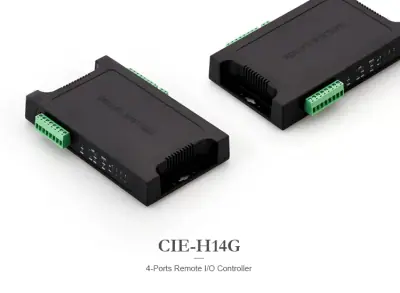
- CIE-H14G
- DSUB 9-pin Male
- 2W typical
Price on request
A project? Our engineers build the solution with you.
Send your requirements: Atlas proposes the architecture, the bill of materials and a quotation, then follows the supply.
Request a quotationRelated pages
 WikiPROFINET: what it is and how it is usedLearn how PROFINET works, its RT and IRT classes, key datasheet parameters to verify, and how to integrate field I/O and gateway hardware.
 ArticleBridging RS-485 Modbus RTU field devices to Modbus TCP and MQTTEngineering guide to bridge RS-485 Modbus RTU buses to Modbus TCP or MQTT, covering slave ID mapping, bus biasing, and timeout tuning.
 ProjectModbus Gateways & Industrial Serial Device ServersTechnical buyer guide on Modbus RTU/TCP gateways and RS-232/485 serial device servers: mapping, isolation, and quotation sourcing.
 ProjectProgrammable Logic Controllers (PLC) & Remote I/O ModulesTechnical sourcing guide for programmable logic controllers (PLC) and DIN-rail remote I/O modules, with protocol criteria and quotation.
 Use caseRaspberry Pi Industrial Control in Robotics & AutomationThis guide examines deploying Raspberry Pi controllers in robotic automation, covering deterministic buses, vision and machine safety.
 OfferRaspberry Pi Industrial Control kit for Robotics & AutomationThis on-quotation kit outlines an open Raspberry Pi control stack with Modbus I/O, IP65 HMI, and remote access for robotic cells.
- ArticleWhat is a Modbus gateway and how does it bridge serial to TCP?Learn how a Modbus gateway converts RTU/ASCII frames to Modbus TCP/IP, handles RS-485 wiring, and routes slave IDs across industrial networks.