
PROFINET definition and core industrial Ethernet architecture
PROFINET is an open industrial Ethernet standard specified under IEC 61158 and IEC 61784 for deterministic data exchange between programmable controllers, motion drives, and distributed field instrumentation. Evolved from serial fieldbus concepts such as PROFIBUS, it preserves modular device modeling, slot indexing, and structured diagnostics while running over standard 100 Mbit/s full-duplex or Gigabit Ethernet physical links in star, line, or ring topologies.
Its communication architecture separates three distinct roles: the IO-Controller executing real-time automation logic, IO-Devices aggregating field sensors, actuators, and remote I/O modules, and the IO-Supervisor dedicated to commissioning, naming, and network diagnostics. Every device provides a standardized XML description called a GSDML file, which declares supported slots, cyclic update intervals, and diagnostic alarm structures directly inside the PLC engineering environment.
How PROFINET handles RT, IRT, and TCP/IP traffic on one cable
PROFINET multiplexes multiple communication channels across a single Ethernet cable according to timing criticality. Acyclic configuration records, device parameterization, asset management, and supervisory HMI traffic travel through standard UDP and TCP/IP stacks, supported by DCP for station name assignment, IP configuration, and LLDP for port-level neighbor discovery across industrial managed switches and ring links.
For cyclic process data, PROFINET bypasses the TCP and IP layers to eliminate routing overhead and unpredictable stack latency. In Real-Time RT mode, Layer 2 Ethernet frames carry EtherType 0x8892 with IEEE 802.1Q VLAN priority tagging, achieving cycle times of a few milliseconds. In Isochronous Real-Time IRT mode, hardware-scheduled switch queues reserve deterministic slots below one millisecond with sub-microsecond jitter.
PROFINET conformance classes and specialized application profiles
The standard organizes device capabilities into four conformance classes labeled CC-A through CC-D. Conformance Class CC-A covers software-based RT cyclic exchange and basic diagnostics over standard Ethernet hardware, whereas Conformance Class CC-B adds Media Redundancy Protocol MRP ring recovery, LLDP topology detection, and SNMP management for factory networks requiring fast fault recovery without manual intervention.
Conformance Class CC-C requires dedicated hardware switching ASICs to guarantee bandwidth reservation for IRT motion synchronization across multi-axis servo drives, while Conformance Class CC-D extends PROFINET deterministic transport over IEEE Time-Sensitive Networking TSN infrastructure. Several application profiles build on these classes, including PROFIsafe for functional safety, PROFIenergy for automated cell power shutdown, and PROFINET PA for process instrumentation and asset monitoring in continuous plants.
Industrial applications and bridging PROFINET with Modbus and OPC UA
PROFINET is widely deployed in discrete manufacturing, robotic assembly cells, high-speed packaging lines, intralogistics conveyors, and water treatment plants where deterministic update cycles and fast device replacement without manual reconfiguration matter. In IIoT architectures, the central controller polls cyclic workshop signals and exposes aggregated production metrics upward to MES or SCADA platforms via OPC UA interfaces or protocol gateways.
Across brownfield facilities, hardware from Modbus, PROFINET & OPC UA Gateways and Protocol Gateways, Serial Device Servers & CAN Adapters bridges legacy field networks with PROFINET backbones. Modbus RTU devices over RS-485 and Modbus TCP controllers can therefore exchange process registers with a PROFINET IO-Controller without rewiring existing instrumentation or replacing installed variable frequency drives, energy meters, and telemetry units.
Key datasheet parameters to check before specifying PROFINET hardware
Before specifying a PROFINET device or protocol gateway, buyers should verify the declared conformance class, whether the unit operates as an IO-Device or IO-Controller, and the minimum supported cycle time in milliseconds. Integrated two-port switches with RJ45 or M12 D-coded connectors enable daisy-chain line wiring and MRP ring topologies while reducing external cabinet switch counts and cabling complexity.
Engineering teams should also confirm GSDML file availability for the target controller revision, galvanic isolation ratings between Ethernet ports and 24 V DC power inputs, ambient operating temperature limits, and enclosure IP protection for cabinet or on-machine mounting. For multiprotocol gateways, check maximum I/O mapping table sizes in bytes, diagnostic alarm forwarding behavior, and declared industrial electromagnetic immunity ratings.
Catalogue hardware and integration options around PROFINET networks
Supplied on quotation, our Modular DIN-Rail Remote I/O Modules complement PROFINET networks through an appropriate protocol gateway. The ODOT Automation B32 system pairs a Modbus-RTU RS485 slave board supporting up to 8192 combined I/O bytes with 16 DI 24VDC, 8AI 12-bit, or 4AO 15/16-bit cards. For supervisory integration, the ICP DAS U-7517 M module offers 8 analog inputs and 4 DO channels over OPC UA.
Among Protocol Gateways, Serial Device Servers & CAN Adapters and compact controllers, the Sollae Systems CIE-H12G (2 inputs, 1 relay output, 160 mA typical) and Sollae Systems CIE-H14G (4-port, RS-232, 2 W typical) support Modbus from -40 °C with EMC 2014/30/EU and RoHS 2011/65/EU compliance. The Sollae Systems SMG-5400 connects Modbus RS-232 and RS-485 devices over Wi-Fi 802.11 a/b/g from -20 °C at 210 mA typical.
Frequently asked questions
What is the difference between PROFINET RT and PROFINET IRT?
PROFINET RT provides software-scheduled real-time frames over standard Ethernet with cycle times of a few milliseconds, suitable for general remote I/O and drives. PROFINET IRT uses dedicated hardware switch scheduling to reserve isochronous time slots under one millisecond for synchronized multi-axis motion control.
Why is a GSDML file required when commissioning a PROFINET device?
The GSDML XML file describes an IO-Device profile to the PLC engineering tool, including supported I/O modules, cyclic byte lengths, startup parameters, and diagnostic alarm definitions. Importing it ensures deterministic configuration without writing custom driver code.
How can Modbus RTU or OPC UA I/O modules work alongside a PROFINET controller?
A protocol conversion gateway acts as a PROFINET IO-Device on the plant network while polling Modbus RTU slaves or OPC UA servers on the field side. Systems such as the ODOT Automation B32 over RS485 or the ICP DAS U-7517 M over OPC UA can then map their I/O points into the controller exchange table.
Can unmanaged office switches be used on a PROFINET network?
Unmanaged office switches may drop IEEE 802.1Q priority tags, block LLDP neighbor discovery, or lack MRP ring recovery. For reliable operation in Conformance Class CC-B or higher, specify industrial managed switches compatible with PROFINET and check forwarding latency in the datasheet.
Products mentioned
U-7517M
Modular DIN-Rail Remote I/O Modules
OPC UA remote I/O module, 8 analog inputs and 4 DO channels · Ref. : U-7517M

Price on request
B32
Modular DIN-Rail Remote I/O Modules
Modular DIN-rail I/O system Modbus RTU RS485 2 slots · Ref. : B32

Price on request
SMG-5400
Protocol Gateways, Serial Device Servers & CAN Adapters
Wireless LAN Modbus gateway, IEEE 802.11b/g · Ref. : SMG-5400

Price on request
CIE-H12G
Modular DIN-Rail Remote I/O Modules
Remote Ethernet I/O Controller, 2 Inputs and 1 Relay Output · Ref. : CIE-H12G

Price on request
CIE-H14G
Modular DIN-Rail Remote I/O Modules
/ 4-Port Remote I/O Controller
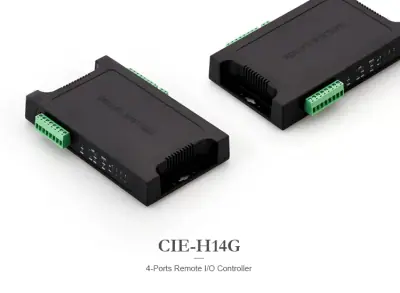
- CIE-H14G
- DSUB 9-pin Male
- 2W typical
Price on request
A project? Our engineers build the solution with you.
Send your requirements: Atlas proposes the architecture, the bill of materials and a quotation, then follows the supply.
Request a quotationRelated pages
 Use caseRaspberry Pi Industrial Control in Robotics & AutomationThis guide examines deploying Raspberry Pi controllers in robotic automation, covering deterministic buses, vision and machine safety.
 ArticleUnderstanding PROFINET: architecture, standards & hardwareThis technical guide explains PROFINET standards, conformance classes, MRP ring topologies, and field hardware integration criteria.
 ArticleBridging RS-485 Modbus RTU field devices to Modbus TCP and MQTTEngineering guide to bridge RS-485 Modbus RTU buses to Modbus TCP or MQTT, covering slave ID mapping, bus biasing, and timeout tuning.
 ProjectModbus Gateways & Industrial Serial Device ServersTechnical buyer guide on Modbus RTU/TCP gateways and RS-232/485 serial device servers: mapping, isolation, and quotation sourcing.
 ProjectProgrammable Logic Controllers (PLC) & Remote I/O ModulesTechnical sourcing guide for programmable logic controllers (PLC) and DIN-rail remote I/O modules, with protocol criteria and quotation.
 OfferRaspberry Pi Industrial Control kit for Robotics & AutomationThis on-quotation kit outlines an open Raspberry Pi control stack with Modbus I/O, IP65 HMI, and remote access for robotic cells.
- ArticleWhat is a Modbus gateway and how does it bridge serial to TCP?Learn how a Modbus gateway converts RTU/ASCII frames to Modbus TCP/IP, handles RS-485 wiring, and routes slave IDs across industrial networks.