
Connectivity challenges and coverage constraints for remote telecom sites
Operating remote telecom shelters and isolated radio towers involves severe challenges due to harsh operating environments and variable wireless signal conditions. Cellular network operators must account for diverse cellular frequency bands across different geographic territories. Antenna selection, mounting height, and insertion loss along coaxial feeder cables dictate the actual link budget. Poor antenna placement or excessive cable attenuation causes recurrent backhaul dropouts, degraded transmission capacity, and elevated packet error rates on mission-critical wireless backhaul links.
Establishing redundant uplinks is essential to maintain high service availability across unattended installations. Modern telecom networks demand heterogeneous backhaul pathways combining 4 G LTE or 5 G cellular connectivity, optical fiber lines, and local Ethernet links. Without centralized remote management and out-of-band access, technicians must perform expensive site visits whenever a core routing device experiences network isolation, configuration lockouts, or sudden software freezes.
Reference architecture with cellular backhaul and out-of-band console access
The core package combines three complementary hardware units to deliver continuous remote site backhaul and resilient device monitoring. At the network perimeter, the E-Lins H720TT-RS232 router from the 4 G LTE / LTE-A Industrial Routers category provides dual-SIM failover, IPsec VPN tunneling, an RS-232 serial port, an RS-485 interface, and integrated PoE capability. This cellular gateway dynamically switches between mobile operators whenever packet loss or link failure occurs on the active subscriber channel.
For out-of-band system administration, the Sollae Systems CSE-H53N device server from the Serial-to-Ethernet Device Servers (RS-232/422/485) family enables console connectivity with baud rates spanning 300 bps 230,400 bps and an operating envelope down to -40 °C or lower. Electrical feed is handled by the Omron S8VK-WA20248-SPI unit from the DIN Rail AC/DC Industrial Power Supplies (Mean Well) category, handling an allowable supply voltage AC of 170-264 V to deliver 48 V with 96 % efficiency.
Technological alternatives and fiber optic extension options
When installations require ultra-broadband throughput or native optical uplinks, the Four-Faith F-NR200 router from the 5 G NR Industrial Routers category offers an advanced option. This router features an IP68 enclosure rating, RS-232 and RS-485 interfaces, Wi-Fi 4 support, and a dedicated fiber port for direct connection to local optical distribution frames. In space-restricted roadside cabinets, the Four-Faith F-R100 router provides DIN rail mounting along with Modbus protocol support and integrated GNSS / GPS tracking.
For high-density facilities containing numerous managed switches, the Sollae Systems SCG-5632 console server supplies 32 x 8-pin RJ45 Connectors operating in TCP Server mode. Power distribution can be reinforced using the MORNSUN 15-480 W DIN rail power supply, which delivers efficiency up to 94% and operates down to -40 °C or lower. Isolated DC/DC Converters (Traco Power / RECOM) can be incorporated to isolate negative forty-eight volt DC telecom busbars from sensitive monitoring electronics.
Infrastructure responsibilities and equipment provided by the operator
Successful physical deployment inside an unattended telecom enclosure depends on specific prerequisites supplied by the site owner. The client provides active SIM cards from separate cellular service providers, provisioned with public static IP addresses or dedicated APN configurations. The operator is also responsible for antenna mounting brackets, wall penetrations, environmental cable glands, and mast fixtures configured according to structural wind-load requirements.
From an electrical perspective, the host facility must supply the primary power feed, whether derived from an AC grid connection or a battery-backed DC busbar. Circuit breakers and upstream surge suppression panels remain under the customer’s responsibility. On the networking layer, the client supplies essential parameters, including IP subnets, VLAN allocations, IPsec pre-shared keys or cryptographic credentials, and upstream gateway addresses required for end-to-end integration.
Critical engineering checkpoints assessed prior to deployment
Network planners must review several critical technical specifications in component datasheets before approving field hardware. Dual-SIM failover logic must be configured with ICMP probing intervals and recovery timers to prevent flapping during momentary cellular network congestion. Furthermore, site engineers must verify the continuous DC input voltage tolerance of all equipment against battery discharge curves and rectifier float charging levels to ensure uninterrupted operation.
Remote management capabilities must include automated hardware watchdogs and auxiliary out-of-band recovery paths to restore connectivity without on-site manual power cycling. In addition, atmospheric surge protection requires installing coaxial lightning arrestors with dedicated grounding paths connected to the main ground busbar. RF engineers must also calculate total cable attenuation across transmission lines to guarantee sufficient receiver sensitivity in fringe reception zones.
Project execution stages for customized packaged hardware deployment
Every deployment begins with a structured technical consultation to evaluate physical enclosure dimensions, RF coverage targets, DC power supply topologies, and required serial console interfaces. Atlas Electronics develops a comprehensive engineering proposal on quotation specifying bill-of-materials components, power budgets, low-loss coaxial cabling, and necessary mounting accessories. This formal proposal ensures complete alignment with the rigorous operating conditions and backhaul requirements of the client’s network.
Following proposal sign-off, equipment enters pre-configuration staging according to the customer’s IP routing matrix and remote access guidelines. Cellular gateway settings, cryptographic tunnels, and failover monitoring parameters are preloaded prior to secure dispatch to the operational site. The customer receives a comprehensive technical documentation package containing terminal wiring schematics and port assignments to facilitate rapid on-site commissioning and standard-compliant cabinet assembly.
Bill of materials
Catalogue products that can fill each role. Atlas Electronics quotes the complete bill of materials for your project; you check each datasheet before ordering.
Site router
Primary cellular edge router providing dual-SIM failover and encrypted tunnels for remote shelters.
H720tt-RS232
4G LTE / LTE-A Industrial Routers
Industrial 4G LTE dual-SIM router with DB9 serial port · Ref. : H720TT-RS232

Price on request
F-NR200
5G NR Industrial Routers
5G NR Industrial CPE Router with Dual-Band Wi-Fi and Fiber Port · Ref. : F-NR200

Price on request
F-R100
4G LTE / LTE-A Industrial Routers
Industrial 4G LTE cellular router with serial ports and Wi-Fi · Ref. : F-R100

- CE, FCC
Price on request
Serial and console access
Serial device server for out-of-band console administration and recovery of networking appliances.
CSE-H53N
Serial-to-Ethernet Device Servers (RS-232/422/485)
/ Industrial RS232 Ethernet Device Server

Price on request
SCG-5632
Serial-to-Ethernet Device Servers (RS-232/422/485)
32-Port RS-232 to Ethernet Console Server · Ref. : SCG-5632

Price on request
CSE-H21
Serial-to-Ethernet Device Servers (RS-232/422/485)
2-Port RS232 Industrial Serial-to-Ethernet Device Server · Ref. : CSE-H21
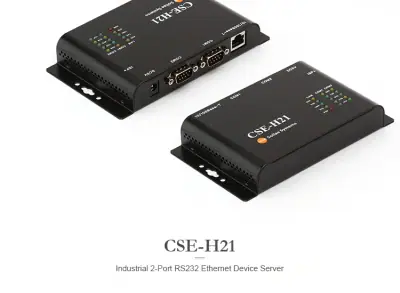
- Remote Debug Function
- 300bps ~ 230,400bps
- TCP Server (T2S)
Price on request
DC power
Industrial DIN rail power supply delivering regulated direct current for telecom communications gear.
S8VK-WA20248-SPI
DIN Rail AC/DC Industrial Power Supplies (Mean Well)
DIN rail AC/DC industrial power supply 2000 W 48 V · Ref. : S8VK-WA20248-SPI

Price on request
15-480W LI
DIN Rail AC/DC Industrial Power Supplies (Mean Well)
High-performance AC/DC DIN rail power supply · Ref. : 15-480W

- up to 94%
- CLASS B
- 10V/m
Price on request
Frequently asked questions
How should dual-SIM failover be configured to prevent connection flapping?
The E-Lins H720TT-RS232 router should be configured with ICMP echo requests directed to at least two distinct public or private DNS targets every 5 to 10 seconds. To prevent erratic switching during transient radio fluctuations, network administrators should specify a failover threshold requiring at least three consecutive probing failures and a stabilization timer before switching back to the primary cellular carrier.
What lightning and surge protection should be installed on coaxial antenna feeds?
Gas discharge tube or quarter-wave coaxial surge suppressors tuned to the operational RF frequency band must be inserted between external antennas and the router. Each lightning arrestor must connect directly to the main shelter grounding busbar using heavy-gauge copper cabling routed along the shortest possible straight path to dissipate high-voltage transient surges safely.
How is out-of-band console access maintained if the primary router becomes unreachable?
The Sollae Systems CSE-H53N serial device server can be interfaced with an auxiliary communication channel or isolated maintenance VLAN. Leveraging its ATC mode configuration and packet separation settings, administrators can connect directly to RS-232 serial console interfaces on managed switches or power rectifiers to execute diagnostics and initiate reboot routines remotely.
A project? Our engineers build the solution with you.
Send your requirements: Atlas proposes the architecture, the bill of materials and a quotation, then follows the supply.
Request a quotationRelated pages
 Use caseTelecom and Remote Sites in Industrial Telecom NetworksThis engineering guide details network architecture, redundant uplinks, and remote console management for resilient telecom remote sites.
 OfferIndustrial IoT Kit for Robotics & AutomationThis technical guide details custom industrial IoT kit integration to link robotics and automation lines with edge and backhaul architectures.
 OfferIndustrial IoT kit for Telecom & NetworksThis technical guide details the on-quotation industrial IoT kit connecting field sensors and PLCs to platforms across telecom networks.
 Use caseEnergy Metering and Power Supervision in Telecom and NetworksThis guide details telecom site energy metering architectures, covering cellular band matching, antenna siting, and dual controller failover.
 Use caseEnergy & Metering in Robotics & AutomationThis technical guide details energy metering integration within robotic automation cells to control electrical loads and cycle speeds.
 OfferEnergy and Metering Kit for Robotics and AutomationThis quotation offer details an energy monitoring kit for robotics automation, pairing industrial controllers with a 4 G gateway.
 OfferEnergy and Metering Kit for Telecom and Network InfrastructuresDiscover an industrial energy monitoring architecture designed for telecom sites to aggregate power meters and ensure resilient 4 G uplink.
 Use caseIndustrial IoT in Robotics and AutomationThis technical guide explains how to interconnect industrial IoT architectures with robotic cells, field sensors, and automation controllers.