
Balancing INT8 TOPS Per Watt Against Memory Bandwidth
Sizing an edge inference platform begins with the ratio between INT8 throughput per watt and available memory bandwidth. A neural engine advertising high peak matrix operations stalls quickly when transfers between system memory and compute cores saturate during tensor and feature-map loading. Engineering buyers must therefore separate theoretical sparse peak figures from sustained dense throughput on continuous multi-stream vision or transformer workloads.
Within Edge AI Compute Accelerators, the Leetop VAST-BOX built on NVIDIA Jetson Orin targets 32 TOPs and up to 200 Sparse TOPS in INT8, paired with two Ethernet ports, CAN bus, RS-232, RS-485, and one 3.5 mm audio jack for field acquisition. Buyers must check the selected power profile and memory clock frequency in the datasheet before finalizing the industrial enclosure power budget.
ONNX and TensorRT Runtime Alignment on Jetson and x86 Targets
Porting a trained neural network onto industrial hardware depends directly on the inference runtime supported by the target silicon. Exporting graphs in ONNX decouples model training frameworks from production deployment, while TensorRT compilation performs layer fusion, INT8 calibration, and deterministic latency optimization across ARM tensor cores or x86 host systems fitted with dedicated PCIe or M.2 accelerator modules.
For modular deployments, Jetson Carrier Boards match I/O interfaces to the selected compute module. The Seeed Studio 102110769 carrier board supports NVIDIA Jetson Orin modules with USB, Ethernet, and a 12 V/5 A power adapter, whereas the Seeed Studio 102110770 targets Jetson Orin Nano and Orin NX modules. To maintain continuity across Jetson Xavier NX, Nano, and TX2 NX fleets, the Seeed Studio 102991695 carrier board provides USB, Ethernet, and a 12 V/5 A power adapter.
PCIe Gen 5 Expansion, M.2 Accelerators and Rugged Inference Systems
When workloads exceed compact ARM module budgets and demand multiple high-resolution camera streams, PCIe-based Edge AI PCs and rugged inference appliances provide scalable bandwidth. Hosting discrete cards over PCIe Gen 5 lanes or specialized M.2 modules combines neural acceleration with deterministic host processing. Buyers must check electrical lane routing per slot and physical card clearance inside the manufacturer specification sheet.
The Portwell NURO-822E workstation integrates dual PCIe Gen 5 slots on an Intel R 680 E/Q 670 E chipset with AMI uEFI BIOS, DP 1.4 output up to 7680x4320 at 60 Hz, and HDMI 2.1 up to 4096x2160 at 60 Hz in an 8 by 8 by 16 inch chassis. Alternatively, the iEi GAIA-3010I server on Intel Q 670/Q 670 E provides four hot-swap HDD/SSD bays, two RS-232/422/485 ports, and 437 by 44 by 560 mm dimensions.
Thermal Throttling Thresholds and Enclosure Operating Limits
Inside sealed industrial cabinets, thermal throttling is the primary driver of inference latency drift on NPU and GPU accelerators. Once junction temperature crosses the driver trip point, clock frequencies step down progressively, increasing per-frame execution time. Buyers must inspect the full-load thermal derating curve, required airflow rate, and dust ingress constraints in the manufacturer datasheet before locking final cabinet mechanical integration.
Specified environmental envelopes differ significantly across hardware classes. The Portwell NURO-822E supports 0 °C to 50 °C operating temperature, -20 °C to 80 °C storage, and 5 to 95% relative humidity, while the iEi GAIA-3010I specifies a minimum operating temperature of 0 °C or higher. For the Seeed Studio 102110769, Seeed Studio 102110770, and Leetop VAST-BOX, buyers must confirm maximum ambient temperature ratings with heatsink cooling on the datasheet.
Preparing Your Technical Specification and Supply Request on Quotation
Supply of Edge AI Compute Accelerators, Jetson Carrier Boards, and rugged PCIe inference appliances is handled strictly on quotation so each hardware configuration aligns with your site constraints. Before submitting a sourcing request, compile your target numerical precision, sensor or high-resolution camera stream formats, expected frame rate, available DC or AC power input rail, and mandatory field interfaces including Ethernet, CAN bus, or RS-485.
Specify whether your deployment requires a carrier board such as the Seeed Studio 102991695, a compact appliance like the Leetop VAST-BOX, or an expandable platform such as the Portwell NURO-822E or iEi GAIA-3010I. Including projected annual quantities, lifecycle OS requirements, and chassis mounting preferences enables Atlas Electronics to prepare a structured technical and budgetary proposal on quotation.
Frequently asked questions
How do sparse TOPS differ from dense TOPS when sizing an Edge AI accelerator?
Sparse TOPS figures assume a high ratio of zero-weight pruning inside the neural network. For standard dense computer vision models, buyers should size around sustained dense INT8 throughput and check memory bandwidth limits on the Leetop VAST-BOX datasheet.
How do the Seeed Studio 102110769, 102110770, and 102991695 carrier boards differ?
Selection depends on the Jetson compute module and included power accessories. The Seeed Studio 102110769 supports Jetson Orin with a 12 V/5 A adapter included, the 102110770 targets Jetson Orin Nano and Orin NX, and the 102991695 supports Jetson Xavier NX, Nano, and TX2 NX.
Why pair ONNX export with TensorRT on ARM modules or PCIe Gen 5 workstations?
ONNX keeps training pipelines independent from hardware targets, while TensorRT compiles execution graphs with INT8 calibration and layer fusion. This minimizes per-frame latency across compact ARM modules as well as dual PCIe Gen 5 systems like the Portwell NURO-822E.
Which thermal limits must be checked before deploying an edge AI system in a closed cabinet?
Compare internal cabinet ambient temperature against manufacturer ratings, such as 0 °C to 50 °C on the Portwell NURO-822E and 0 °C or higher minimum operating temperature on the iEi GAIA-3010I, and inspect derating curves to prevent thermal throttling.
Products mentioned
GAIA-3010I
AI Inference Appliances
Turnkey edge AI inference server, 4 hot-swap HDD/SSD bays · Ref. : GAIA-3010I
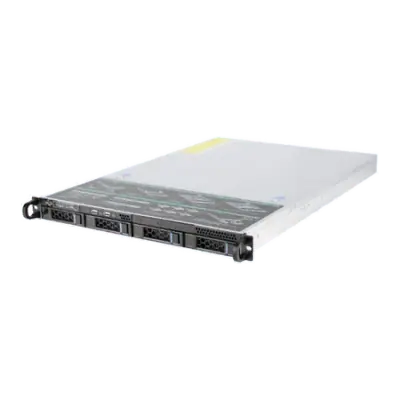
- Intel® Q670/Q670E
Price on request
VAST-BOX
Edge AI Compute Accelerators
NVIDIA Jetson Orin edge AI computer 32 TOPS
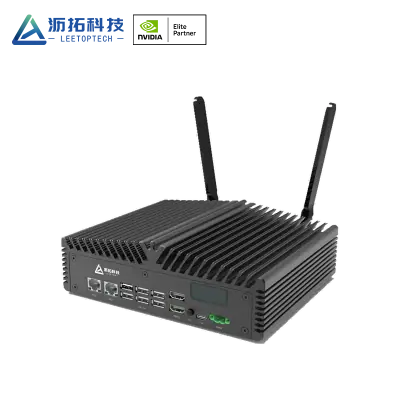
- 1 x Audio Jack (3.5mm)
- Arm Cortex-A78AE
- 2 GHz
Price on request
NURO-822E
Industrial Workstations
Edge GPU workstation with dual PCIe Gen 5 slots · Ref. : NURO-822E
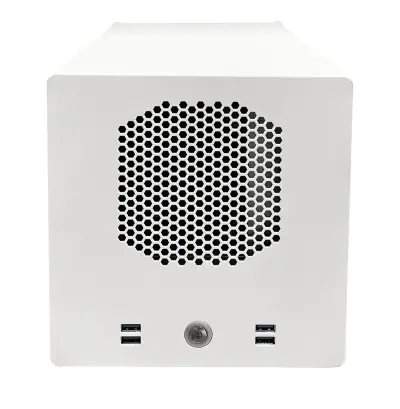
- AMI uEFI BIOS
- Intel R680E/Q670E
- 8” x 8” x 16”
Price on request
reComputer J401
Jetson Carrier Boards
Open-source carrier board for NVIDIA Jetson Orin modules · Ref. : 102110769
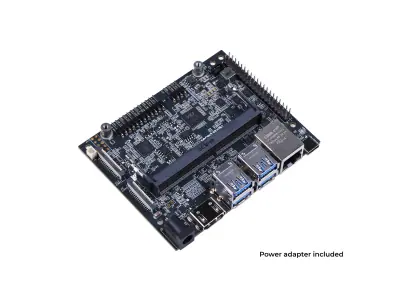
- USB
- Dimensions (W x D)
- Ethernet
Price on request
reComputer J202
Jetson Carrier Boards
Carrier board for Jetson Xavier NX, Nano and TX2 NX modules · Ref. : 102991695
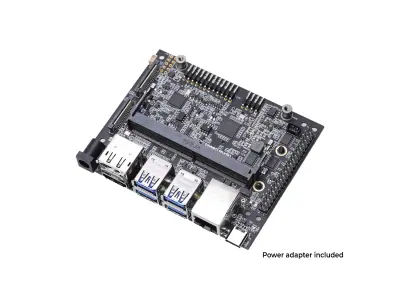
- USB
- Dimensions (W x D)
- Ethernet
Price on request
reComputer J401
Jetson Carrier Boards
Open-source carrier board for Jetson Orin Nano and Orin NX · Ref. : 102110770
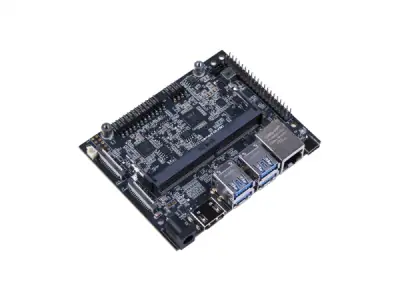
- USB
- Dimensions (W x D)
- Ethernet
Price on request
A project? Our engineers build the solution with you.
Send your requirements: Atlas proposes the architecture, the bill of materials and a quotation, then follows the supply.
Request a quotationRelated pages
 Use caseAI Visual Inspection in Data Centres & IT InfrastructureHardware architecture and field deployment guide addressing operational requirements. Certified industrial hardware, custom integration, and supply on quotation.
 Use caseAI Visual Inspection in Robotics & AutomationHardware architecture and field deployment guide addressing operational requirements. Certified industrial hardware, custom integration, and supply on quotation.
- OfferAI Visual Inspection kit for Data Centres & IT InfrastructureComplete hardware package ready for industrial deployment. Verified components, architecture review by Atlas engineering desk, and procurement on quotation.
 OfferAI Visual Inspection kit for Robotics & AutomationComplete hardware package ready for industrial deployment. Verified components, architecture review by Atlas engineering desk, and procurement on quotation.
 Use caseEdge AI in Data Centres & IT InfrastructureHardware architecture and field deployment guide addressing operational requirements. Certified industrial hardware, custom integration, and supply on quotation.
 Use caseEdge AI in Electronics & OEM/ODMHardware architecture and field deployment guide addressing operational requirements. Certified industrial hardware, custom integration, and supply on quotation.
 Use caseMachine Vision in Data Centres & IT InfrastructureHardware architecture and field deployment guide addressing operational requirements. Certified industrial hardware, custom integration, and supply on quotation.
 Use caseMachine Vision in Electronics & OEM/ODMHardware architecture and field deployment guide addressing operational requirements. Certified industrial hardware, custom integration, and supply on quotation.