
Selecting 3-Axis, 6-Axis and 9-Axis MEMS Architectures for Industrial Motion
Across Motion Sensors, Inertial Sensors, and Tilt and Inclination Sensors, selecting a MEMS sensing architecture begins with isolating the physical degrees of freedom required by the application. A 3-axis accelerometer measures static gravity vectors, slow inclination changes, and linear shock events, whereas a 6-axis IMU combines an accelerometer with a gyroscope to track angular rate and compensate dynamic accelerations during motion. Adding a magnetometer in a 9-axis configuration provides an absolute heading reference relative to the geomagnetic field whenever nearby ferrous structures and high-current conductors do not distort local flux lines.
Before requesting a quotation, buyers should confirm in the manufacturer datasheet the full-scale measurement range, digital resolution, and operating temperature limits. System teams must also check whether a single sensor module performs internal orientation fusion or streams raw inertial samples to an external host processor.
Bias Stability, Spectral Noise Density and Thermal Drift in MEMS Inertial Modules
Long-term angular accuracy in an inclinometer or industrial IMU depends primarily on in-run bias stability and the spectral noise density of both sensing elements. When integrating gyroscope outputs over time, residual zero-rate offset produces cumulative orientation drift within seconds unless corrected by gravity or external aiding. Likewise, elevated acceleration noise density masks low-amplitude structural oscillations and degrades static tilt resolution on stationary platforms and leveling fixtures.
Ambient temperature swings across minus forty degrees Celsius to one hundred five degrees Celsius shift zero-g offset and scale-factor linearity inside MEMS silicon structures during continuous machine operation. When preparing a technical sourcing request on quotation, buyers should check datasheet specifications for temperature drift coefficients, turn-on repeatability, and factory multi-point calibration tables rather than relying on room-temperature typical values alone.
Board-Level SPI and I2C Interfaces Versus Industrial CAN and RS-485 Buses
Electrical interface selection separates embedded board-level modules from remote field sensors mounted across heavy machinery. Short-reach SPI and I2C buses suit printed circuit assemblies spanning a few centimeters, delivering low-latency register polling at three point three volts logic levels. Beyond an enclosure wall, however, single-ended clock and data traces suffer from ground potential shifts, capacitive loading, and electromagnetic transients generated by variable-frequency drives.
For multi-meter cable runs along booms, masts, or vehicle frames, differential CAN and RS-485 buses maintain common-mode noise rejection and deterministic multi-node addressing. Buyers evaluating compact modules equipped natively with SPI or I2C should check the datasheet for bus timing margins and plan an isolated CAN or RS-485 transceiver bridge rated for the target cable length and baud rate.
Vibration Damping, Mechanical Mounting and Parasitic Shock Filtering
Combustion engines, gearboxes, and hydraulic pumps excite broadband mechanical energy that can clip accelerometer front ends or induce bias rectification error inside MEMS proof masses. Rigid mounting directly onto vibrating housings couples high-frequency impacts straight to the silicon die, whereas an improperly damped elastomer mount introduces phase lag and low-frequency structural resonance inside the useful tilt bandwidth.
Proper mechanical integration aligns sensor housing axes with machine reference frames, avoids cantilevered carrier boards, and pairs hardware anti-aliasing with configurable digital low-pass filters matched to the sampling rate. Prior to volume supply on quotation, buyers should check the datasheet for maximum shock survivability, internal sensor resonant frequencies, and programmable output data rate filtering options to suppress out-of-band machine vibration without delaying control loops.
Inertial Sensors Available on Quotation in the Atlas Electronics Catalogue
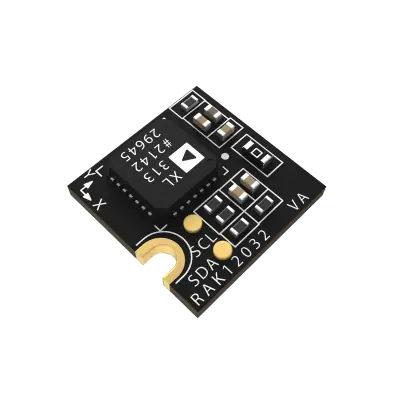
Within the Motion and Position Sensors category, the RAKwireless 100092 WisBlock module integrates the Analog Devices ADXL 313 3-axis accelerometer supporting a selectable range from plus or minus 0.5 g to plus or minus 4 g, measurement current from 30 uA to 300 uA, nominal standby current of 76.2 nA, and minimum operating temperature of minus 40 °C or lower.
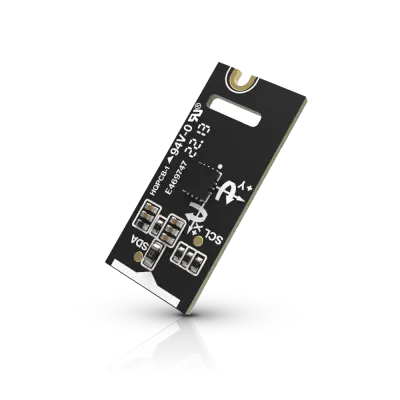
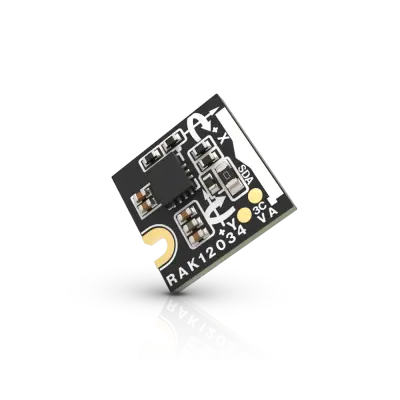
For multi-axis motion tracking, RAKwireless 100093 model RAK 12033 provides 6-axis accelerometer and gyroscope sensing from minus 40 °C to 105 °C with a typical standby current of 46.7 uA. When full orientation sensing is needed, RAKwireless 100094 model RAK 12034 built around Bosch BMX160 delivers 9-axis measurement from minus 40 °C to 105 °C at 3.3 V nominal supply and 1.61 mA nominal active current, supplied on quotation by Atlas Electronics.
Frequently asked questions
How do 3-axis accelerometers, 6-axis IMUs and 9-axis IMUs differ for industrial tilt measurement?
A 3-axis accelerometer resolves static inclination from gravity alone, so dynamic linear acceleration distorts angle readings. A 6-axis IMU adds a gyroscope to preserve orientation during motion, while a 9-axis IMU includes a magnetometer for heading estimation when surrounding metal structures do not distort magnetic fields.
When should buyers specify CAN or RS-485 instead of SPI or I2C for an inertial sensor?
SPI and I2C interfaces work well over short PCB traces at 3.3 V on embedded modules such as WisBlock carrier boards. When sensors must sit meters away on machine booms or chassis exposed to motor switching noise, differential CAN and RS-485 buses provide common-mode immunity and long-distance signal integrity.
Which bias and noise datasheet parameters matter most before requesting a quotation?
Buyers should check in-run bias stability, accelerometer and gyroscope spectral noise density, thermal zero-offset drift across minus 40 °C to 105 °C, and programmable low-pass filter cutoffs. These figures determine how rapidly orientation drifts between external reference updates.
How can engineers limit vibration-induced bias shift on rotating equipment?
Mount the sensor rigidly to a stiff structural member free of in-band resonance, select a full-scale g range above peak vibration amplitudes, and enable internal low-pass filtering. When using elastomer isolation mounts, buyers must check attenuation curves in the mount datasheet to avoid phase lag.
Products mentioned
RAK12032
Motion and Position Sensors
WisBlock 3-axis accelerometer, ±0.5 g to ±4 g range · Ref. : 100092
Price on request
RAK12033
Motion and Position Sensors
6-axis accelerometer and gyroscope sensor WisBlock · Ref. : 100093
Price on request
RAK12034
Motion and Position Sensors
9-axis Bosch BMX160 accelerometer sensor for WisBlock · Ref. : 100094
Price on request
A project? Our engineers build the solution with you.
Send your requirements: Atlas proposes the architecture, the bill of materials and a quotation, then follows the supply.
Request a quotationRelated pages
 WikiCAN busTechnical definition, operating principles, industrial standards, and datasheet selection criteria for hardware integration projects supported by Atlas engineers.
 ArticleIMU sensor explained: 6-axis vs 9-axis, drift and industrial usesUnderstand how an IMU sensor works, from 6-axis and 9-axis MEMS sensing to Kalman fusion, bias drift, CAN buses, and industrial use cases.
 ArticleBridging RS-485 Modbus RTU field devices to Modbus TCP and MQTTEngineering guide to bridge RS-485 Modbus RTU buses to Modbus TCP or MQTT, covering slave ID mapping, bus biasing, and timeout tuning.
 ProjectCollaborative Robot Arms, Mobile Robots & ActuatorsTechnical buyer guide to specify and quote collaborative robot arms, mobile robots, actuators, and educational STEM robotics kits.
 ProjectDIN-Rail Energy Meters & Three-Phase Modbus SubmetersCompare DIN-rail single and three-phase Modbus RS-485 energy meters by CT sizing, MID compliance, harmonic monitoring, and quotation needs.
 Use caseEnergy & Metering in Robotics & AutomationHardware architecture and field deployment guide addressing operational requirements. Certified industrial hardware, custom integration, and supply on quotation.
 Use caseEnergy & Metering in Telecom & NetworksHardware architecture and field deployment guide addressing operational requirements. Certified industrial hardware, custom integration, and supply on quotation.
 OfferEnergy & Metering kit for Robotics & AutomationComplete hardware package ready for industrial deployment. Verified components, architecture review by Atlas engineering desk, and procurement on quotation.