
M.2 Key B, Mini-PCIe, and SMD Form Factors Across 3GPP Categories
Selecting an embedded cellular modem starts with matching the mechanical form factor to your carrier board constraints, choosing among M.2 Key B cards, Mini-PCIe slots, and surface-mount SMD footprints. Within the Atlas Electronics Cellular Modules catalog, OEM Cellular Modules (M.2 / mPCIe) simplify field replacement and radio upgrades without redesigning the host PCB, whereas soldered SMD packages maximize mechanical retention against shock and thermal cycling in compact industrial enclosures.
Throughput, latency, and power targets then dictate the 3GPP air interface across LTE Cat 1 Modules, LTE Cat 4 Modules, NB-IoT Modules, and 5 G Modules. For deployments targeting North American carriers, the MultiTech MTQ-LAT3-B01.R3 provides LTE Cat 1 M.2 connectivity for AT&T and Verizon, while the MultiTech MTQ-LAT3-B02.R2A adds network fallback capabilities for resilient telemetry links.
Power Rail Sizing for Peak TX Current Bursts and Thermal Budgets
Cellular power amplifiers draw sharp peak TX current bursts during network attachment, paging intervals, and weak-signal transmissions. Insufficient bulk capacitance or narrow power traces cause instantaneous voltage droop that triggers baseband brownout resets. Hardware engineers must verify maximum peak current ratings, recommended decoupling capacitance, and copper pour thermal dissipation paths directly in the module datasheet before finalizing the host regulator stage.
Low-power wide-area interfaces in NB-IoT Modules and LTE-M designs lower average energy consumption via extended sleep states while still requiring stable power regulation. According to the product specifications, the RAKwireless 610000 Arduino-shield cellular module specifies a maximum current draw of 500 mA, while the Dragino NB-IOT SHIELD accepts a 4.5 V to 5.5 V input rail and operates down to minus 40 °C.
GNSS Receiver Integration and Multi-Antenna RF Isolation
Asset tracking, fleet telematics, and time-synchronized industrial gateways often rely on an integrated GNSS receiver embedded alongside the cellular baseband to avoid separate positioning hardware. Achieving reliable satellite lock requires controlled 50 ohm microstrip routing, continuous ground reference planes, and adequate antenna isolation so high-power cellular TX harmonics do not desensitize sensitive LNA front ends during concurrent transmission.
Several MultiTech modules in the catalog simplify antenna provisioning by bundling positioning accessories directly with the radio hardware. Both the MultiTech MTQ-LAT3-B01.R3 and the LTE Cat M1 MultiTech MTQ-MNA1-B02.R1-SP, as well as the MultiTech MTQ-LAT3-B02.R2A, include GNSS / GPS capability, one 3.3 V magnetic GPS antenna, and one Micro USB cable. Designers should check active antenna bias limits and RF port multiplexing rules in the datasheet.
Linux QMI and MBIM Drivers, Host Buses, and Dual-SIM Failover
In embedded Linux systems, M.2 Key B and Mini-PCIe modems typically enumerate over USB 2.0, USB 3.0, or PCIe lanes alongside serial UART ports for AT command diagnostics. While AT interfaces handle SIM status checks, APN configuration, and signal telemetry, kernel drivers such as qmiwwan and cdcmbim managed through ModemManager or libqmi provide low-overhead IP packet forwarding suited to sustained LTE and 5 G throughput.
High-availability industrial sites requiring multi-carrier redundancy can alternatively evaluate integrated 5 G Modules and router assemblies. The Four-Faith FNR500 combines 5 G cellular connectivity with a dual-SIM dual-module architecture, VPN support, Wi-Fi 6, an IP20 to IP44 enclosure rating, and a minimum operating temperature of minus 30 °C. Software teams should verify Linux kernel version compatibility and USB vendor identifiers in the manufacturer documentation prior to image builds.
Regional Frequency Bands, FCC Compliance, and Quotation Supply
Matching regional frequency bands and regulatory approvals to the target deployment geography prevents costly hardware revisions late in production. For North American networks, the MultiTech MTQ-LAT3-B01.R3, MultiTech MTQ-MNA1-B02.R1-SP, and MultiTech MTQ-LAT3-B02.R2A carry FCC approval and target AT&T and Verizon networks. For European or regional LPWA bands, the Dragino NB-IOT SHIELD supports Quectel BC95 or BG96 modules covering bands B1, B3, B8, B5, B20, and B28, plus dedicated B5 850 MHz and B8 900 MHz variants.
Before placing an OEM order, engineering and procurement teams should review carrier band plans, industrial SIM temperature grades, and antenna clearances against the product datasheet. Atlas Electronics provides supply on quotation across Cellular Modules, OEM Cellular Modules (M.2 / mPCIe), and NB-IoT Modules, supporting prototype evaluations and scheduled production rollouts.
Frequently asked questions
What is the difference between Linux QMI and MBIM drivers for M.2 and Mini-PCIe modems?
QMI is a Qualcomm-specific protocol handled by the Linux qmiwwan driver that exposes granular radio diagnostics alongside IP data. MBIM is an industry-standard USB-IF interface supported natively by cdcmbim on Linux and Windows, easing cross-vendor host integration. Always check the module datasheet to confirm which USB interface descriptors the active firmware exposes.
How should power rails be sized for cellular modem peak TX current bursts?
Cellular RF power amplifiers draw brief high-current bursts during registration and maximum-power transmission that significantly exceed average sleep or idle currents. Engineers must check the datasheet peak current specification, place low-ESR bulk and high-frequency decoupling capacitors close to the power pins, and keep regulator trace impedance low to prevent brownout resets.
When should I select LTE Cat 1 versus LTE Cat M1 or NB-IoT for an OEM design?
LTE Cat 1 modules such as the MultiTech MTQ-LAT3-B01.R3 suit industrial gateways requiring megabit-class throughput and low-latency telemetry. LTE Cat M1 and NB-IoT solutions like the MultiTech MTQ-MNA1-B02.R1-SP or RAKwireless 610000 fit low-bandwidth, battery-powered sensors, provided you confirm regional carrier band support and coverage in the datasheet.
What PCB and antenna precautions prevent GNSS desensitization next to a cellular radio?
Physical separation between cellular and GNSS antennas, orthogonal polarization, and 50 ohm impedance-matched RF routing minimize out-of-band interference. When integrating GNSS-enabled modems such as the MultiTech MTQ-LAT3-B02.R2A supplied with a 3.3 V magnetic GPS antenna, check the datasheet for active antenna bias limits and whether any RF port is shared between cellular diversity and GNSS.
Products mentioned
NB-IOT SHIELD
NB-IoT Modules
NB-IoT shield for Arduino with Quectel BC95 or BG96 modules · Ref. : NB-IOT SHIELD

- 4.5v ~ 5.5v
Price on request
FNR500
OEM Cellular Modules (M.2 / mPCIe)
Industrial 5G router with dual SIM and dual cellular module

Price on request
MTQ-MNA1-B02.R1-SP
OEM Cellular Modules (M.2 / mPCIe)
LTE Cat M1 embedded cellular modem with GNSS · Ref. : MTQ-MNA1-B02.R1-SP
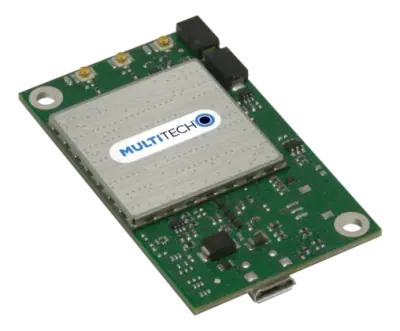
Price on request
MTQ-LAT3-B02.R2A
OEM Cellular Modules (M.2 / mPCIe)
LTE Cat 1 embedded cellular modem with fallback, AT&T network · Ref. : MTQ-LAT3-B02.R2A
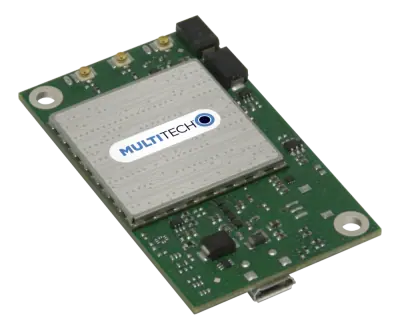
Price on request
MTQ-LAT3-B01.R3
OEM Cellular Modules (M.2 / mPCIe)
LTE Cat 1 embedded cellular module M.2 for AT&T · Ref. : MTQ-LAT3-B01.R3
Price on request
RAK2011
NB-IoT Modules
LPWA NB-IoT, LTE-M and GPS cellular module in Arduino shield format · Ref. : 610000

Price on request
A project? Our engineers build the solution with you.
Send your requirements: Atlas proposes the architecture, the bill of materials and a quotation, then follows the supply.
Request a quotationRelated pages
 ArticleIntegrating a 4 G LTE or 5 G M.2 / Mini-PCIe cellular modem in OEM hardwareEngineering guide covering M.2 vs Mini-PCIe buses, 3.3 V/3.8 V peak current rails, MHF 4/U.FL RF, SIM routing, and Linux QMI/ModemManager.
 Use caseTurnkey Cellular IoT Connectivity in Electronics & OEM/ODMHardware architecture and field deployment guide addressing operational requirements. Certified industrial hardware, custom integration, and supply on quotation.
 Use caseTurnkey Cellular IoT Connectivity in Telecom & NetworksHardware architecture and field deployment guide addressing operational requirements. Certified industrial hardware, custom integration, and supply on quotation.
 OfferTurnkey Cellular IoT Connectivity kit for Electronics & OEM/ODMComplete hardware package ready for industrial deployment. Verified components, architecture review by Atlas engineering desk, and procurement on quotation.
 OfferTurnkey Cellular IoT Connectivity kit for Telecom & NetworksComplete hardware package ready for industrial deployment. Verified components, architecture review by Atlas engineering desk, and procurement on quotation.
 ArticleRadio Equipment Directive RED and CE marking for wireless modulesThis guide outlines Directive 2014/53/EU (RED) obligations for integrating wireless modules and affixing CE marking to industrial equipment.
 Use caseTransportation & Fleet in Automotive & Electric MobilityHardware architecture and field deployment guide addressing operational requirements. Certified industrial hardware, custom integration, and supply on quotation.
 Use caseTransportation & Fleet in Electronics & OEM/ODMHardware architecture and field deployment guide addressing operational requirements. Certified industrial hardware, custom integration, and supply on quotation.