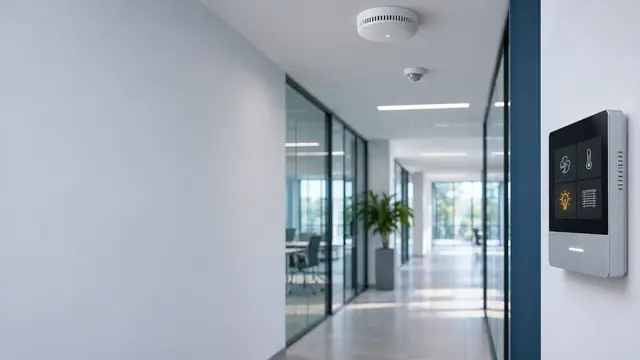
Definition and Fundamental Principles of the Open KNX Standard
The KNX standard, defined under international standard ISO/IEC 14543-3 and European standard EN 50090, is an open communications protocol designed for commercial and industrial building automation. Created through the historical unification of Batibus, EIB, and EHS protocols, it guarantees direct interoperability between hardware from diverse manufacturers without requiring proprietary translation software. Each device on the network operates with decentralized intelligence, storing its own application program and parameters to prevent single points of failure across the automation plant.
Control sequences within a KNX installation are executed by exchanging standardized telegrams containing group addresses linked to distinct automation functions. Sensors gather physical parameters such as presence, temperature, and illumination, while actuators operate relays, dimmers, or valve positioners. System integrators configure communication links using the standardized ETS engineering tool, where standard Datapoint Types, known as DPTs, enforce consistent data formats and unit scaling across all field modules.
Communication Architecture and Protocol Stack of the KNX Network
The KNX protocol stack follows the OSI reference model to provide deterministic communication across building automation systems. At the data link layer, bus access is managed via CSMA/CA arbitration with bit-level collision avoidance, ensuring that safety-critical messages and urgent technical alarms retain priority on the bus. Information travels inside structured frames containing the physical source address, the destination group address, and specific application data payloads.
At the upper application layer, standardized runtime services handle read, write, and response requests through specific operation codes. To secure industrial networks against unauthorized manipulation, the KNX Secure protocol introduces two distinct encryption mechanisms based on the AES-128 cryptographic algorithm. KNX Data Secure encrypts and authenticates individual telegrams directly between field components, while KNX IP Secure protects entire encapsulated telegram streams travelling over industrial Ethernet backbones.
Physical Topology, Bus Segmentation, and KNX Transmission Media
The primary physical layer media in commercial automation remains KNX TP1, utilizing a dedicated shielded twisted pair operating at 9600 bit/s and delivering auxiliary direct current between 21 V and 30 V DC to bus participants. The physical topology supports flexible linear, star, and tree layouts without terminating resistors, strictly forbidding closed ring loops. A standard line segment supports up to 64 devices depending on bus power requirements, spanning a maximum cable distance of 1000 meters.
Large installations are structured using line couplers and area couplers to filter traffic and isolate local bus telegrams across up to fifteen distinct areas. The KNX specification also covers KNX IP over high-speed Ethernet backbones, KNX RF operating on the 868 MHz band for wireless expansions where cabling is unfeasible, and KNX PL 110 powerline transmission over existing mains distribution cabling.
Integration of KNX in Industrial and Commercial Infrastructures
In modern industrial production plants, distribution logistics hubs, and commercial facilities, automated KNX networks manage facility automation systems encompassing architectural lighting, mechanical shading louvers, HVAC climate control, and electrical sub-metering. The bus operates in close synergy with industrial communication protocols such as Modbus RTU, BACnet/IP, and Profinet through modular programmable logic controllers or dedicated industrial protocol gateways.
This cross-system integration enables plant managers and facility supervisors to align environmental climate control setpoints and lighting schedules with manufacturing work shifts or emergency safety shutdown sequences. Multi-protocol interfaces translate KNX group addresses into Modbus holding registers or BACnet objects, providing central supervisory SCADA platforms and enterprise energy management software with continuous operational data and diagnostic alarms from electrical distribution boards.
Selection Criteria and Datasheet Checklist for KNX Hardware
When evaluating technical datasheets for KNX equipment, industrial purchasers must examine bus current consumption, which commonly ranges from 5 mA to 20 mA under 21-30 V DC bus power. Devices incorporating touchscreens, graphic displays, or high-throughput network transceivers frequently require supplementary auxiliary power supplies, typically 24 V DC, to prevent premature line voltage drops and avoid overloading the primary bus power supply unit.
Technical buyers should systematically review KNX Secure implementation support, operating temperature ranges, and enclosure ingress protection ratings suitable for harsh industrial plant floors. For switching actuators, critical parameters in the manufacturer documentation include contact rated current, inrush current withstand capability for capacitive LED driver loads, relay mechanical switching cycles, and integrated current measurement accuracy across active channels.
Control Devices and KNX Gateways in the Atlas Electronics Catalogue
In the KNX Actuators category, the Euchips KNX-EUK1220 module provides DIN rail mount Yes, Min. operating temperature 0 °C or higher, Bus Voltage 21-30VDC, and Current detection accuracy (50 mA 249 mA)±20 mA (250 mA 16 mA)±2%. For lighting control, the HDL Automation PRODUCT100000411921952 controller operates with Input Voltage 100 - 240 V AC, 50/60 Hz 0.1 A, supports Number of drivers supported 64, and requires a Rated Current 5 mA/30 V DC.
Within KNX Push Buttons and Panels, the GVS Smart S15 unit operates under Bus Voltage 21-30 V DC and accommodates Installation Single 86 Box or Dual European 60 Box. The Euchips KNX-EUR05 sensor provides IP rating IP20 to IP44, Bus current <12 mA, and Auxiliary voltage 24VDC. For network interconnection, the Dusun IoT DSGW-510 gateway features Cellular network 4 G LTE Cat 4, RS-485 Yes, and CAN bus Yes to interface KNX lines with supervisory networks.
Frequently asked questions
What is the primary operational difference between KNX TP1 and KNX IP media?
KNX TP1 operates over a dedicated shielded twisted pair providing both data transmission at 9600 bit/s and bus power between 21 V and 30 V DC. In contrast, KNX IP encapsulates standardized telegrams into UDP/IP packets over high-speed Ethernet infrastructure, functioning primarily as a fast backbone connecting distinct lines and building zones.
How do KNX Data Secure and KNX IP Secure safeguard building automation networks?
KNX Data Secure operates at the application layer by encrypting and authenticating messages between individual bus devices using AES-128 algorithms to prevent unauthorized command injection. KNX IP Secure establishes an encrypted tunnel for all KNX telegram traffic routed across local IP networks, protecting building backbones from eavesdropping and external tampering.
Why must system designers evaluate individual device bus current draw on technical datasheets?
A standard KNX line segment is powered by a dedicated supply typically rated between 160 mA and 640 mA at 30 V DC. Because devices draw between 5 mA and 20 mA under normal operation, calculating aggregate bus current prevents voltage drops. Furthermore, devices with touchscreens or wireless modules often require supplementary auxiliary power connections.
How does KNX interface with supervisory industrial management systems using Modbus or BACnet?
System integration is achieved using multi-protocol communication gateways. The gateway translates KNX group addresses into standardized Modbus registers or BACnet objects, allowing supervisory SCADA platforms and building management software to monitor sensor readings, adjust control setpoints, and record alarms without compromising decentralized bus control.
Products mentioned
DSGW-510
KNX Gateways and Interfaces
Rail-mounted KNX data gateway with Ethernet, WiFi and LTE · Ref. : DSGW-510

Price on request
KNX-EUR05
KNX Push Buttons and Panels
Indoor KNX microwave sensor with motion and illuminance detection · Ref. : KNX-EUR05

- <33mA
- <792mW
- 24VDC
Price on request
KNX-EUK1220
KNX Actuators
12 Channel Current Detection Execution Module KNX · Ref. : KNX-EUK1220
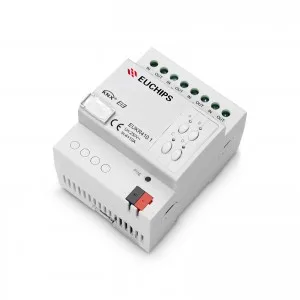
- 21-30VDC
- ≤20mA
- ≤600mW
Price on request
CHTI-15.6/240.1.21
KNX Push Buttons and Panels
15.6-inch KNX touch panel with KNX Secure and SIP intercom · Ref. : S15

- 21-30V DC
- Black, Gray, Silver
Price on request
MDL64-KT.53
KNX Push Buttons and Panels
KNX-DALI lighting dimming controller with DALI-2 · Ref. : PRODUCT100000411921952

Price on request
A project? Our engineers build the solution with you.
Send your requirements: Atlas proposes the architecture, the bill of materials and a quotation, then follows the supply.
Request a quotation