
Electromagnetic principles and impulse radio modulation of ultra-wideband
Ultra-wideband technology operates by emitting baseband radio pulses of sub-nanosecond duration across a bandwidth exceeding five hundred megahertz or occupying more than twenty percent of its center frequency. Unlike conventional narrowband transceivers that modulate continuous carrier waves, this impulse-based transmission spreads spectral energy across an exceptionally wide frequency spectrum. The resulting power spectral density remains below the ambient electromagnetic noise floor, complying with international regulatory limits and ensuring non-interfering coexistence with concurrent wireless links.
This vast radio bandwidth delivers fine time resolution in the picosecond domain. Receiver architectures can separate direct line-of-sight signal paths from multipath reflections generated by structural metalwork, storage racks, and concrete walls. Multipath immunity represents the primary operational advantage of this modulation scheme within dense industrial environments. Furthermore, transmitting brief pulses minimizes energy consumption per measurement frame, establishing a practical radio foundation for battery-powered localization nodes.
Ranging methodologies via time of flight and time difference of arrival
Spatial localization using ultra-wideband relies on two primary geometric frameworks. Two-way ranging, commonly abbreviated as TWR, measures distance between two unsynchronized nodes by calculating the bidirectional round-trip propagation time of timestamped radio packets. Symmetrical double-sided two-way ranging resolves crystal clock drift between transceivers without requiring physical clock distribution cabling, facilitating swift setup for mobile tracking tags and temporary positioning anchors across plant floors.
Conversely, time difference of arrival architectures, designated as TDoA, require precise nanosecond synchronization across an array of static receiver anchors. In this operational topology, an active tag emits a single omnidirectional pulse burst that is captured by multiple surrounding anchors. Evaluating the differential reception arrival timestamps at a central location engine delivers multi-dimensional position coordinates while extending tag operating lifespans. Angle of arrival, known as AoA, complements these methods by determining phase differences across antenna arrays.
IEEE 802.15.4z standards and cryptographic pulse security
The evolution of ultra-wideband specifications reached maturity with the ratification of the IEEE 802.15.4z standard, augmenting the baseline IEEE 802.15.4-2020 foundation. This standard addresses physical-layer relay attacks and distance manipulation exploits that vulnerable transceivers previously faced during keyless building access and transactional authentication routines. The enhanced physical layer inserts a scrambled timestamp sequence directly into the radio packet structure.
By employing cryptographically generated pseudo-random pulse spacing and polarity shifts, the transceiver prevents adversarial nodes from injecting premature pulses or spoofing propagation delays. Hardware evaluators must consult product datasheets to confirm whether a given radio controller implements IEEE 802.15.4z security extensions alongside hardware cryptographic accelerators. Deploying standard-compliant silicon provides dependable defense against signal manipulation, making it an essential requirement for automated transport routes and perimeter management in sensitive facilities.
Industrial deployments of ultra-wideband in asset tracking and mobile robotics
Manufacturing sites and automated distribution hubs present harsh radio frequency conditions characterized by metallic shelving, structural steel columns, and dynamic forklift traffic. Ultra-wideband provides dependable real-time location performance for tooling fixtures, high-value work-in-progress materials, and inventory containers where satellite positioning cannot function indoors. Unlike optical tag readers or signal strength indicators that suffer from occlusion and attenuation, impulse radio maintains centimeter-grade accuracy despite non-line-of-sight conditions.
In autonomous intralogistics, industrial automated guided vehicles and autonomous mobile robots utilize ultra-wideband transceivers for real-time fleet positioning, cooperative navigation, and collision avoidance. When paired with radar sensing modes, modules can measure clearances and detect personnel approaching moving machinery. Implementing dynamic digital safety zones based on vehicle speed and heading reduces workshop incidents while optimizing material throughput across continuous manufacturing operations.
Critical datasheet parameters for selecting ultra-wideband transceivers
Selecting an industrial radio module requires systematic verification of electrical and radio frequency parameters documented in technical datasheets. System designers must first review channel support across lower bands around four gigahertz and upper bands exceeding six gigahertz to adhere to regional spectrum allocation frameworks. Power supply architecture represents another pivotal design factor, where operational input voltage spans, coin-cell battery compatibility, and peak transmission currents directly dictate sensor tag operating longevity.
RF interface specifications demand careful analysis of antenna port configurations, distinguishing between basic single-transceiver architectures and multi-channel antenna arrays designed for angular measurement. Engineers should evaluate connector choices, such as micro-coaxial IPEX terminations, alongside supported digital host bus interfaces like asynchronous serial UART or high-speed SPI channels. Finally, verifying that operating temperature ratings cover industrial extremes between minus forty and plus eighty-five degrees Celsius ensures field durability under demanding conditions.
Hardware integration of UWB modules available on quotation at Atlas Electronics
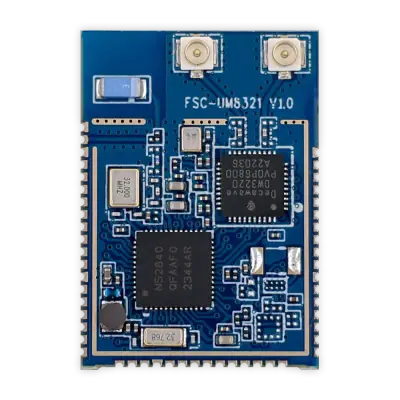
The Atlas Electronics catalogue features components from the UWB Modules family supplied on quotation for industrial hardware projects. The RAKwireless 100101 module incorporates the Decawave DW1000 transceiver, operating across a temperature range of -40° C 85° C with dual power inputs including a 4.2 V typical VBAT battery rail and 3.3 V. For combined networking, the Feasycom FSC-UM8321 integrates the Qorvo DW 3220 UWB IC, Bluetooth 5.2 Low Energy radio, two Ipex connectors for external antennas, and a VDD operating span of 2.5 V - 3.6 V.
For direction-finding architectures, the NewRadio NRT82687 module provides 2 T 3 R antenna ports on channel CH2, delivering angle accuracy below 1° and supporting coin-cell power supply. Additionally, the Ebyte EWM551-3G9T13SX features the DW1000 chip solution for the 3743.6–4243.6 MHz band, featuring a UART communication interface and a 400 m ranging distance in a 20 × 26 mm footprint. These catalog items offer defined technical parameters to suit diverse tracking and industrial networking requirements.
Frequently asked questions
What is the fundamental difference between TWR and TDoA in ultra-wideband systems?
Two-way ranging TWR computes distance between two transceivers by measuring round-trip propagation time, eliminating the need for anchor clock synchronization while increasing tag radio power consumption. Time difference of arrival TDoA requires nanosecond synchronization across fixed anchors, enabling tags to transmit a single brief pulse to be located, thereby maximizing tag battery life.
How does the IEEE 802.15.4z standard enhance ranging security against physical attacks?
The IEEE 802.15.4z amendment introduces a scrambled timestamp sequence into the physical radio layer. By generating cryptographically randomized pulses with a shared key, the standard prevents physical relay attacks and pulse manipulation exploits designed to artificially shorten or fabricate calculated time-of-flight measurements.
Why does ultra-wideband outperform Bluetooth or Wi-Fi in dense industrial indoor settings?
Operating with an RF bandwidth exceeding five hundred megahertz, ultra-wideband emits sub-nanosecond pulses. This high time resolution enables receivers to differentiate between the direct line-of-sight path and multipath reflections from structural metalwork, eliminating signal fading and errors that typically affect received signal strength indicators.
Which UWB frequency channels should be selected for global industrial deployments?
Channel CH5 centered at 6489.6 MHz and channel CH9 centered at 7987.2 MHz offer the broadest international regulatory acceptance across Europe, North America, and Asia. Channel CH2 centered around 4 GHz is supported by several transceivers but faces tighter regional power restrictions depending on local spectrum rules.
Products mentioned
EWM551-3G9T13SX
UWB Modules
High-precision UWB ranging module with UART interface · Ref. : EWM551-3G9T13SX
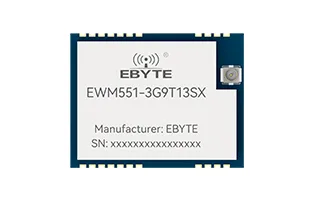
- DW1000
- UART
- 20 × 26 mm
Price on request
FSC-UM8321
UWB Modules
UWB Transceiver Module with Bluetooth 5.2 LE · Ref. : FSC-UM8321
Price on request
NRT82687
UWB Modules
Industrial UWB module, Channel 2, RISC-V processor · Ref. : NRT82687

Price on request
RAK13801
UWB Modules
DW1000 UWB Module for Real-Time Location · Ref. : 100101

Price on request
A project? Our engineers build the solution with you.
Send your requirements: Atlas proposes the architecture, the bill of materials and a quotation, then follows the supply.
Request a quotationRelated pages
 ArticleHow to choose hardware for Aerospace, Space & DefenceTechnical buying guide for selecting GNSS receivers, thermal cameras, and propulsion hardware for aerospace, space, and defence systems.
 ProjectHardware for Aerospace, Space & Defence projectsThis guide helps aerospace, space, and defence buyers specify, select, and quote a complete hardware bill of materials via Atlas.