
360 degree coverage vs directional sectoring for 4 G/5 G, Wi-Fi, and LoRaWAN gateways
Choosing between an omnidirectional antenna and a directional panel shapes the effective coverage of industrial 4 G, 5 G, Wi-Fi, and LoRaWAN gateways. An omnidirectional radiator distributes energy across a full 360 degrees in the horizontal plane, making it suited to central base stations, courtyard telemetry, and scattered machine sensors. By contrast, a directional panel concentrates radio frequency power into a narrower angular sector to extend range toward a defined zone.
Before specifying hardware within the RF and Antennas taxonomy family, buyers should map endpoint distribution and metallic obstructions across the facility. Central deployments align with Omnidirectional Antennas, whereas point-to-point backhaul or long warehouse aisles align with Yagi and Directional Antennas. Selecting an inappropriate radiation geometry introduces dead zones or co-channel interference that degrades overall link margin across active industrial networks.
Radiation pattern, main lobe shaping, and beamwidth in industrial deployments
Antenna gain expressed in dBi does not amplify transmitter power; instead, it reshapes how radiated energy is distributed in three-dimensional space. A higher-gain omnidirectional dipole compresses its vertical elevation beamwidth into a flattened doughnut around the horizon to reach distant endpoints. Conversely, a directional panel narrows both horizontal azimuth and vertical elevation beamwidths into a focused main lobe with higher forward directivity.
Evaluating a radiation pattern requires checking half-power beamwidth and front-to-back ratio directly in the datasheet. When mounted on a tall mast, an overly high-gain omnidirectional pole can create a signal null directly beneath the tower. Inside rack-filled halls, tilting a directional panel keeps side lobes away from reflective steel walls and suppresses multipath fading on Wi-Fi or cellular links.
Coaxial cable attenuation, RF connectors, and link budget from sub-GHz to 5 G bands
Higher antenna gain yields little benefit if coaxial feedline losses dissipate signal power before it reaches the radiator. Attenuation per meter in 50 ohm coaxial cable climbs steeply as carrier frequency rises from 433 MHz and 868 MHz to 2.4 GHz Wi-Fi and 3.5 GHz 5 G bands. Keeping cable runs short or mounting the gateway enclosure close to the mast preserves usable link budget.
Connector selection also affects insertion loss and mechanical resilience at outdoor bulkheads. Field installations commonly rely on rugged N-Type interfaces paired with RP-SMA or MHF pigtails inside the gateway housing. Buyers must verify connector gender, voltage standing wave ratio, and regional equivalent isotropically radiated power limits in the datasheet before pairing an outdoor mast antenna with a multi-meter coaxial assembly.
Lightning surge protection, grounding, and environmental rating on outdoor masts
Any roof-mounted or tower-mounted antenna exposes connected radio equipment to lightning-induced transients and electrostatic buildup. Installing an inline coaxial gas-discharge or quarter-wave surge arrester at the building entry bulkhead, bonded to a low-impedance earth ground, diverts surge currents away from sensitive transceiver front ends. Forming a drip loop below the entry gland and sealing coaxial joints also prevents moisture ingress.
Mechanical wind load and environmental ratings differ markedly between vertical fiberglass poles and flat panel housings. Tall cylindrical radomes generate higher bending torque during gusts, whereas directional panels present variable wind resistance depending on azimuth bracket orientation. Buyers must inspect ingress protection ratings, wind-load figures, and minimum operating temperature down to -40 °C or -20 °C in the datasheet.
Pre-purchase selection criteria: mounting elevation, obstructions, and multi-band timing
A disciplined pre-purchase choice weighs three site metrics: angular spread of field nodes, available mast height, and local interference levels. Select an omnidirectional model when endpoints encircle the gateway at balanced distances. Choose a directional panel when assets sit within a 60 to 120 degree sector or behind attenuating partitions where higher front-to-back rejection improves receiver selectivity against neighboring transmitters.
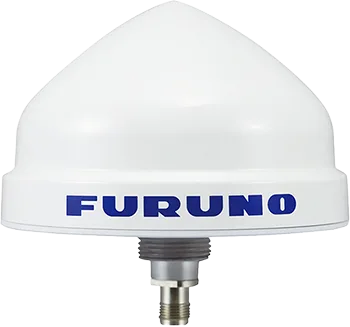
On shared masts combining cellular, sub-GHz, and timing receivers, spatial decoupling prevents desensitization across adjacent bands. Within the Combination Multi-Band Antennas family, the Furuno AU-500/AU-300 dual-band L1/L5 multi-GNSS antenna supports precision time synchronization for networked gateways. Mounting it outside the main beamwidth of high-power transmitting panels or omnidirectional dipoles preserves satellite lock reliability under dense RF operation.
Catalogue omnidirectional antennas and directional panel sourcing on quotation
In the Omnidirectional Antennas family, several RAKwireless models address 360 degree LoRaWAN deployments. The RAKwireless 911008 (N-Type to MHF) and RAKwireless 911007 (N-Type to RP-SMA) fiberglass dipoles deliver 5.8 dBi across an 800 ± 10 mm body rated at -40 °C or lower for LoRaWAN EU868, with 433 MHz noted in the specification table. For compact masts, RAKwireless 911004 provides 3 dBi with N-Type Male to MHF down to -20 °C.
Within Whip and Dipole Antennas, the RAKwireless 921005 TPE antenna measures 109 mm by 10 mm at approximately 0.2 kg, providing 2 dBi at 433 MHz via an RP-SMA Male connector. Directional panels from the Yagi and Directional Antennas family are configured and supplied on quotation according to band, beamwidth, and polarization; buyers must verify exact frequency and connector specs in each datasheet.
Frequently asked questions
When should an omnidirectional antenna be chosen over a directional panel antenna?
Choose an omnidirectional antenna when LoRaWAN sensors, Wi-Fi clients, or 4 G/5 G devices surround the gateway across 360 degrees. Choose a directional panel when endpoints lie within a specific sector or require higher forward gain to overcome obstacles.
Does higher dBi gain always improve indoor industrial wireless coverage?
No. Higher gain flattens the vertical lobe of an omnidirectional antenna or narrows a panel beamwidth. Mounted high in a warehouse, excessive gain can leave a coverage null below the antenna and increase multipath reflections off metallic racking.
How can installers minimize coaxial cable attenuation and lightning surge risk?
Keep 50 ohm coaxial runs as short as practical, match rugged N-Type or RP-SMA connectors to the gateway interface, and install a grounded coaxial surge protector with weatherproofing and a drip loop at the building entry point.
What must buyers verify before requesting a quotation for RAKwireless or directional panel antennas?
Buyers must confirm the exact operating band in the datasheet (such as EU868, 433 MHz, or 860-930 MHz), connector gender and cable adapter type, beamwidth requirements, and minimum operating temperature for the installation site.
Products mentioned
AU-500/AU-300
Combination Multi-Band Antennas
Dual-band L1/L5 multi-GNSS antenna for time synchronisation · Ref. : AU-500/AU-300
Price on request
911008
Omnidirectional Antennas
5.8 dBi fiberglass dipole antenna for LoRa 433 MHz
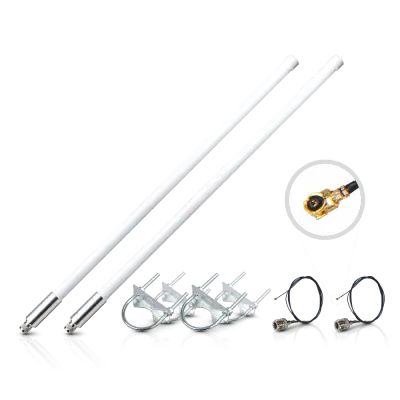
- White / N-Type to MHF
- 800 ± 10mm
- 360 degrees
Price on request
911004
Omnidirectional Antennas
3 dBi Fiberglass Omnidirectional Antenna for LoRa, N-Type · Ref. : 911004
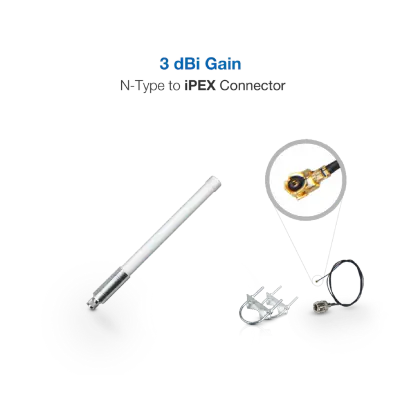
- 360 degrees
- N-Type Male
- N-Type to MHF
Price on request
911007
Omnidirectional Antennas
5.8 dBi fiberglass dipole antenna for LoRa 433 MHz, white
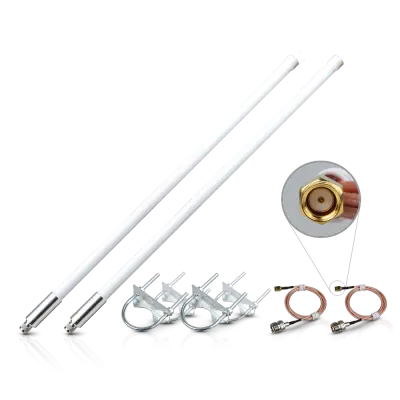
- 800 ± 10mm
- 360 degrees
- N-Type Male
Price on request
921005
Whip and Dipole Antennas
LoRa 2 dBi 433 MHz Antenna with RP-SMA Connector
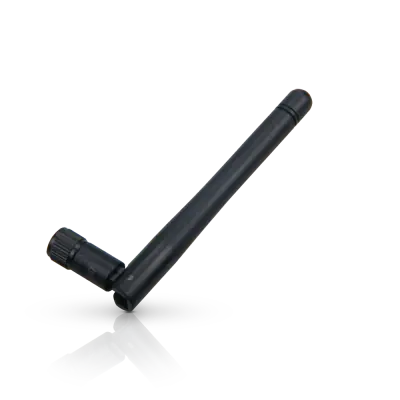
- 109mm x 10mm
- Approximately 0.2kg
- TPE
Price on request
A project? Our engineers build the solution with you.
Send your requirements: Atlas proposes the architecture, the bill of materials and a quotation, then follows the supply.
Request a quotationRelated pages
 Use caseIndoor Mobile Coverage in Telecom & NetworksHardware architecture and field deployment guide addressing operational requirements. Certified industrial hardware, custom integration, and supply on quotation.
 OfferIndoor Mobile Coverage kit for Telecom & NetworksComplete hardware package ready for industrial deployment. Verified components, architecture review by Atlas engineering desk, and procurement on quotation.
 ArticleCoaxial cables, connectors and RF link budget for industrial antennasCalculate RF link budgets at 868 MHz, 2.4 GHz and 3.5 GHz: cable loss per meter, 50 ohm impedance, connectors, bend radius and surge arresters.
 ProjectIndustrial 5 G MIMO, GNSS Antennas & RF Coaxial AssembliesThis guide covers 5 G MIMO band coverage, active L1/L5 GNSS reception, VSWR, SMA vs N-type connectors, and coaxial loss for B2B RF quotation.