
Reference Hardware Architecture for Telecom Remote Maintenance
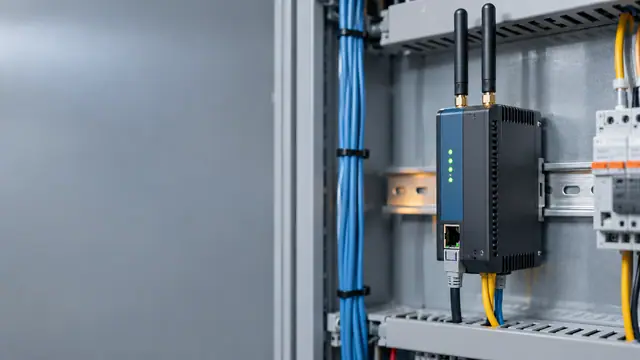
Reliable remote access to telecom enclosures demands industrial hardware selected to eliminate dispatch expenses during operational diagnostics. The reference architecture centers on the Four-Faith F3936-3736H router from the 4 G LTE / LTE-A Industrial Routers category. This device delivers 4 G LTE connectivity with LTE TDD download speeds of 68 Mbps, RS-232 and RS-485 interfaces, and an operating threshold down to -30 °C. It establishes the primary cellular gateway toward the central operations room.
Local machine monitoring is assigned to the Axiomtek GOT315B-ADL-WCD from the Industrial HMI Touch Panels, Keypads & Operator Interfaces group, offering an IP65 front frame and one Ethernet port. Core automation relies on the ICP DAS RPAC-2658 M from the Programmable Logic Controllers (PLC) family, handling native Modbus communication and DCON remote input-output expansion.
Integration Alternatives and Hardware Expansion for Remote Cabinets
Constrained field enclosures often require hardware variants to accommodate space limits and power budgets. The Four-Faith M2M router, classified under Industrial Cellular Routers, presents a compact alternative delivering 4 G LTE connectivity, RS-232 and RS-485 serial ports, an IP20 to IP44 enclosure rating, and operation down to -30 °C. This alternative router replaces larger modules when DIN rail dimensions inside compact pole-mounted enclosures require minimal footprints.
For installations demanding continuous control availability, two ICP DAS RPAC-2658 M controllers can form a redundant architecture with a failover switchover time of 0.2 seconds as stated in the manufacturer documentation. Engineers can expand field monitoring by connecting I 7000 or M 7000 remote modules directly to the serial ports. Adding an integrated Wi-Fi 4 interface further allows service technicians to diagnose cabinet parameters wirelessly without opening protective enclosures.
Radio Frequency Constraints, Cellular Bands, and Antenna Selection
Cellular uptime at remote telecom stations depends directly on matching local operator spectrum allocations with modem specifications. Transceivers must support the specific LTE TDD or FDD carrier bands deployed across the destination territory. Technical personnel must evaluate frequency charts for each target deployment zone before installation to prevent communication blackouts. Incompatible band configurations cause intermittent link drops that compromise scheduled supervisory data transfers and remote diagnostics.
Antenna design and coaxial cable attenuation govern overall link budget performance. Excess cable length or inadequate dielectric shielding introduces severe insertion losses that degrade signal strength. In dense metal shelters, external mast-mounted omnidirectional antennas are necessary to maintain clear line of sight. Integrators must calculate decibel losses per meter and select low-loss coaxial cabling to ensure robust fade margins against seasonal weather variations.
Network Segmentation, Redundant Uplinks, and Equipment Monitoring
Defending industrial telecom infrastructure requires strict segregation between local machine subnets and external communications channels. Implementing isolated IP subnets and deterministic firewall rules blocks unauthorized lateral movement across cabinet hardware. The gateway enforces strict packet filtering policies that deny unsolicited inbound connections, ensuring that the programmable controller and operator interface remain unreachable from untrusted public networks and unauthorized corporate segments.
High availability relies on multi-path uplink redundancy coupling the primary cellular modem with wired Ethernet or fiber-optic connections. When the primary route suffers connectivity degradation, automated route failover redirects diagnostic traffic across the secondary path without dropping supervisory sessions. Remote telemetry monitoring runs through structured SNMP traps and Modbus polling, enabling network administrators to monitor link health, voltage levels, and temperature metrics continuously.
Secure VPN Tunnelling, Access Governance, and Session Auditing
Remote engineering sessions connect exclusively over encrypted IPsec or OpenVPN tunnels negotiated between the field cellular router and central company gateways. This topology removes any need for exposed public IP addresses on the machine network. Access management follows least-privilege principles governed by individual cryptographic keys. System administrators can revoke technician certificates instantly, terminating permissions to reprogram controllers or modify operator screens without reconfiguring entire network nodes.
Comprehensive session accountability represents a mandatory standard for telecom infrastructure maintenance. Every remote access event is registered in an immutable audit log capturing user credentials, connection timestamps, session duration, and accessed target addresses. The ICP DAS RPAC-2658 M controller utilizes internal File Access & Data Log capabilities to store local parameter adjustments directly on solid-state memory, preserving detailed records for technical incident reviews.
Site Prerequisites, Customer Responsibilities, and Project Execution
Deploying this integrated solution on quotation requires explicit coordination of site prerequisites prior to field energization. The client supplies an active industrial SIM card provisioned with appropriate APN parameters, a regulated 24 VDC power supply, and standard DIN rail space inside the enclosure. The client must also confirm sufficient mobile signal coverage at the exterior antenna mounting position before dispatching integration teams.
Project execution follows a disciplined trajectory spanning site telemetry review, baseline hardware assembly, security policy parameterization, and hardware supply. On-site commissioning checks cellular link budgets, verifies enclosure cable gland seals, and executes failover tests between network paths. Technical teams assist the client through final handover, ensuring smooth integration with central management platforms and operational maintenance tools.
Bill of materials
Catalogue products that can fill each role. Atlas Electronics quotes the complete bill of materials for your project; you check each datasheet before ordering.
VPN router
Primary Four-Faith F3936-3736H 4 G LTE router and Four-Faith M2M compact variant for secure cellular remote access.
F3936-3736H
4G LTE / LTE-A Industrial Routers
Vehicle LTE TDD WIFI Operating Router

Price on request
M2M
Industrial Cellular Routers
Router industrial 4G LTE F5936

Price on request
Operator panel
Axiomtek GOT315B-ADL-WCD 15.6-inch fanless touch panel PC with IP65 front bezel for local field interface.
GOT315B-ADL-WCD
Industrial HMI Touch Panels, Keypads & Operator Interfaces
15.6-inch FHD fanless industrial touch panel PC · Ref. : GOT315B-ADL-WCD

- 1 x Line-out
- AMI
- Intel® H610
Price on request
Controller
ICP DAS RPAC-2658 M programmable automation controller supporting Modbus and dual-controller redundancy.
RPAC-2658M
Programmable Logic Controllers (PLC)
Win-GRAF Linux programmable automation controller, quad-core · Ref. : RPAC-2658M

Price on request
Frequently asked questions
How are remote maintenance access permissions revoked for external technicians?
Access rights are revoked at the central VPN concentrator by terminating the technician individual cryptographic certificate or account credentials. Once revoked, the Four-Faith F3936-3736H router blocks subsequent connection handshakes and terminates active tunnels immediately, requiring zero reconfiguration on the local PLC or operator panel.
How can coaxial cable attenuation losses be minimized during cellular installation?
Integrators should position the cellular router as close to the external antenna as possible, restricting coaxial runs to under five meters using low-loss cables such as HDF 200. When equipment is placed inside metallic telecom shelters, an external mast-mounted high-gain antenna compensates for transmission losses and secures adequate carrier reception margins.
How does the architecture prevent unauthorized traffic between machine and corporate networks?
Network separation is enforced through discrete physical Ethernet interfaces and VLAN segmentation with deterministic firewall rules. The industrial cellular router drops unauthorized traffic between the machine LAN and client WAN, restricting communication exclusively to established encrypted VPN tunnels addressing defined IP destinations.
What operational advantage does dual controller redundancy provide in telecom enclosures?
Coupling two ICP DAS RPAC-2658 M controllers in a redundant configuration achieves automated hardware failover within 0.2 seconds upon fault detection. This failover speed prevents communication drops with critical telecom monitoring sensors and maintains unhindered supervisory control during hardware maintenance.
A project? Our engineers build the solution with you.
Send your requirements: Atlas proposes the architecture, the bill of materials and a quotation, then follows the supply.
Request a quotationRelated pages
 Use caseSecure Remote Maintenance in Robotics & AutomationLearn how to deploy secure remote maintenance for robotic cells while isolating real-time fieldbuses and preserving machine safety integrity.
 Use caseSecure Remote Maintenance in Telecom and Network InfrastructuresThis technical guide details edge hardware architectures and resilient cellular links for secure remote maintenance across telecom networks.
 OfferSecure Remote Maintenance kit for Robotics & AutomationThis technical guide details the secure remote maintenance hardware kit on quotation for robotics automation cells and industrial machinery.
 OfferIndustrial IoT Kit for Robotics & AutomationThis technical guide details custom industrial IoT kit integration to link robotics and automation lines with edge and backhaul architectures.
 OfferIndustrial IoT kit for Telecom & NetworksThis technical guide details the on-quotation industrial IoT kit connecting field sensors and PLCs to platforms across telecom networks.
 Use caseEnergy Metering and Power Supervision in Telecom and NetworksThis guide details telecom site energy metering architectures, covering cellular band matching, antenna siting, and dual controller failover.
 Use caseIndustrial IoT in Robotics and AutomationThis technical guide explains how to interconnect industrial IoT architectures with robotic cells, field sensors, and automation controllers.
 Use caseIndustrial IoT in Telecom and Networks InfrastructureThis technical guide explains how industrial IoT architecture secures cellular uplinks and edge telemetry across remote telecom networks.