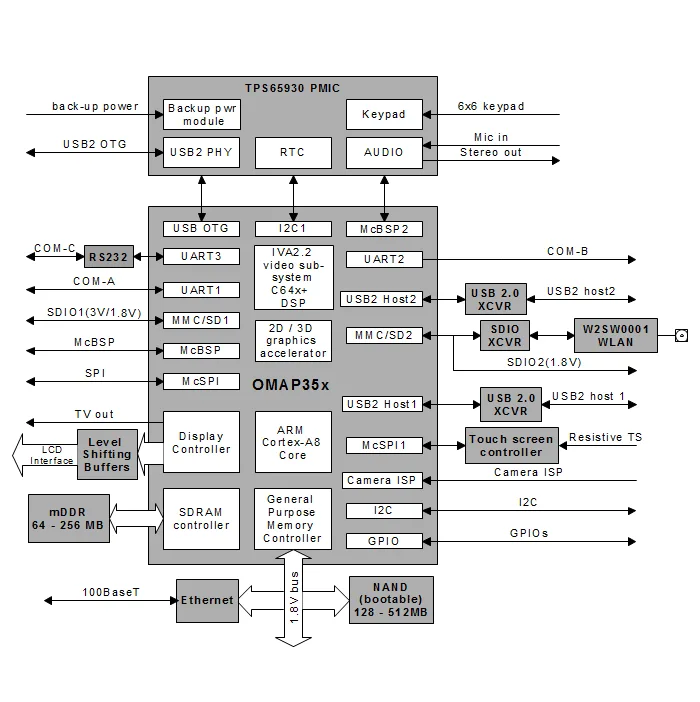
The CompuLab CM-T3530 is a computer-on-module (SoM / CoM) built around an ARM Cortex-A8 OMAP3530 processor up to 720 MHz, designed for battery-powered embedded systems.
Temperature range — Commercial; Extended; Industrial — -; TE; TI-; 24; 100
RTC — Real Time Clock, powered by external lithium battery+
Overview. The CompuLab CM-T3530 is a compact computer-on-module (CoM / SoM) measuring 66 x 44 x 7 mm, designed as a building block for embedded applications. It includes all components required to run operating systems such as Linux and Windows CE.
Main characteristics. ARM Cortex-A8 processor, OMAP3503 at 600 MHz or OMAP3530 at 720 MHz, with mobile DDR DRAM of 64, 128 or 256 MB and NAND flash of 128 or 512 MB, bootable. The module combines a Cortex-A8 core with a TMS320C64x+ DSP for video processing and a PowerVR SGX GPU for 2D / 3D graphics acceleration with OpenGL-ES and OpenVG support.
Interfaces and connectivity. 10/100BaseT Ethernet (SMSC LAN9220), USB, WiFi 802.11b/g interface (discontinued according to the data), 16-bit external local bus, up to 74 GPIO lines, serial ports, MMC / SD / SDIO interfaces (SDHC up to 32 GB), TSC2046 touchscreen controller for 4-wire resistive panels and I2S audio codec with differential microphone input. The real-time clock (RTC) is powered by an external lithium battery.
Power and environment. Supply of 3.8 V or lithium-ion polymer battery, active consumption of 0.2 to 2 W depending on configuration and CPU speed, standby consumption of 20 to 100 mW. Operating temperature: commercial 0 to 70 °C, extended -20 to 70 °C, industrial -40 to 85 °C. Shock resistance 50 G / 20 ms, vibration 20 G / 0 - 600 Hz. Weight 16 g.
Integration. The 2 x 140 pin CAMI connectors at 0.6 mm pitch allow interchange with other CompuLab modules. An SB-T35 carrier board turns the module into a single board computer.
Ethernet — SMSC LAN9220 MAC & PHY, 10/100BaseT, Activity LED's
E
External local bus — 16-bit, variable rate up to 133 MHz, 1.8V levels
+
General Purpose I/O — Up to 74 lines shared with other functions. Can also be used as interrupt inputs
+
Keyboard & mouse — USB, keypad or redirection from COM port
+
MMC / SD — MMC / SD / SDIO support including SDHC up to 32GB
+
MTTF
> 200,000 hours
NAND Flash Disk* — 128 - 512 Mbytes, bootable
N
NAND flash size — 128 MB; 512 MB — N128; N512
-; 12
Operation temperature (case)
Commercial: 0° to 70° C; Extended: -20° to 70° C; Industrial: -40° to 85° C. Click for availability note
QTY
Factor
RAM — 64 - 256 MB, Mobile DDR, 166 MHz, 32-bit
D
Relative humidity
10% to 90% (operation); 05% to 95% (storag
RTC — Real Time Clock, powered by external lithium battery
+
Shock
50G / 20 ms
Standby/Sleep consumption
20 - 100 mW, depending on configuration and mode
Storage Temperature
-40° to 85° C
Temperature range — Commercial; Extended; Industrial — -; TE; TI
-; 24; 100
Tiny Size
66 x 44 x 7 mm
Touchscreen ctrl. — TSC2046 touchscreen controller. Support 4-wire resistive panels
I
Touchscreen — No; Yes — -; I
-; 2.4
USB — No; Yes — -; U
-; 3.6
Vibration
20G / 0 - 600 Hz
Weight
16 gram
WiFi (discontinued) — No; Yes — -; W
-; 22.8
No specification matches.
Last verification : 2026-11-04
Technical documentation
Official documents and the technical data recorded for CM-T3530. For a missing document or a specific revision, our experts send it to you.
1. Technical overview
The CompuLab CM-T3530 is a computer-on-module (SoM / CoM) built around an ARM Cortex-A8 OMAP3530 processor up to 720 MHz, designed for battery-powered embedded systems.
Temperature range — Commercial; Extended; Industrial — -; TE; TI-; 24; 100
RTC — Real Time Clock, powered by external lithium battery+
Ethernet — SMSC LAN9220 MAC & PHY, 10/100BaseT, Activity LED's
E
External local bus — 16-bit, variable rate up to 133 MHz, 1.8V levels
+
General Purpose I/O — Up to 74 lines shared with other functions. Can also be used as interrupt inputs
+
Keyboard & mouse — USB, keypad or redirection from COM port
+
MMC / SD — MMC / SD / SDIO support including SDHC up to 32GB
+
MTTF
> 200,000 hours
NAND Flash Disk* — 128 - 512 Mbytes, bootable
N
NAND flash size — 128 MB; 512 MB — N128; N512
-; 12
Operation temperature (case)
Commercial: 0° to 70° C; Extended: -20° to 70° C; Industrial: -40° to 85° C. Click for availability note
QTY
Factor
RAM — 64 - 256 MB, Mobile DDR, 166 MHz, 32-bit
D
Relative humidity
10% to 90% (operation); 05% to 95% (storag
RTC — Real Time Clock, powered by external lithium battery
+
Shock
50G / 20 ms
Standby/Sleep consumption
20 - 100 mW, depending on configuration and mode
Storage Temperature
-40° to 85° C
Temperature range — Commercial; Extended; Industrial — -; TE; TI
-; 24; 100
Tiny Size
66 x 44 x 7 mm
Touchscreen ctrl. — TSC2046 touchscreen controller. Support 4-wire resistive panels
I
Touchscreen — No; Yes — -; I
-; 2.4
USB — No; Yes — -; U
-; 3.6
Vibration
20G / 0 - 600 Hz
Weight
16 gram
WiFi (discontinued) — No; Yes — -; W
-; 22.8
Integration
Points to check before using CM-T3530 in a design. They are derived from the recorded characteristics, not from the manufacturer's application circuits.
1Powerplan for a supply compatible with Single 3.8V or Lithium-ion polymer battery.
Power and communication
Supply voltage
Single 3.8V or Lithium-ion polymer battery
Active power consumption
0.2 - 2 W, depending on configuration and CPU speed
RTC — Real Time Clock, powered by external lithium battery
+
Standby/Sleep consumption
20 - 100 mW, depending on configuration and mode
Check the exact pin assignment and the application circuit in the datasheet, or ask our experts.
Implementation checklist
Power : plan for a supply compatible with Single 3.8V or Lithium-ion polymer battery.
Technical FAQ
Answers to the questions that the recorded characteristics of CM-T3530 can answer. A question is not asked when nothing is recorded to answer it.
1Does it support CAN bus?
Yes — recorded under "General Purpose I/O — Up to 74 lines shared with other functions. Can also be used as interrupt inputs": +.
2Does it include Wi-Fi?
Yes — recorded under "WiFi (discontinued) — No; Yes — -; W": -; 22.8.
3Does it have an Ethernet port?
Yes — recorded under "Ethernet — No; Yes — -; E": -; 7.2.
4Does it have a USB interface?
Yes — recorded under "Keyboard & mouse — USB, keypad or redirection from COM port": +.
5What input voltage does it require?
Single 3.8V or Lithium-ion polymer battery (source: Supply voltage).
Similar parts to answer your needs. Compare the main characteristics. A recorded replacement is a documented relation; a similar product is a similarity only, never a compatibility claim.
Current productCompuLab
CM-T3530
Low-power ARM OMAP3530 720 MHz computer module
Temperature range — Commercial; Extended; Industrial — -; TE; TI
-; 24; 100
RTC — Real Time Clock, powered by external lithium battery
What is recorded about the regulatory status and the life of this part.
Regulatory compliance
No compliance statement is recorded for this part. Ask the supplier for the RoHS and REACH declarations and, for a radio product, the EU declaration of conformity.
No advertising or analytics cookies. A single, strictly necessary cookie is set only if you sign in to your account. Your quote basket and comparison stay in your browser. Details