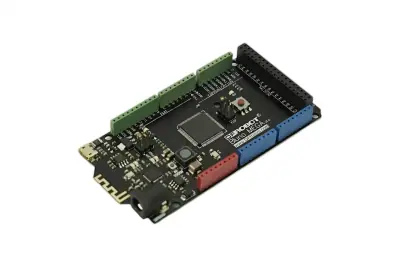
DFRobot development board for 2WD and 4WD robots, integrating an ESP32-S3 microcontroller and an OV3660 camera for first-person view and AI recognition tasks.
Operating Temperature0 to 60℃
Type-C Input Voltage5V
VIN Input Voltage7-24V
VM Input Voltage5-24V
Maximum Output Current of 5V Power Supply2A
Bluetooth Frequency125 Kbps, 500 Kbps, 1 Mbps, 2 Mbps
Product overview
Overview. The DFRobot Romeo ESP32-S3 is a development board designed for robotics projects. It integrates the ESP32-S3 microcontroller and an onboard OV3660 camera, and supports 2WD and 4WD robots.
Main characteristics. The ESP32-S3-WROOM-1U-N16R8 module provides 16 MB of Flash and 8 MB of PSRAM, with 512 KB of SRAM and 384 KB of ROM. The Xtensa® dual-core 32-bit LX7 processor runs at a main frequency of 240 MHz. The OV3660 camera offers 3-megapixel resolution, up to 2048*1536.
Interfaces and connectivity. The board supports 2.4 GHz WiFi under IEEE 802.11b/g/n, in Station, SoftAP and SoftAP+Station combined modes, as well as Bluetooth 5 and Bluetooth mesh. It provides a USB 2.0 OTG full-speed port and a Type-C interface.
Power and environment. The VIN input accepts 7 to 24 V, the VM input 5 to 24 V and the Type-C input 5 V. The 5 V power supply output delivers up to 2 A. The operating voltage is 3.3 V and the operating temperature range is 0 to 60 ℃. Dimensions are 25.4 x 60 mm.
Motor drive. The motor drive channels support a capacity of 2.5 A.
Typical uses. The board supports wireless remote control and video transmission for a first-person view, as well as AI recognition tasks after training. The reserved interfaces allow connecting a microphone, an amplifier or a gas sensor.
No published question about this part yet. Questions are reviewed before publication.
Complete specifications
Every characteristic recorded for DFR0994, with where it comes from. Use the filters to find one quickly.
All specifications (25)
Characteristic
Value
Analog bandwidth
Support 20 MHz and 40 MHz at 2.4 GHz band
Bluetooth Frequency
125 Kbps, 500 Kbps, 1 Mbps, 2 Mbps
Bluetooth protocol
Bluetooth 5, Bluetooth mesh
Dimension
25.4x60mm/2.95x3.54"
DMA Controller
transmit channel x5, receive channel x5
Flash
16MB
Frame Aggregation
TX/RX A-MPDU, TX/RX A-MSDU
IR Transceiver
transmit channel x5, receive channel x5
Main Frequency
240 MHz
Maximum Output Current of 5V Power Supply
2A
Motor Drive Capacity
2.5A
Operating Temperature
0 to 60℃
Operating Voltage
3.3V
Processor
Xtensa® dual-core 32-bit LX7 microprocessor
PSRAM
8MB
ROM
384KB
RTC SRAM
16KB
SRAM
512KB
Type-C Input Voltage
5V
USB
USB 2.0 OTG full-speed
VIN Input Voltage
7-24V
VM Input Voltage
5-24V
WiFi Frequency
2.4GHz
WiFi Mode
Station, SoftAP, SoftAP+Station combined mode
WiFi Protocol
IEEE 802.11b/g/n
No specification matches.
Last verification : 2026-11-02
Technical documentation
Official documents and the technical data recorded for DFR0994. For a missing document or a specific revision, our experts send it to you.
1. Technical overview
DFRobot development board for 2WD and 4WD robots, integrating an ESP32-S3 microcontroller and an OV3660 camera for first-person view and AI recognition tasks.
Operating Temperature0 to 60℃
Type-C Input Voltage5V
VIN Input Voltage7-24V
VM Input Voltage5-24V
Maximum Output Current of 5V Power Supply2A
2. Datasheet extract (recorded values)
Parameter
Value
Analog bandwidth
Support 20 MHz and 40 MHz at 2.4 GHz band
Bluetooth Frequency
125 Kbps, 500 Kbps, 1 Mbps, 2 Mbps
Bluetooth protocol
Bluetooth 5, Bluetooth mesh
Dimension
25.4x60mm/2.95x3.54"
DMA Controller
transmit channel x5, receive channel x5
Flash
16MB
Frame Aggregation
TX/RX A-MPDU, TX/RX A-MSDU
IR Transceiver
transmit channel x5, receive channel x5
Main Frequency
240 MHz
Maximum Output Current of 5V Power Supply
2A
Motor Drive Capacity
2.5A
Operating Temperature
0 to 60℃
Operating Voltage
3.3V
Processor
Xtensa® dual-core 32-bit LX7 microprocessor
PSRAM
8MB
ROM
384KB
RTC SRAM
16KB
SRAM
512KB
Type-C Input Voltage
5V
USB
USB 2.0 OTG full-speed
VIN Input Voltage
7-24V
VM Input Voltage
5-24V
WiFi Frequency
2.4GHz
WiFi Mode
Station, SoftAP, SoftAP+Station combined mode
WiFi Protocol
IEEE 802.11b/g/n
Integration
Points to check before using DFR0994 in a design. They are derived from the recorded characteristics, not from the manufacturer's application circuits.
1Thermalrated operating range 0 to 60℃ — check it against the installation environment.
Power and communication
Maximum Output Current of 5V Power Supply
2A
Operating Voltage
3.3V
Type-C Input Voltage
5V
VIN Input Voltage
7-24V
VM Input Voltage
5-24V
Check the exact pin assignment and the application circuit in the datasheet, or ask our experts.
Implementation checklist
Thermal : rated operating range 0 to 60℃ — check it against the installation environment.
Applications and use cases
Architectures in which DFR0994 can play a role, derived from its category. This is not a compatibility statement: check the specifications against your requirements.
RAKwireless WisGate gateways run WisGateOS 2 and are managed from WisDM, RAKwireless’ cloud device management platform with a built-in network server, alongside RAK sensor nodes, radio modules and concentrators
To check
WisDM built-in network server, or a third-party one (ChirpStack, TTN/TTS, AWS IoT Core, Actility)
Remote configuration and updates of the gateways from WisDM
Regional frequency plan of the gateways and nodes
Associated system blocks
GatewaysSensors and modulesDevelopment boardsMounting
Seeed SenseCAP sensors connect to Seeed’s SenseCAP cloud platform and app, and Seeed edge computers, camera modules, Grove and XIAO boards complete the chain for custom devices and local processing
To check
SenseCAP cloud platform and app, or the customer’s own network server
Prototype on Grove and XIAO, then move to industrial versions
Local processing on the edge computers or in the cloud
Associated system blocks
SensorsEdge computingDevelopment boards
Need a complete solution?
Send a request for DFR0994 and the other parts of your project.
Similar parts to answer your needs. Compare the main characteristics. A recorded replacement is a documented relation; a similar product is a similarity only, never a compatibility claim.
Current productDFRobot
DFR0994
ESP32-S3 robot development board with OV3660 camera
What is recorded about the regulatory status and the life of this part.
Regulatory compliance
No compliance statement is recorded for this part. Ask the supplier for the RoHS and REACH declarations and, for a radio product, the EU declaration of conformity.
No advertising or analytics cookies. A single, strictly necessary cookie is set only if you sign in to your account. Your quote basket and comparison stay in your browser. Details