
SEN0430
ToF distance ranging sensor 20 to 2500 mm, I2C
- Operating Temperature
- -30~60℃
- Distance Sensing Range
- 100-2500mm
- Proximity Detection Range
- 20-100mm
- Communication interface
- Breakout 2.54mm-8Pin I2C
ToF distance ranging sensor 20 to 2500 mm, I2C
Educational STEM Coding & Sensor Starter Packs
DFRobot TMF8801 time-of-flight distance ranging module with I2C interface, covering 20 to 2500 mm. Used for proximity and distance detection in embedded systems and robotics.
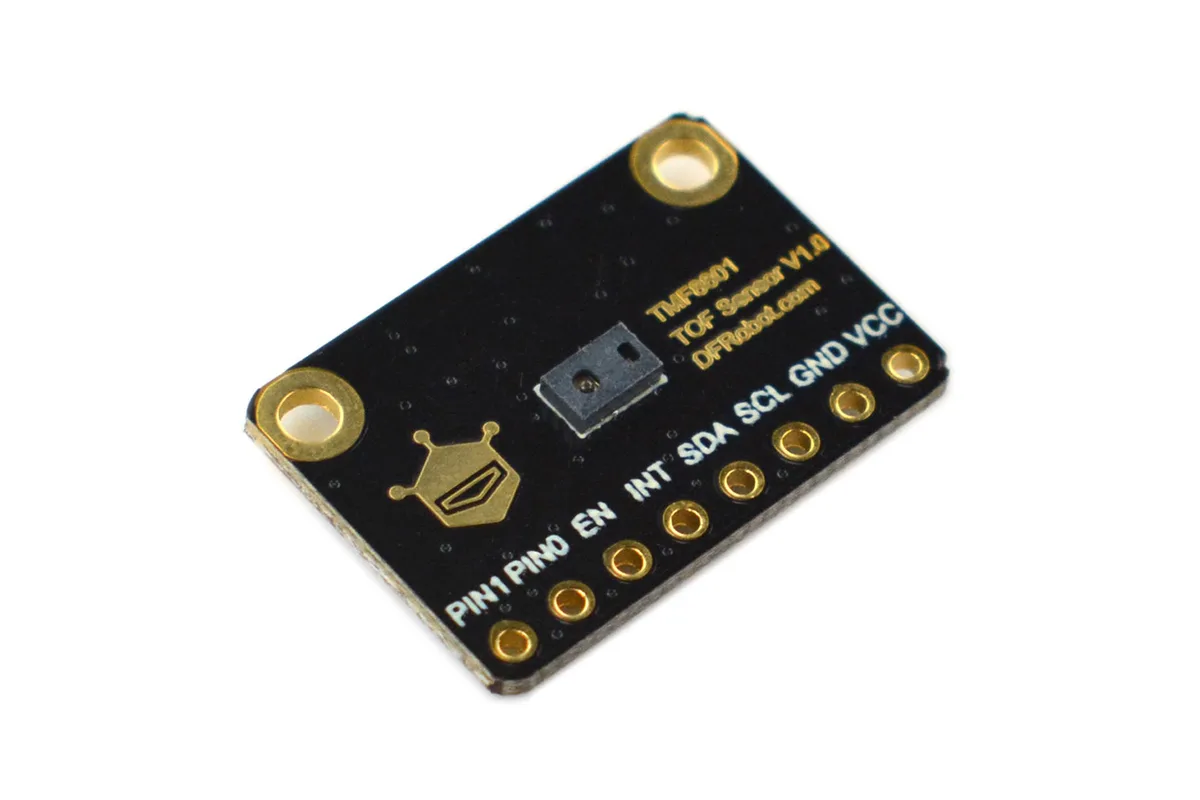
Overview. The DFRobot Fermion TMF8801 (reference SEN0430) is a time-of-flight distance ranging sensor breakout that measures the travel time of emitted and reflected light pulses to determine the distance of an object at the centre of its sensing field, with a 21° field of illumination.
Main characteristics. The sensor covers a proximity detection range of 20 to 100 mm and a distance sensing range of 100 to 2500 mm. Its operating current is below 1.5 mA and its operating temperature range is -30 to 60 ℃. The module measures 21 × 14.5 mm, with 2.0 mm mounting holes spaced 17 mm apart.
Interfaces and connectivity. The module is a 2.54 mm 8-pin breakout and communicates over I2C.
Power and environment. The operating voltage is 2.7 to 3.3 V. The sensor is rated for operation between -30 and 60 ℃.
Typical uses. The module suits obstacle detection, proximity detection and distance measurement in robotics and embedded devices.
Integration. The sensor works with development platforms such as Arduino and robotics controllers through its I2C bus. Available on quotation from Atlas Electronics.
No published question about this part yet. Questions are reviewed before publication.
Every characteristic recorded for SEN0430, with where it comes from. Use the filters to find one quickly.
| Characteristic | Value |
|---|---|
| Communication interface | Breakout 2.54mm-8Pin I2C |
| Dimension | 21*14.5mm/0.83*0.57" |
| Distance Sensing Range | 100-2500mm |
| Fermion | TMF8801 ToF Distance Ranging Sensor (20-2500mm) (Breakout, I2C) |
| Mounting Hole Pitch | 17mm |
| Mounting Hole Size | 2.0mm |
| Operating Current | <1.5mA |
| Operating Temperature | -30~60℃ |
| Operating Voltage | 2.7~3.3V |
| Proximity Detection Range | 20-100mm |
No specification matches.
Last verification : 2026-11-02
Official documents and the technical data recorded for SEN0430. For a missing document or a specific revision, our experts send it to you.
DFRobot TMF8801 time-of-flight distance ranging module with I2C interface, covering 20 to 2500 mm. Used for proximity and distance detection in embedded systems and robotics.
| Parameter | Value |
|---|---|
| Communication interface | Breakout 2.54mm-8Pin I2C |
| Dimension | 21*14.5mm/0.83*0.57" |
| Distance Sensing Range | 100-2500mm |
| Fermion | TMF8801 ToF Distance Ranging Sensor (20-2500mm) (Breakout, I2C) |
| Mounting Hole Pitch | 17mm |
| Mounting Hole Size | 2.0mm |
| Operating Current | <1.5mA |
| Operating Temperature | -30~60℃ |
| Operating Voltage | 2.7~3.3V |
| Proximity Detection Range | 20-100mm |
Points to check before using SEN0430 in a design. They are derived from the recorded characteristics, not from the manufacturer's application circuits.
| Operating Current | <1.5mA |
| Operating Voltage | 2.7~3.3V |
Check the exact pin assignment and the application circuit in the datasheet, or ask our experts.
Answers to the questions that the recorded characteristics of SEN0430 can answer. A question is not asked when nothing is recorded to answer it.
Yes — recorded under "Communication interface": Breakout 2.54mm-8Pin I2C.
-30~60℃ (source: Operating Temperature).
Similar parts to answer your needs. Compare the main characteristics. A recorded replacement is a documented relation; a similar product is a similarity only, never a compatibility claim.
ToF distance ranging sensor 20 to 2500 mm, I2C
5pcs 1.5V-6V Type Miniature DC Motors

Multicolored Dupont Wire Kit for Arduino® (120pcs)

USB3.0 HUB Extender Compatible with Ros Robot/Car Raspberry Pi Jetson Series Boards

Describe your application and constraints in a request.
What is recorded about the regulatory status and the life of this part.
No compliance statement is recorded for this part. Ask the supplier for the RoHS and REACH declarations and, for a radio product, the EU declaration of conformity.
| Current status | Status not stated |
| Key dates | Not recorded |
| Manufacturer part number | SEN0430 |
| Manufacturer | DFRobot |
Educational STEM Coding & Sensor Starter Packs
5 V Power Booster and Charger Module for Single-Cell Lithium Battery · Ref. : DFR0446
Price on request
Educational STEM Coding & Sensor Starter Packs
30 kg·cm magnetic encoder bus servo 360° · Ref. : 21100250
Price on request
Educational STEM Coding & Sensor Starter Packs
ROS2 Omnidirectional Mecanum Wheel Mobile Robot · Ref. : 3000200901
Price on request
Educational STEM Coding & Sensor Starter Packs
ESP32 robot chassis expansion shield
Price on request
No advertising or analytics cookies. A single, strictly necessary cookie is set only if you sign in to your account. Your quote basket and comparison stay in your browser. Details


