ES32C14_12V
ESP32 expansion board with 4 relays and analogue I/O
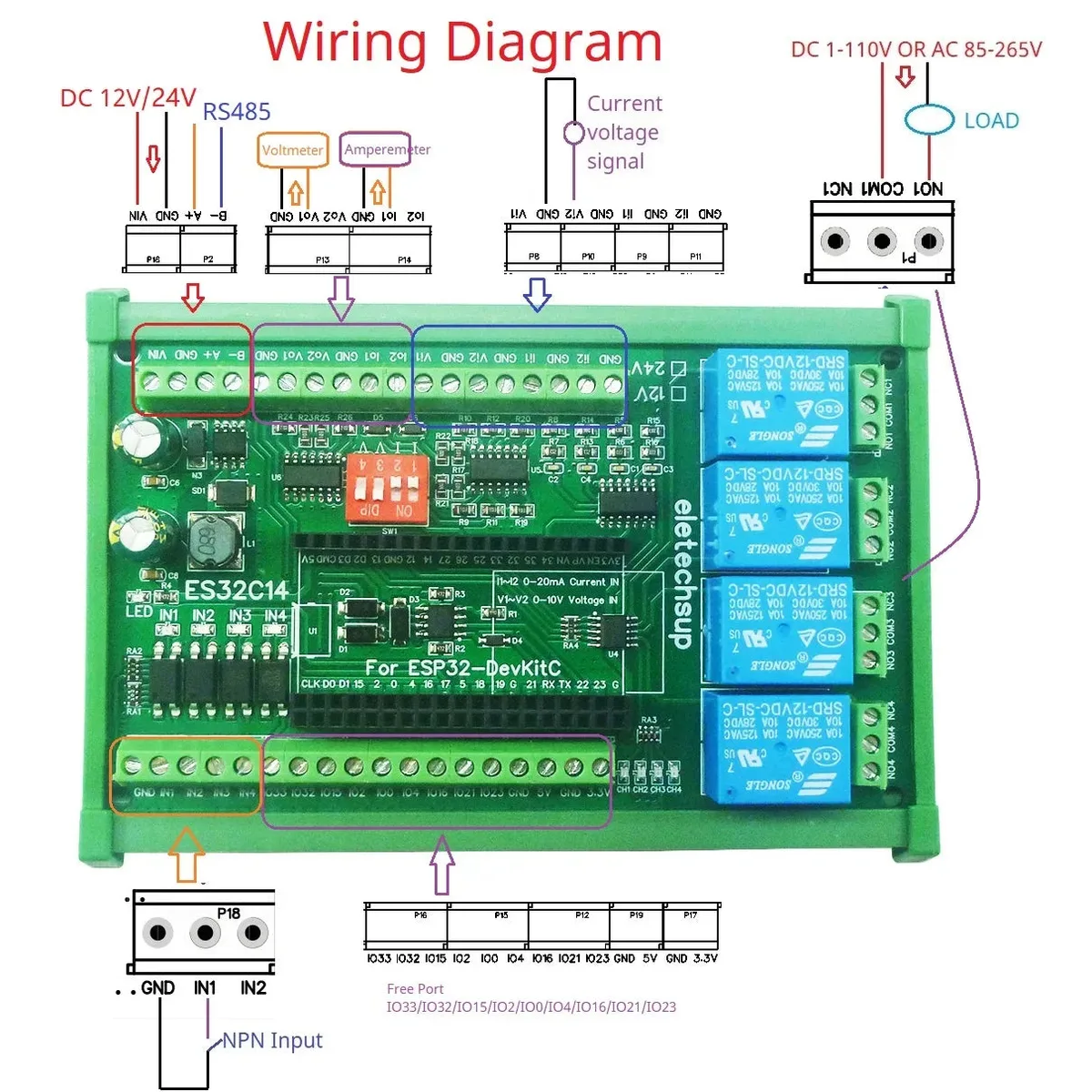
Limited record: this part has neither specifications nor a datasheet in the catalog yet. It is shown for reference and is not indexed.
ESP32 expansion board with 4 relays and analogue I/O
Eletechsup ES32C14 expansion board for 38-pin ESP32, with 4 relay outputs, analogue inputs and outputs and an RS485 interface, for automation, home automation and IoT projects.
Eletechsup ES32C14 is a relay expansion board for 38-pin ESP32 modules, designed for automation and IoT projects. Its 4 relay outputs and opto-isolated inputs allow switching and monitoring of loads, while its analogue inputs and outputs handle measurement and control of process signals.
Main characteristics. Expansion board with 1 ESP32 slot, 4 relay outputs, 4 opto-isolated NPN inputs with low-level trigger, 2 current inputs 0/4-20 mA, 2 current outputs 0/4-20 mA, 2 voltage inputs 0-5 V/10 V and 2 voltage outputs 0-5 V/10 V (or 2 current outputs 0/4-20 mA). Dimensions 121 × 72 × 19 mm, 94 g board only and 185 g with shell.
Interfaces and connectivity. One RS485 interface allows master or slave operation on a serial bus, for example with a PLC. Wireless connectivity is provided by the ESP32 module fitted to the board.
Power and consumption. Operating voltage DC 12 V or DC 24 V. Standby current 14 mA with the digital tube off and 51 mA with it on. Consumption of 76 mA with 1 relay open, 107 mA with 2 relays, 133 mA with 3 relays and 166 mA with 4 relays.
Typical uses. Wi-Fi remote control switching, current and voltage acquisition, motor forward and reverse control, timing functions (timing on, timing off, power-up delay, trigger delay, cyclic delays), power sequencer.
Integration. The board cannot work independently: it must be used with a 38-pin ESP32 board, to be purchased separately or as a kit. The manufacturer provides only test codes for the hardware; further functions must be developed by the user.
No published question about this part yet. Questions are reviewed before publication.
Official documents and the technical data recorded for ES32C14_12V. For a missing document or a specific revision, our experts send it to you.
Eletechsup ES32C14 expansion board for 38-pin ESP32, with 4 relay outputs, analogue inputs and outputs and an RS485 interface, for automation, home automation and IoT projects.
Similar parts to answer your needs. Compare the main characteristics. A recorded replacement is a documented relation; a similar product is a similarity only, never a compatibility claim.
ESP32 expansion board with 4 relays and analogue I/O
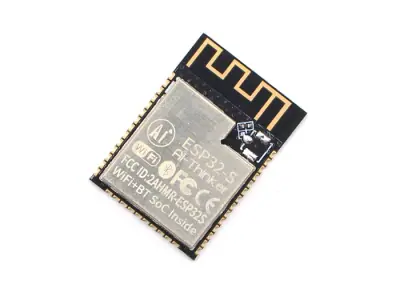
WiFi Espressif ESP32
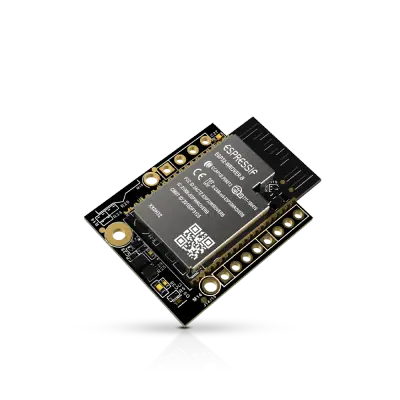
WiFi and BLE Espressif ESP32-WROVER — RAK11200 WiFi and BLE Espressf ESP32-WROVER with Arduino Open Source
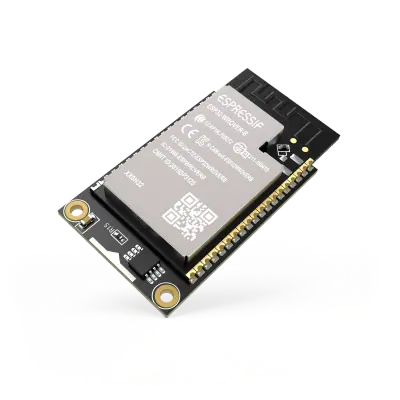
WiFi and BLE Espressif ESP32-WROVER — RAK11200 WiFi and BLE Espressf ESP32-WROVER with Voice Processing
Describe your application and constraints in a request.
What is recorded about the regulatory status and the life of this part.
No compliance statement is recorded for this part. Ask the supplier for the RoHS and REACH declarations and, for a radio product, the EU declaration of conformity.
| Current status | Status not stated |
| Key dates | Not recorded |
| Manufacturer part number | ES32C14_12V |
| Manufacturer | Eletechsup |
Wi-Fi and Bluetooth Modules
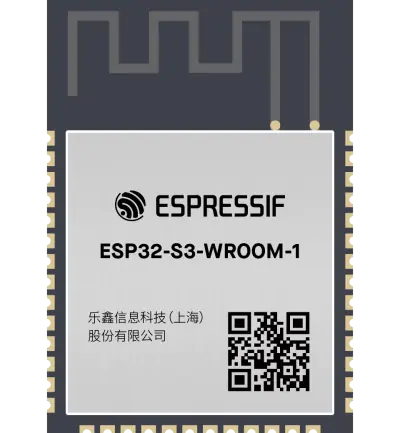
Wi-Fi and Bluetooth LE module with PCB antenna · Ref. : ESP32-S3-WROOM-1-N4R2
Price on request
Wi-Fi and Bluetooth Modules
M.2 2230 Wi-Fi 6 and Bluetooth 5.3 Card · Ref. : AP12275-M2
Price on request
Wi-Fi and Bluetooth Modules
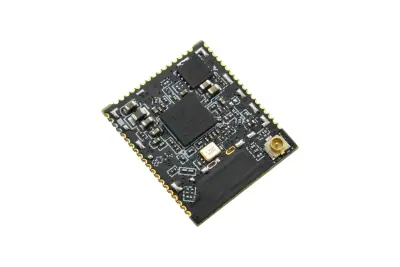
802.11b/g/n Wi-Fi and Bluetooth SoC Module · Ref. : MCC32SESP
Price on request
Wi-Fi and Bluetooth Modules
Wi-Fi and NFC module with ARM Cortex-M3 microcontroller · Ref. : DFR0477
Price on request
With your consent, we use Google cookies to measure the site’s audience and our advertising. Your quote basket and comparison stay in your browser either way. Details