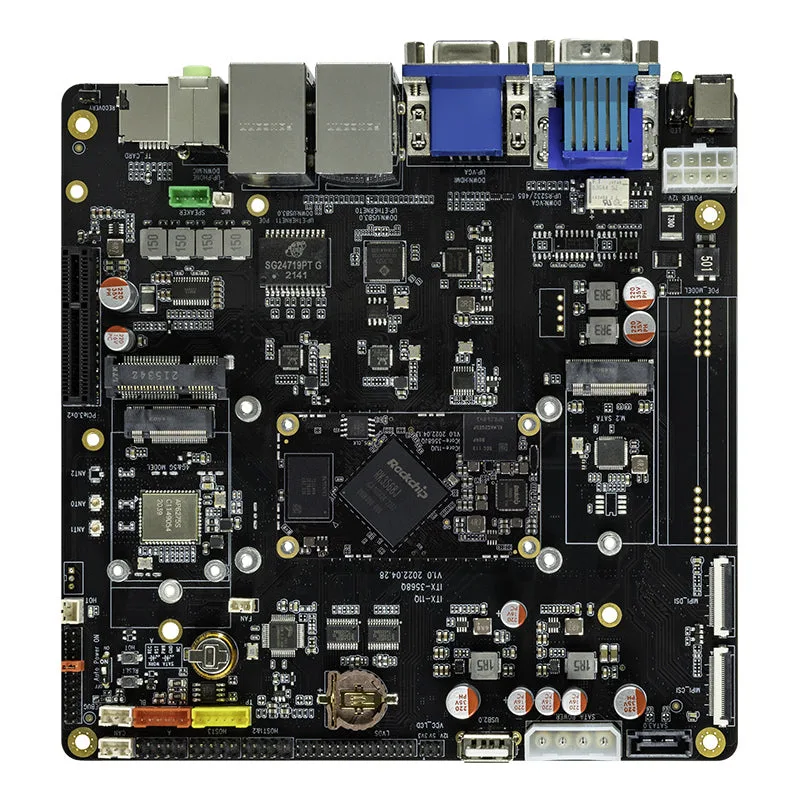
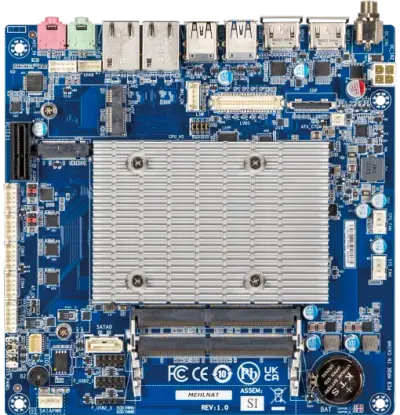
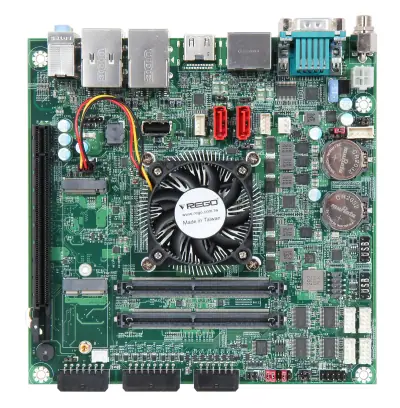
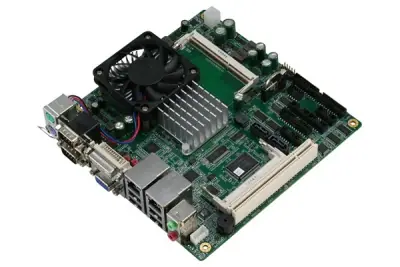
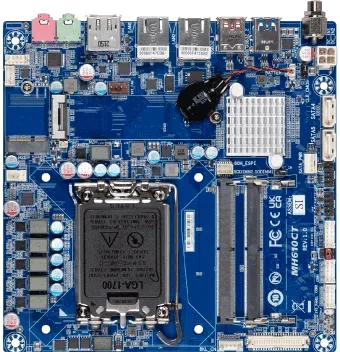
Overview. The Firefly ITX-3568Q is an industrial Mini-ITX motherboard in 17 cm × 17 cm format, compatible with a standard ITX case. It is built on the Rockchip RK3568B2 SoC and supports Android 11.0, Ubuntu 18.04 and 20.04, and RTLinux.
Main characteristics. The processor is paired with LPDDR4 memory (1 GB, 2 GB, 4 GB or 8 GB optional) and eMMC storage (8 GB to 128 GB), plus a 16 MB SPI Flash. The ARM G52 2EE GPU supports OpenGL ES 1.1/2.0/3.2, OpenCL 2.0 and Vulkan 1.1. An 8M ISP with HDR support and an integrated RKNN NPU delivering 1.0 TOPS at INT8 (commercial version) or 512 MAC (industrial and automotive versions) complete the board. The NPU allows one-click switching between Caffe, TensorFlow, TFLite, ONNX, PyTorch, Keras and Darknet. Video capabilities include H.264 encoding at 4K@60 fps or 1080P@60 fps, 8-channel multi-format decoding at 1080P@30 fps, and VP9 encoding.
Interfaces and connectivity. Two Gigabit Ethernet RJ45 ports (1000 Mbps) provide network connectivity, one of them PoE-capable up to 60 W. The board integrates dual-band 2.4 GHz/5 GHz Wi-Fi 6 (802.11a/b/g/n/ac/ax), Bluetooth 5.0 and can be expanded to 5G/4G LTE. Serial and field interfaces include RS485, RS232, I2C, CAN, UART, ADC, GPIO, Debug, FAN and MIC. For storage and expansion, the board offers one SATA 3.0 port, one M.2 SATA 3.0 slot expandable to 2242, one PCIe 3.0 (2 lanes), four USB 3.0 ports and four USB 2.0 ports.
Display and audio. Three video outputs can run simultaneously: HDMI 2.0 (4K@60 Hz), MIPI DSI (1920 × 1080@60 fps), LVDS and two VGA outputs (1080P). A MIPI CSI camera input is configurable as a single 4-lane channel or two 2-lane channels. Audio includes an HDMI audio output, a 3.5 mm jack with microphone input and a 10 W Class D speaker output into 8 Ω.
Power and integration. The board accepts 12 V DC input (5.5 × 2.1 mm connector, 12 V/1.5 A or higher recommended), a 12 V input through a standard ATX connector, or PoE 48 V up to 60 W. It weighs approximately 400 g, peripherals not included. Its RS485, CAN and GPIO interfaces support integration into control and monitoring equipment.