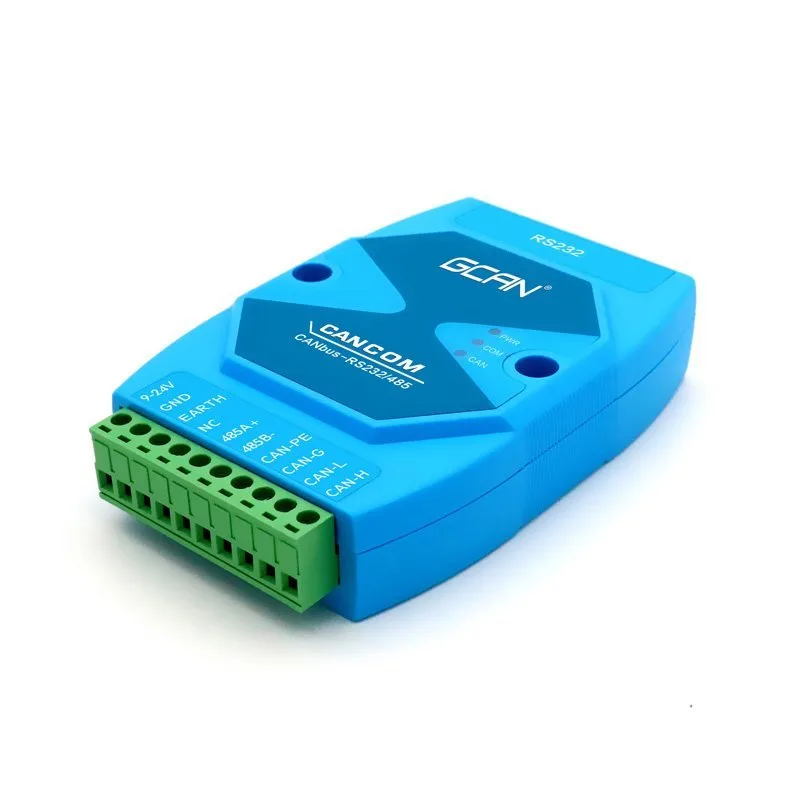
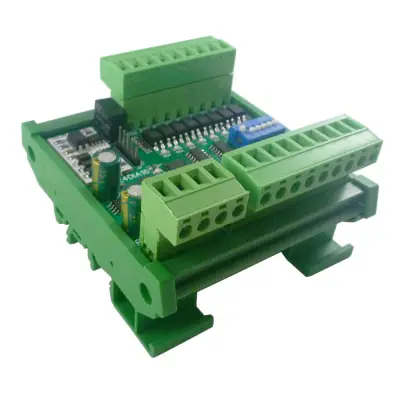
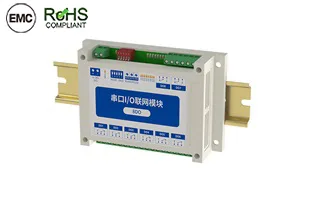
The GCAN-207 is a bidirectional converter between RS232 or RS485 serial buses and a CAN bus, used to connect serial devices to a CAN network or to link a PLC or HMI to a CAN network.
Operating Temperature-40°C~85°C
Current20mA, 24V DC
Maximum Frame Rate400 fps unidirectional
CAN baud rate5kbit/s to 1Mbit/s
CAN connectorOpen terminal block
Humidity15 to 95% non-condensing
Product overview
Overview. The GCAN-207 RS232/RS485 to CAN converter from GCAN provides bidirectional communication between an RS232 or RS485 bus and a CAN bus. It allows serial devices to be connected to a CAN network, or a host PLC or HMI to be connected to a CAN bus network. Each interface has an integrated isolation module and the unit mounts on a DIN rail.
Main characteristics. The product supports CAN 2.0A and CAN 2.0B conforming to ISO11898-2, with a CAN baud rate from 5 kbit/s to 1 Mbit/s and a serial baud rate from 600 bps to 115200 bps. The maximum frame rate is 400 fps unidirectional. Three conversion modes are available: transparent conversion, transparent conversion with identify, and format conversion, in which the data are defined in 13 bytes.
Interfaces and connectivity. The serial interface is either RS232 via a DB9 connector or RS485 via an open terminal block. The CAN bus connects via an open terminal block. Electrical isolation is DC 1500 V.
Power and environment. The power supply ranges from 9 to 30 V DC, with a current of 20 mA at 24 V DC. The operating temperature range is -40 °C to 85 °C, and the permissible humidity is 15 to 95% non-condensing. Dimensions are 112 x 70 x 25 mm for a weight of approximately 100 g.
Typical uses. The GCAN-207 suits converting the communication of a sensor fitted with an RS485 interface to a CAN bus, collecting CAN bus data for a PLC that has no CAN interface, and rebuilding the communication bus of a public bicycle system.
Integration. The product can be configured for transparent frame transfer or for adding an address identifier to the CAN frame ID, the position and length of this identifier being configurable.
No published question about this part yet. Questions are reviewed before publication.
Complete specifications
Every characteristic recorded for GCAN-207, with where it comes from. Use the filters to find one quickly.
All specifications (15)
Characteristic
Value
CAN baud rate
5kbit/s to 1Mbit/s
CAN connector
Open terminal block
CAN — interface
CAN 2.0A, CAN 2.0B, conform to ISO11898-2
Current
20mA, 24V DC
Data conversion mode
transparent conversion, transparent conversion with identify, format conversion
Humidity
15 to 95% non-condensing
Installation
DIN rail
Isolation
DC 1500V electrical isolation
Maximum Frame Rate
400 fps unidirectional
Operating Temperature
-40°C~85°C
Power supply
9~30V DC
Serial baud rate
600bps~115200bps
Serial Interface
RS232 via DB9 or RS485 via Open terminal block
Size(LxWxH)
112 x 70 x 25 mm
Weight
approx.100g
No specification matches.
Last verification : 2026-11-03
Technical documentation
Official documents and the technical data recorded for GCAN-207. For a missing document or a specific revision, our experts send it to you.
1. Technical overview
The GCAN-207 is a bidirectional converter between RS232 or RS485 serial buses and a CAN bus, used to connect serial devices to a CAN network or to link a PLC or HMI to a CAN network.
Operating Temperature-40°C~85°C
Current20mA, 24V DC
Maximum Frame Rate400 fps unidirectional
CAN baud rate5kbit/s to 1Mbit/s
CAN connectorOpen terminal block
2. Datasheet extract (recorded values)
Parameter
Value
CAN baud rate
5kbit/s to 1Mbit/s
CAN connector
Open terminal block
CAN — interface
CAN 2.0A, CAN 2.0B, conform to ISO11898-2
Current
20mA, 24V DC
Data conversion mode
transparent conversion, transparent conversion with identify, format conversion
Humidity
15 to 95% non-condensing
Installation
DIN rail
Isolation
DC 1500V electrical isolation
Maximum Frame Rate
400 fps unidirectional
Operating Temperature
-40°C~85°C
Power supply
9~30V DC
Serial baud rate
600bps~115200bps
Serial Interface
RS232 via DB9 or RS485 via Open terminal block
Size(LxWxH)
112 x 70 x 25 mm
Weight
approx.100g
Integration
Points to check before using GCAN-207 in a design. They are derived from the recorded characteristics, not from the manufacturer's application circuits.
1Thermalrated operating range -40°C~85°C — check it against the installation environment.
Power and communication
Current
20mA, 24V DC
Power supply
9~30V DC
Check the exact pin assignment and the application circuit in the datasheet, or ask our experts.
Implementation checklist
Thermal : rated operating range -40°C~85°C — check it against the installation environment.
Applications and use cases
Architectures in which GCAN-207 can play a role, derived from its category. This is not a compatibility statement: check the specifications against your requirements.
Every intervention on a remote machine means a trip on site. A 4G or 5G router with VPN gives the maintenance team secure access to the PLC and the operator panel from the office
To check
VPN type and how access rights are granted and removed
Mobile coverage at the machine site
Separation between the machine network and the customer network
A proprietary PLC locks the project into one vendor’s tools. Industrial controllers built on the Raspberry Pi Compute Module run Linux, Node-RED, Python or CODESYS on DIN rail, with I/O modules, an operator panel and a cellular router for remote access
Similar parts to answer your needs. Compare the main characteristics. A recorded replacement is a documented relation; a similar product is a similarity only, never a compatibility claim.
What is recorded about the regulatory status and the life of this part.
Regulatory compliance
No compliance statement is recorded for this part. Ask the supplier for the RoHS and REACH declarations and, for a radio product, the EU declaration of conformity.
No advertising or analytics cookies. A single, strictly necessary cookie is set only if you sign in to your account. Your quote basket and comparison stay in your browser. Details