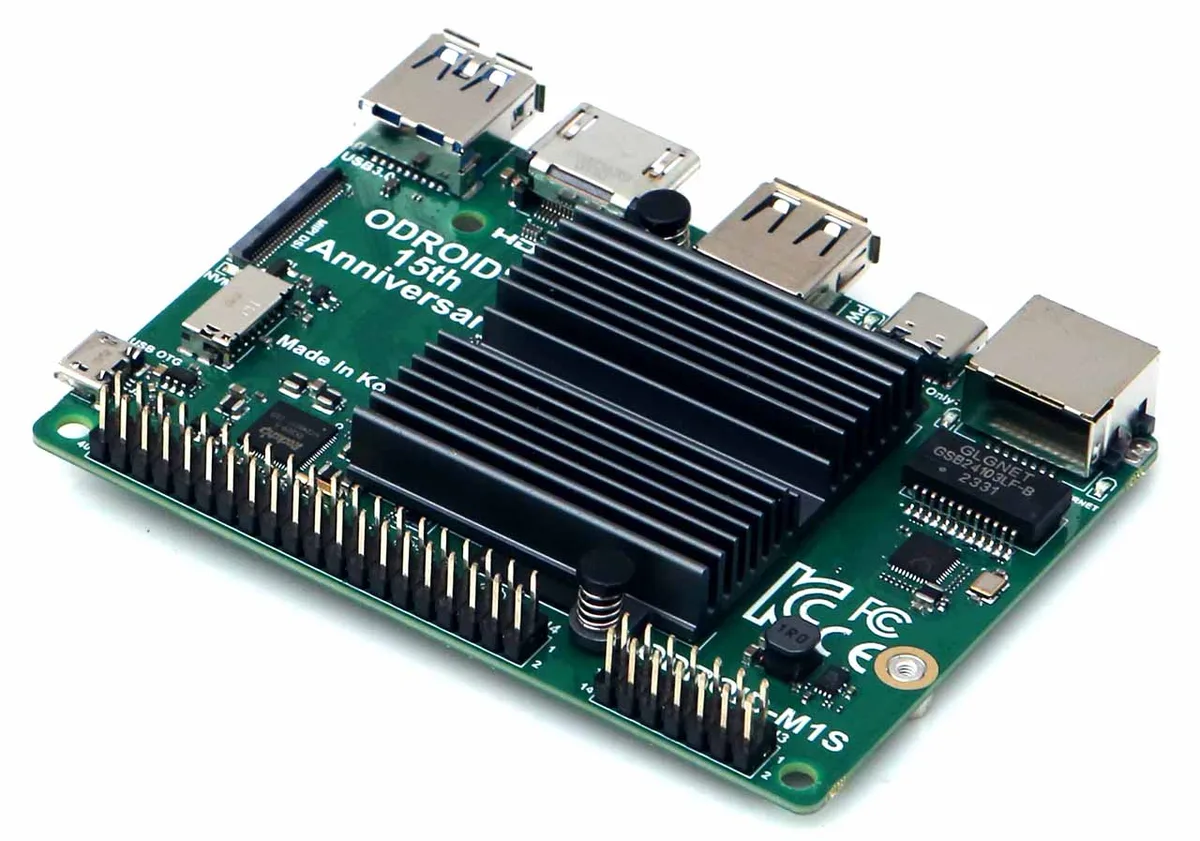
Hardkernel ODROID-M1S. ARM single-board computer built around a Rockchip RK3566 quad-core Cortex-A55 processor clocked at 1.8 GHz, with 4 GB of LPDDR4 memory, 64 GB of on-board eMMC and a 40-pin GPIO connector.
Main characteristics. Rockchip RK3566 processor with Mali-G52 GPU at 800 MHz, 32-bit LPDDR4 memory with a data rate of 2112 MT/s, and an integrated 0.8 TOPS@INT8 RKNN NPU supporting Caffe, TensorFlow, TFLite, ONNX, PyTorch, Keras and Darknet. The board measures 90 mm x 65 mm x 16 mm and weighs 52 g including the heatsink.
Interfaces and connectivity. One GbE RJ45 LAN port (10/100/1000 Mbps) with Realtek RTL8211F transceiver, one USB 3.0 host port, one USB 2.0 host port, one USB 2.0 micro OTG port, one debug serial console (UART), a 14-pin GPIO header, an HDMI 2.0 output up to 4K@60Hz with HDR, a 30-pin MIPI DSI interface, a micro SD slot supporting UHS-I SDR104 and an NVMe M.2 slot (PCIe 2.1 x 1 lane).
Power and environment. Power supplied through a USB Type C connector, a 5V/3A adapter being recommended, DC input from 4.9 V to 5.3 V, consumption of about 1.1 W at idle and about 3.52 W under CPU stress, and an RTC backup battery connector to keep date and time.
Typical uses. Edge AI inference embedded systems, gateways and connected controllers thanks to its GbE, USB and GPIO ports, and display output via HDMI or MIPI DSI. The board comes with a base software package (bootloader, kernel, partition table, build documentation and USB-UART debugging).
Integration. The manufacturer notes that ODROID-M1 OS images cannot be used as-is because the bootloader and kernel settings differ, but that porting is quick. M.2 SATA devices are not supported; only PCIe (M-Key) NVMe modules are.