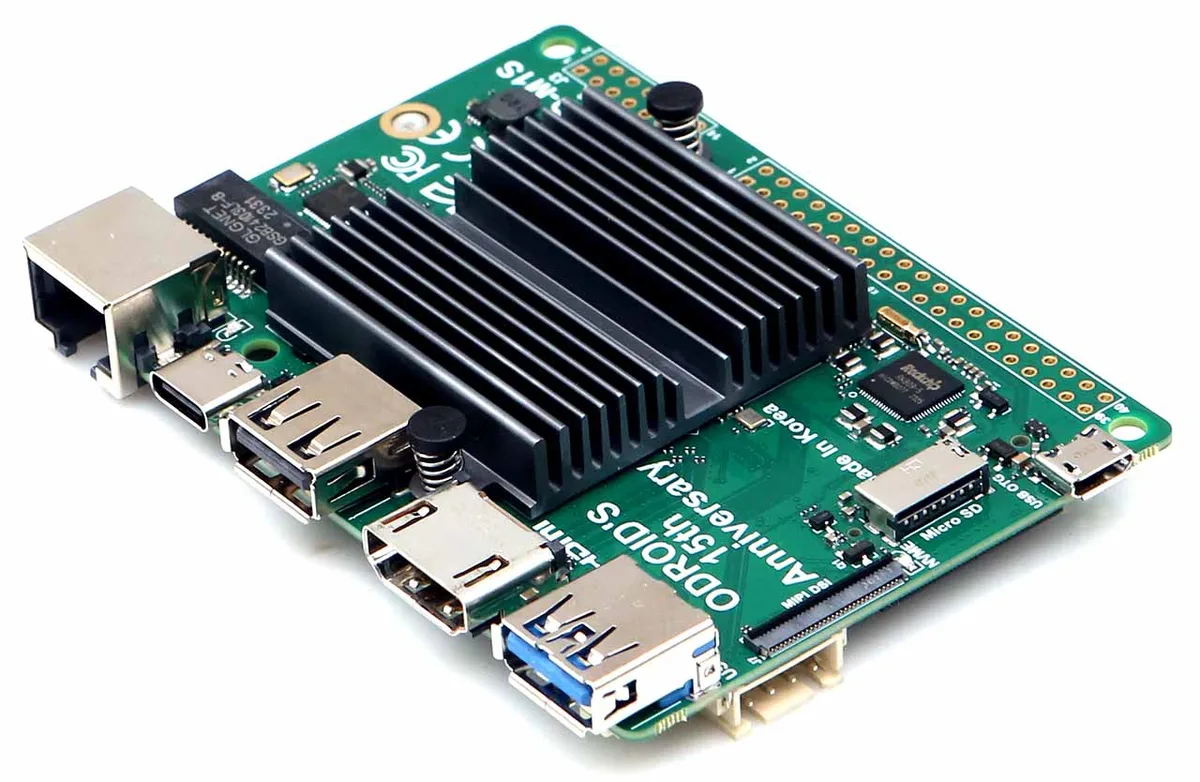
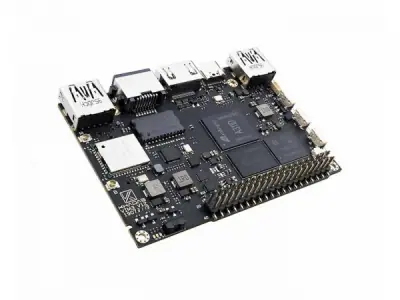
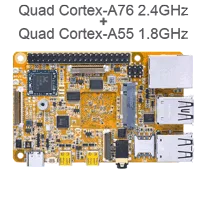
Overview. The Hardkernel ODROID-M1S (model ODROID-M1S, with 4GB of RAM) is an ARM single board computer built around the Rockchip RK3566 processor. It is the slimmer successor to the ODROID-M1 and shares its software family.
Main characteristics. The processor is a quad-core Cortex-A55 clocked at 1.8GHz, with ARMv8-A architecture, Neon and Crypto extensions, and a Mali-G52 GPU at 800MHz. Memory is LPDDR4 4 or 8GiB with 32-bit bus width at 2112 MT/s. The board measures 90mm x 65mm x 16mm and weighs 52g including heatsink. An integrated RKNN NPU offers 0.8 TOPS@INT8 and supports Caffe, TensorFlow, TFLite, ONNX, PyTorch, Keras and Darknet.
Storage. A 64GB eMMC is soldered to the board, complemented by a microSD slot (UHS-I SDR104) and an M.2 NVMe slot (PCIe 2.1 x 1 lane, 2280 form factor).
Interfaces and connectivity. One GbE RJ45 LAN port (10/100/1000 Mbps) with Realtek RTL8211F transceiver, one USB 3.0 host port, one USB 2.0 host port, one USB 2.0 micro OTG port, a debug serial console (UART), a 40-pin GPIO and a 14-pin GPIO. Video output is HDMI 2.0 (up to 4K@60Hz with HDR) and a MIPI DSI interface on a 30-pin connector.
Power and environment. Power is supplied through USB Type C with a DC input of 4.9V to 5.3V; a USB Type C 5V/3A adapter is recommended. Consumption is about 1.1W idle and about 3.52W under CPU stress. An RTC backup battery connector keeps time and date for several months without main power.
Typical uses. The GPIO and UART allow the board to serve as a controller for embedded systems, an acquisition interface or an edge AI inference gateway, within the functions described in the data.
Integration. A Board-Support-Package provides the boot-loader, kernel, partition table, build instructions and USB-UART console debugging.