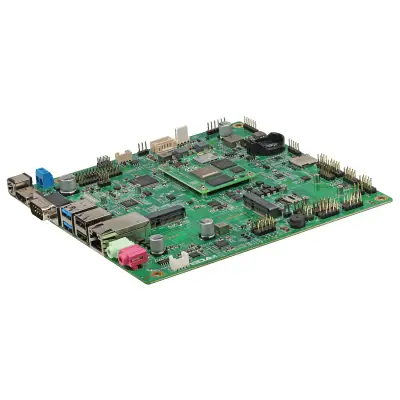
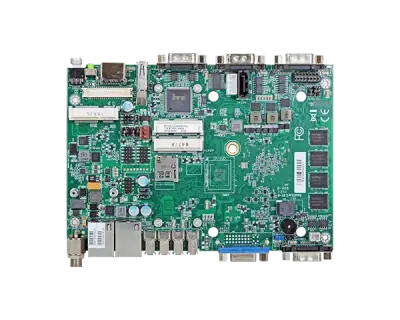
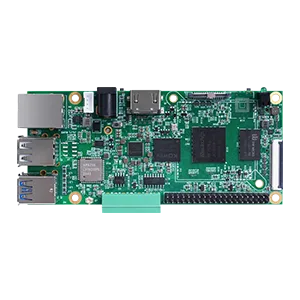
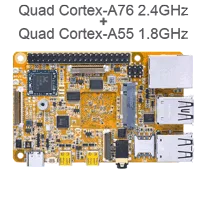
Hardkernel ODROID-M1S ARM single board computer with Rockchip RK3566 quad-core processor, 8 GB LPDDR4 and 64 GB on-board eMMC, designed for embedded systems.
Product overview
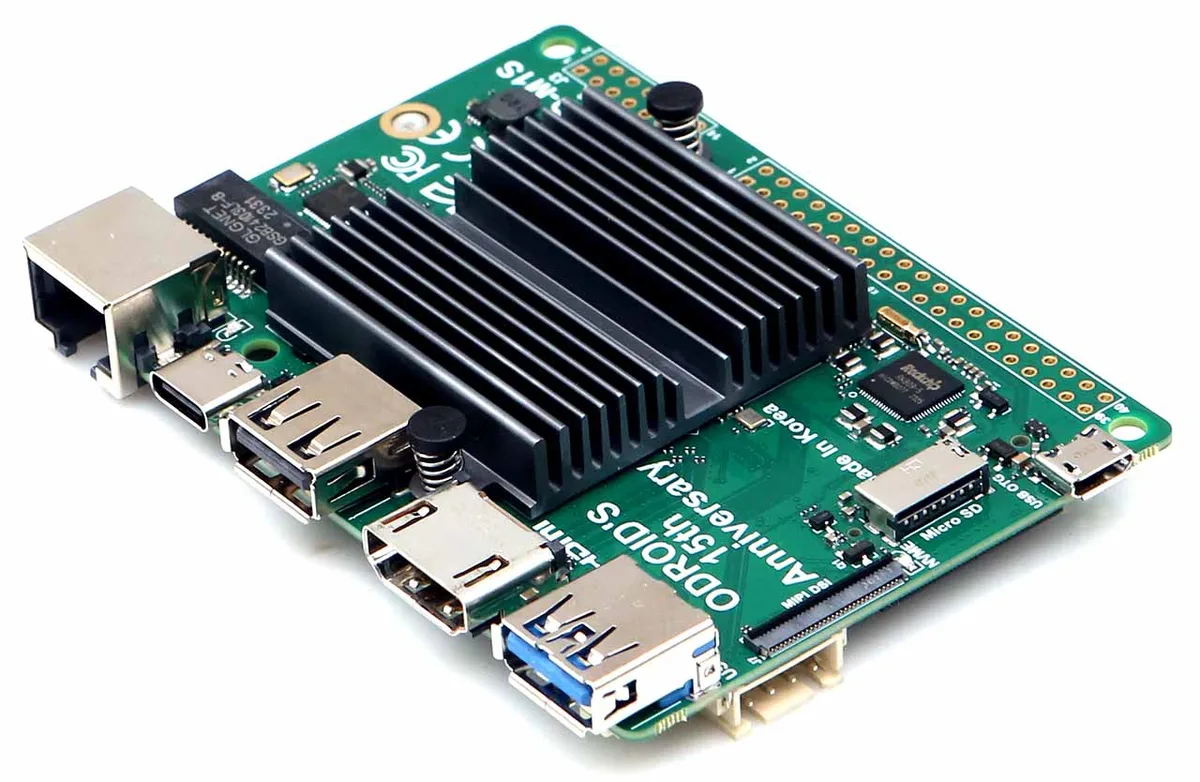
Overview. The Hardkernel ODROID-M1S, model ODROID-M1S, is an ARM single board computer built around the Rockchip RK3566 quad-core Cortex-A55 processor clocked at 1.8 GHz, with 8 GB of LPDDR4 memory on a 32-bit bus and a 64 GB eMMC chip soldered to the board.
Main characteristics. Dimensions of 90 mm x 65 mm x 16 mm, weight of 52 g including the heatsink. The Mali-G52 GPU has two execution engines clocked at 800 MHz. The integrated RKNN NPU provides 0.8 TOPS at INT8 and supports one-click switching between Caffe, TensorFlow, TFLite, ONNX, PyTorch, Keras and Darknet.
Interfaces and connectivity. One GbE RJ45 LAN port (10/100/1000 Mbps) based on the Realtek RTL8211F Ethernet transceiver, one USB 3.0 host port, one USB 2.0 host port, one USB 2.0 micro OTG port, one debug serial console (UART), one 40-pin GPIO header and one 14-pin GPIO header. An M.2 NVMe slot (PCIe 2.1 x 1 lane) and a micro SD slot (UHS-I SDR104) complete the storage options. Video output includes one HDMI 2.0 interface up to 4K@60Hz with HDR and one MIPI DSI interface with a 30-pin connector.
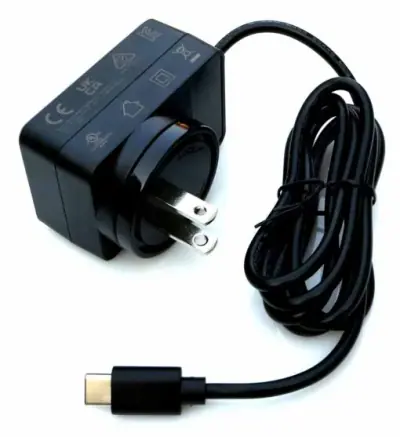
Power and environment. Powered through a USB Type C connector, DC input of 4.9 V to 5.3 V, a USB Type C 5 V/3 A adapter is recommended. Consumption of about 1.1 W at idle and about 3.52 W under CPU stress. An RTC backup battery connector keeps time and date for several months without main power. LED indicators show power status and kernel execution.
Typical uses. Development of standalone embedded systems requiring local AI inference, embedded storage and GPIO interfaces for controlling equipment.
Integration. Supplied with a board support package (BSP) including bootloader, kernel, partition table and build instructions, with USB-UART console debugging.
No published question about this part yet. Questions are reviewed before publication.
Complete specifications
Every characteristic recorded for G231031113442, with where it comes from. Use the filters to find one quickly.
All specifications (13)
Characteristic
Value
Form factor
Board Dimensions: 90mm x 65mm x 16mm; Weight: 52g including heatsink
Conf=0.25 — CPU (ms) — NPU (ms)
NPU: Cam (fps)
External I/O
1 x USB 2.0 host port; 1 x USB 3.0 host port; 1 x USB 2.0 micro OTG port; 1 x Debug serial console (UART); 1 x 40 pin GPIO and 1 x 14 pin GPIO
M1S — 1288.3 — 70
11.8
Memory
LPDDR4 4 or 8GiB with 32-bit bus width, Data rate: 2112 MT/s, up to 1,055MHz
Networking
1 x GbE LAN ports (RJ45, supports 10/100/1000 Mbps); – Realtek RTL8211F Ethernet transceiver; – LED indicators; * Green LED: Flashing by data traffics at 100Mbps connection; * Amber LED: Flashing by data traffics at 1000Mbps connection
NPU
0.8 TOPS@INT8, Integrated AI accelerator RKNN NPU; Supports one-click switching of Caffe/TensorFlow/TFLite/ONNX/PyTorch/Keras/Darknet
Other features
RTC backup battery connector (to keep time and date for several months without main power input); System LED Indicators:; – Red (POWER) – Solid light when DC power is connected; – Blue (ALIVE) – Flashing like heartbeat while Kernel is running. Solid On in the u-boot stage.
Power
1 x USB Type C for Power only; DC input : 4.9V ~ 5.3V; – USB Type C 5V/3A power adapter is recommended; – IDLE : ≃ 1.1W; – CPU Stress : ≃ 3.52W (Performance governor); – Power Off : ≃ 0W
Processor
Rockchip RK3566 Processor; L1 instruction cache: 32 KB, 4-way set associative (128 sets), 64 byte lines, shared by 1 processor; L1 data cache: 32 KB, 4-way set associative (128 sets), 64 byte lines, shared by 1 processor; L3 data cache: 512KB, 16-way set associative (512 sets), 64 byte lines, shared by 4 processorsQuad-Core Cortex-A55 (1.8GHz); ARMv8-A architecture with Neon and Crypto extensions; Mali-G52 GPU with 2 x Execution Engines (800Mhz)
Software Board-Support-Package
Boot-loader, Kernel, Partition table, How-to-build, Boot-sequence, USB-UART console debugging and so on
Storage
1 x 64GB eMMC embedded (soldered to the PCB); 1 x Micro SD slot (UHS-I SDR104, Boot priority is always higher than eMMC); 1 x NVME M.2 SSD (PCIe 2.1 x 1 lane)
Video
1 x HDMI 2.0 (up to 4K@60Hz with HDR, EDID); 1 x MIPI DSI Interface (30pin connector which is different from 31pin of the original ODROID-M1)
No specification matches.
Last verification : 2026-11-02
Technical documentation
Official documents and the technical data recorded for G231031113442. For a missing document or a specific revision, our experts send it to you.
1. Technical overview
Hardkernel ODROID-M1S ARM single board computer with Rockchip RK3566 quad-core processor, 8 GB LPDDR4 and 64 GB on-board eMMC, designed for embedded systems.
Conf=0.25 — CPU (ms) — NPU (ms)NPU: Cam (fps)
M1S — 1288.3 — 7011.8
2. Datasheet extract (recorded values)
Parameter
Value
Form factor
Board Dimensions: 90mm x 65mm x 16mm; Weight: 52g including heatsink
Conf=0.25 — CPU (ms) — NPU (ms)
NPU: Cam (fps)
External I/O
1 x USB 2.0 host port; 1 x USB 3.0 host port; 1 x USB 2.0 micro OTG port; 1 x Debug serial console (UART); 1 x 40 pin GPIO and 1 x 14 pin GPIO
M1S — 1288.3 — 70
11.8
Memory
LPDDR4 4 or 8GiB with 32-bit bus width, Data rate: 2112 MT/s, up to 1,055MHz
Networking
1 x GbE LAN ports (RJ45, supports 10/100/1000 Mbps); – Realtek RTL8211F Ethernet transceiver; – LED indicators; * Green LED: Flashing by data traffics at 100Mbps connection; * Amber LED: Flashing by data traffics at 1000Mbps connection
NPU
0.8 TOPS@INT8, Integrated AI accelerator RKNN NPU; Supports one-click switching of Caffe/TensorFlow/TFLite/ONNX/PyTorch/Keras/Darknet
Other features
RTC backup battery connector (to keep time and date for several months without main power input); System LED Indicators:; – Red (POWER) – Solid light when DC power is connected; – Blue (ALIVE) – Flashing like heartbeat while Kernel is running. Solid On in the u-boot stage.
Power
1 x USB Type C for Power only; DC input : 4.9V ~ 5.3V; – USB Type C 5V/3A power adapter is recommended; – IDLE : ≃ 1.1W; – CPU Stress : ≃ 3.52W (Performance governor); – Power Off : ≃ 0W
Processor
Rockchip RK3566 Processor; L1 instruction cache: 32 KB, 4-way set associative (128 sets), 64 byte lines, shared by 1 processor; L1 data cache: 32 KB, 4-way set associative (128 sets), 64 byte lines, shared by 1 processor; L3 data cache: 512KB, 16-way set associative (512 sets), 64 byte lines, shared by 4 processorsQuad-Core Cortex-A55 (1.8GHz); ARMv8-A architecture with Neon and Crypto extensions; Mali-G52 GPU with 2 x Execution Engines (800Mhz)
Software Board-Support-Package
Boot-loader, Kernel, Partition table, How-to-build, Boot-sequence, USB-UART console debugging and so on
Storage
1 x 64GB eMMC embedded (soldered to the PCB); 1 x Micro SD slot (UHS-I SDR104, Boot priority is always higher than eMMC); 1 x NVME M.2 SSD (PCIe 2.1 x 1 lane)
Video
1 x HDMI 2.0 (up to 4K@60Hz with HDR, EDID); 1 x MIPI DSI Interface (30pin connector which is different from 31pin of the original ODROID-M1)
Applications and use cases
Architectures in which G231031113442 can play a role, derived from its category. This is not a compatibility statement: check the specifications against your requirements.
Charge-point controllers combine a metering and safety controller with a network link (Ethernet, Wi-Fi or cellular) toward a charge-point management system
To check
Outdoor temperature range and ingress protection
Metering accuracy requirements set by local regulation
Not every vision task justifies an industrial vision system. A Raspberry Pi with a camera module and an expansion board runs simple detection and counting models at low cost, close to the scene
To check
Frame rate and model size the board can run
Lighting and lens for the scene
Enclosure and cooling for the installation
Associated system blocks
ComputeCameras
Need a complete solution?
Send a request for G231031113442 and the other parts of your project.
Answers to the questions that the recorded characteristics of G231031113442 can answer. A question is not asked when nothing is recorded to answer it.
1Does it have an Ethernet port?
Yes — recorded under "Networking": 1 x GbE LAN ports (RJ45, supports 10/100/1000 Mbps); – Realtek RTL8211F Ethernet transceiver; – LED indicators; * Green LED: Flashing by data traffics at 100Mbps connection; * Amber LED: Flashing by data traffics at 1000Mbps connection.
2Does it have a USB interface?
Yes — recorded under "External I/O": 1 x USB 2.0 host port; 1 x USB 3.0 host port; 1 x USB 2.0 micro OTG port; 1 x Debug serial console (UART); 1 x 40 pin GPIO and 1 x 14 pin GPIO.
Similar parts to answer your needs. Compare the main characteristics. A recorded replacement is a documented relation; a similar product is a similarity only, never a compatibility claim.
Current productHardkernel
G231031113442
ARM single board computer with RK3566 and 8 GB LPDDR4, 0.8 TOPS NPU
What is recorded about the regulatory status and the life of this part.
Regulatory compliance
No compliance statement is recorded for this part. Ask the supplier for the RoHS and REACH declarations and, for a radio product, the EU declaration of conformity.
No advertising or analytics cookies. A single, strictly necessary cookie is set only if you sign in to your account. Your quote basket and comparison stay in your browser. Details