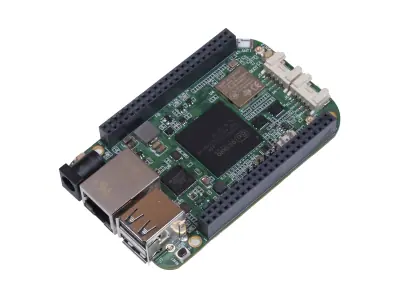
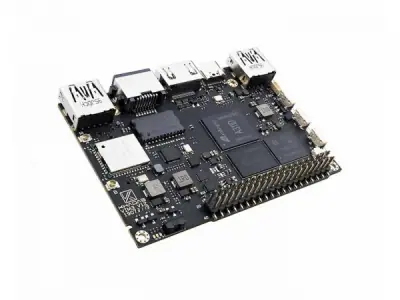
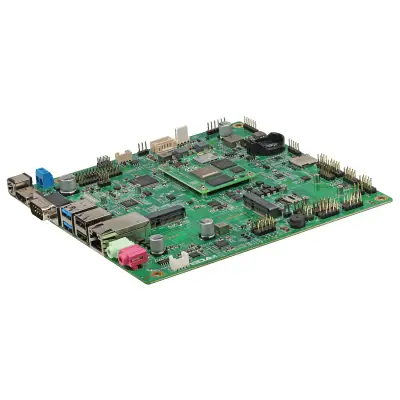
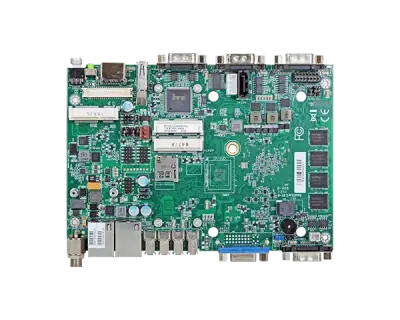
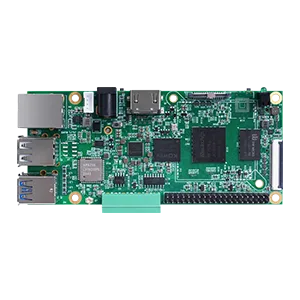
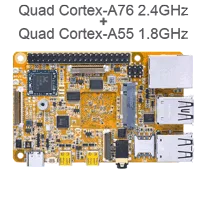
Overview. The Hardkernel ODROID-M1S is an ARM single board computer built around the Rockchip RK3566 processor, designed for building embedded systems. It provides 4 GB of LPDDR4 memory and 64 GB of eMMC storage soldered to the board.
Processor and memory. The RK3566 integrates four Cortex-A55 cores at 1.8 GHz, an ARMv8-A architecture with Neon and Crypto extensions, and a Mali-G52 GPU with 2 execution engines (800 MHz). The 4 or 8 GiB LPDDR4 memory runs on a 32-bit bus at 2112 MT/s. An integrated RKNN NPU AI accelerator delivers 0.8 TOPS@INT8 and supports Caffe, TensorFlow, TFLite, ONNX, PyTorch, Keras and Darknet.
Storage. The board includes a soldered 64 GB eMMC, a microSD slot (UHS-I SDR104) whose boot priority is always higher than the eMMC, and an M.2 NVMe slot (PCIe 2.1 x 1 lane) for a 2280 form factor SSD.
Interfaces and connectivity. One GbE LAN port (RJ45, 10/100/1000 Mbps, Realtek RTL8211F transceiver), one USB 2.0 host port, one USB 3.0 host port, one USB 2.0 micro OTG port, a debug serial console (UART), a 40-pin GPIO header and a 14-pin GPIO header. Video is provided by an HDMI 2.0 output (up to 4K@60Hz with HDR, EDID) and a MIPI DSI interface (30-pin connector).
Power and environment. Power is supplied through a USB Type-C port (DC input 4.9 V to 5.3 V; USB Type-C 5 V/3 A adapter recommended). Consumption is about 1.1 W idle and about 3.52 W under CPU stress (performance governor). An RTC backup battery connector keeps time and date for several months without main power. Dimensions 90 mm x 65 mm x 16 mm, weight 52 g including heatsink.
Typical uses. The GPIO header and UART console make the board suitable for embedded development and prototyping, and the NPU supports edge AI inference applications.
Integration. Hardkernel provides a software board-support package including bootloader, kernel, partition table, build instructions, boot sequence and USB-UART console debugging.