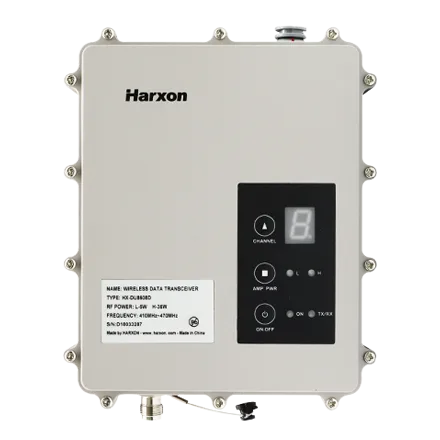
UHF wireless data radio modem with 35 W transmit power, designed for half-duplex data links between stations.
Operating Temperature-30℃ to +65℃
Frequency Stability≤ ±1.0ppm
Storage Temperature-40°C to +85°C
Dimensions186×140×73mm
Channel Spacing25KHz/12.5KHz
ConnectorTNC female
Product overview
Harxon HX-DU8608D. This Harxon UHF radio modem is a wireless data link operating from 410 MHz to 470 MHz in half-duplex mode.
Main characteristics. Transmit power selectable across five levels from 5 W to 35 W, channel spacing of 12.5 kHz or 25 kHz, GMSK modulation, air baud rate of 9600 bps or 19200 bps and serial port baud rate from 9600 to 115200 bps.
Interfaces and connectivity. TNC female antenna connector and LEMO 5-pin data connector, with repeater function on the same frequency or on different frequencies.
Power and environment. 12 V operating voltage, typical power dissipation up to 110 W at full power and 1.5 W in standby, operating temperature from -30 °C to +65 °C and storage temperature from -40 °C to +85 °C.
Radio performance. Sensitivity of -114 dBm at BER 10-3 at 9600 bps, adjacent channel selectivity above 50 dB at 25 kHz, frequency stability within ±1.0 ppm.
Typical uses. Transmission of RTK corrections between a base and a rover in geomatics, topographic surveys and site positioning.
Integration. Dimensions of 186 × 140 × 73 mm, weight approximately 1.5 kg, available on quotation from Atlas Electronics.
No published question about this part yet. Questions are reviewed before publication.
Complete specifications
Every characteristic recorded for DU8608D, with where it comes from. Use the filters to find one quickly.
All specifications (16)
Characteristic
Value
Dimensions
186×140×73mm
Channel Spacing
25KHz/12.5KHz
Connector
TNC female
Data Connector
LEMO 5pin
Frequencies(selectable)
410MHz~470MHz
Frequency Stability
≤ ±1.0ppm
Modem
Air Baud Rate:; 9600bps / 19200bps; Modulation type: GMSK; Serial Port Baud:; 9600 bps/ 19200 bps/ 38400 bps/ 57600 bps/ 115200 bps
Modulation Type
GMSK
Operating Mode
Half-duplex
Operating Temperature
-30℃ to +65℃
Operating Voltage
12V
Power Dissipation (Typical)
High power level(35W): ≤ 110W @ DC 12V; High power level(30W): ≤ 100W @ DC 12V; High power level(20W): ≤ 75W @ DC 12V; Low power level (15W): ≤ 60W @ DC 12V; Low power level (10W): ≤ 45W @ DC 12V; Low power level (5W): ≤ 25W @ DC 12V; Standby: ≤ 1.5W @ DC 12V
RF output power:; High level(35W): 45.5±0.5dBm@D C12V; High level(30W): 44.8±0.5dBm@D C12V; High level(20W): 43±1dBm@DC12 V; Low level(15W): 41.8±1dBm@DC 12V; Low level(10W): 40±1dBm@DC12 V; Low level(5W): 37.5±1dBm@DC 12V; Power stability: ±1dB; Harmonics: >50dB
Weight
Approx. 1.5kg
No specification matches.
Last verification : 2026-11-02
Technical documentation
Official documents and the technical data recorded for DU8608D. For a missing document or a specific revision, our experts send it to you.
1. Technical overview
UHF wireless data radio modem with 35 W transmit power, designed for half-duplex data links between stations.
Operating Temperature-30℃ to +65℃
Frequency Stability≤ ±1.0ppm
Storage Temperature-40°C to +85°C
Dimensions186×140×73mm
Channel Spacing25KHz/12.5KHz
2. Datasheet extract (recorded values)
Parameter
Value
Dimensions
186×140×73mm
Channel Spacing
25KHz/12.5KHz
Connector
TNC female
Data Connector
LEMO 5pin
Frequencies(selectable)
410MHz~470MHz
Frequency Stability
≤ ±1.0ppm
Modem
Air Baud Rate:; 9600bps / 19200bps; Modulation type: GMSK; Serial Port Baud:; 9600 bps/ 19200 bps/ 38400 bps/ 57600 bps/ 115200 bps
Modulation Type
GMSK
Operating Mode
Half-duplex
Operating Temperature
-30℃ to +65℃
Operating Voltage
12V
Power Dissipation (Typical)
High power level(35W): ≤ 110W @ DC 12V; High power level(30W): ≤ 100W @ DC 12V; High power level(20W): ≤ 75W @ DC 12V; Low power level (15W): ≤ 60W @ DC 12V; Low power level (10W): ≤ 45W @ DC 12V; Low power level (5W): ≤ 25W @ DC 12V; Standby: ≤ 1.5W @ DC 12V
RF output power:; High level(35W): 45.5±0.5dBm@D C12V; High level(30W): 44.8±0.5dBm@D C12V; High level(20W): 43±1dBm@DC12 V; Low level(15W): 41.8±1dBm@DC 12V; Low level(10W): 40±1dBm@DC12 V; Low level(5W): 37.5±1dBm@DC 12V; Power stability: ±1dB; Harmonics: >50dB
Weight
Approx. 1.5kg
Integration
Points to check before using DU8608D in a design. They are derived from the recorded characteristics, not from the manufacturer's application circuits.
1Thermalrated operating range -30℃ to +65℃ — check it against the installation environment.
Power and communication
Operating Voltage
12V
Power Dissipation (Typical)
High power level(35W): ≤ 110W @ DC 12V; High power level(30W): ≤ 100W @ DC 12V; High power level(20W): ≤ 75W @ DC 12V; Low power level (15W): ≤ 60W @ DC 12V; Low power level (10W): ≤ 45W @ DC 12V; Low power level (5W): ≤ 25W @ DC 12V; Standby: ≤ 1.5W @ DC 12V
Check the exact pin assignment and the application circuit in the datasheet, or ask our experts.
Implementation checklist
Thermal : rated operating range -30℃ to +65℃ — check it against the installation environment.
Applications and use cases
Architectures in which DU8608D can play a role, derived from its category. This is not a compatibility statement: check the specifications against your requirements.
A factory or port needs reliable coverage it controls itself. A private 4G or 5G network uses small cells on site and industrial routers or modems on the equipment
To check
Frequency band and licence available in the country
Adding a mobile connection to a product means choosing a modem, a SIM and a way to manage both. A cellular modem or HAT, an IoT SIM and a router or gateway form one connectivity chain, managed from a single platform
To check
Countries and networks where the devices will operate
Data volume per device and per month
Network technology (LTE-M, NB-IoT, 4G, 5G) supported by the modem and the SIM
Similar parts to answer your needs. Compare the main characteristics. A recorded replacement is a documented relation; a similar product is a similarity only, never a compatibility claim.
Current productHarxon
DU8608D
UHF data radio modem 410-470 MHz 35 W, GMSK data link
What is recorded about the regulatory status and the life of this part.
Regulatory compliance
No compliance statement is recorded for this part. Ask the supplier for the RoHS and REACH declarations and, for a radio product, the EU declaration of conformity.
No advertising or analytics cookies. A single, strictly necessary cookie is set only if you sign in to your account. Your quote basket and comparison stay in your browser. Details