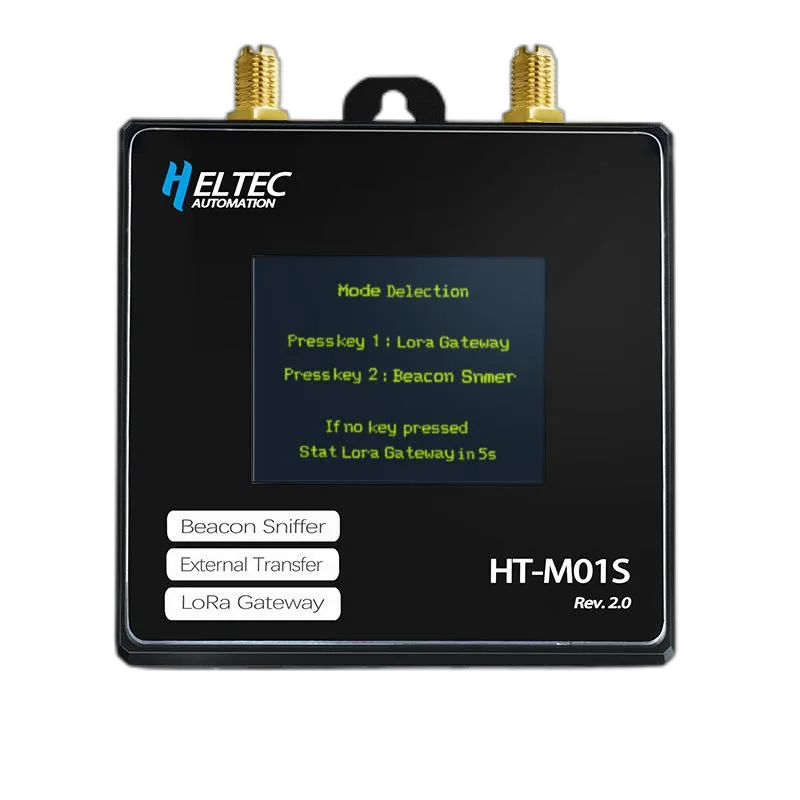
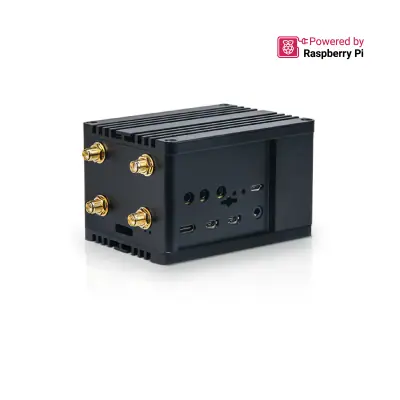
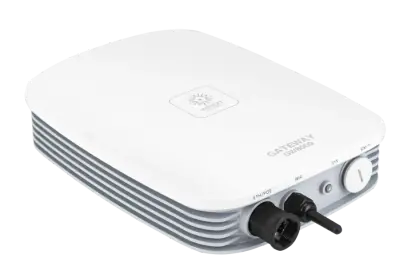
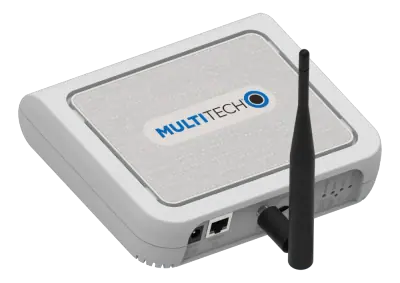
Heltec HT-M01S indoor LoRaWAN gateway based on an ESP32 microcontroller, without a Linux system, to connect LoRa nodes to a LoRaWAN network server.
Operating Temperature-20 ~ 70 ℃
Frequency863~870MHz, 902~928MHz, 470~510MHz
Ethernet100M RJ45
Dimensions70(+11) x 70 x 23 mm
LoRa Band470~510MHz, 863~870MHz, 902~928MHz
LoRa chipsetSX1303 + SX1250
Product overview
Heltec HT-M01S. indoor LoRaWAN gateway. The Heltec HT-M01S (Rev. 2.0) is a standard LoRaWAN gateway based on an ESP32 MCU, which does not require a Linux operating system on a high-performance CPU.
Main characteristics. The gateway supports LoRaWAN Class A and Class C protocols, with eight uplink channels and one downlink channel. Its maximum output power is +27 ± 2 dBm and its maximum receiving sensitivity is -139 dBm. The housing is aluminum with a tempered glass panel.
Interfaces and connectivity. It provides a 100M RJ45 Ethernet port and Wi-Fi 802.11 b/g/n. A built-in display shows real-time receiving and transmitting information, the ID and the IP address.
Power and environment. Power consumption is about 550 mA in transmission (maximum), about 120 mA in reception and 7.5 mA in standby. It operates from -20 to 70 °C, with 10 to 90 % humidity, non-condensing.
Frequency bands. The model is available in the 470 to 510 MHz, 863 to 870 MHz or 902 to 928 MHz band, and the operating band must match the hardware.
Typical uses. It can serve as a regular LoRaWAN gateway, a Helium beacon sniffer, or an external LoRa transceiver for the Heltec indoor hotspot.
Integration. Configuration takes three steps: power on, network configuration, then connection to a LoRaWAN network server. Available on quotation from Atlas Electronics.
No published question about this part yet. Questions are reviewed before publication.
Complete specifications
Every characteristic recorded for HT-M01S, with where it comes from. Use the filters to find one quickly.
All specifications (16)
Characteristic
Value
Dimensions
70(+11) x 70 x 23 mm
Ethernet
100M RJ45
Frequency
863~870MHz, 902~928MHz, 470~510MHz
LoRa Band
470~510MHz, 863~870MHz, 902~928MHz
LoRa chipset
SX1303 + SX1250
Max. Receiving Sensitivity
-139dBm
Max Tx Power
+27 ± 2 dBm
Maximum Output
27 ± 2 dBm
MCU
ESP32-D0WDQ6
Multi-channel
Eight (8) uplink, one (1) downlink.
Operating Humidity
10%~90%, no-condensing
Operating Temperature
-20 ~ 70 ℃
Power consumption
Tx (Max) ≈ 550mA, Rx ≈ 120mA, standby 7.5mA
Shell material
Aluminum housing, tempered glass panel.
Weight
1500 g
Wi-Fi
802.11 b/g/n
No specification matches.
Last verification : 2026-11-02
Technical documentation
Official documents and the technical data recorded for HT-M01S. For a missing document or a specific revision, our experts send it to you.
1. Technical overview
Heltec HT-M01S indoor LoRaWAN gateway based on an ESP32 microcontroller, without a Linux system, to connect LoRa nodes to a LoRaWAN network server.
Operating Temperature-20 ~ 70 ℃
Frequency863~870MHz, 902~928MHz, 470~510MHz
Ethernet100M RJ45
Dimensions70(+11) x 70 x 23 mm
LoRa Band470~510MHz, 863~870MHz, 902~928MHz
2. Datasheet extract (recorded values)
Parameter
Value
Dimensions
70(+11) x 70 x 23 mm
Ethernet
100M RJ45
Frequency
863~870MHz, 902~928MHz, 470~510MHz
LoRa Band
470~510MHz, 863~870MHz, 902~928MHz
LoRa chipset
SX1303 + SX1250
Max. Receiving Sensitivity
-139dBm
Max Tx Power
+27 ± 2 dBm
Maximum Output
27 ± 2 dBm
MCU
ESP32-D0WDQ6
Multi-channel
Eight (8) uplink, one (1) downlink.
Operating Humidity
10%~90%, no-condensing
Operating Temperature
-20 ~ 70 ℃
Power consumption
Tx (Max) ≈ 550mA, Rx ≈ 120mA, standby 7.5mA
Shell material
Aluminum housing, tempered glass panel.
Weight
1500 g
Wi-Fi
802.11 b/g/n
Integration
Points to check before using HT-M01S in a design. They are derived from the recorded characteristics, not from the manufacturer's application circuits.
1Thermalrated operating range -20 ~ 70 ℃ — check it against the installation environment.
Power and communication
Max Tx Power
+27 ± 2 dBm
Power consumption
Tx (Max) ≈ 550mA, Rx ≈ 120mA, standby 7.5mA
Check the exact pin assignment and the application circuit in the datasheet, or ask our experts.
Implementation checklist
Thermal : rated operating range -20 ~ 70 ℃ — check it against the installation environment.
Applications and use cases
Architectures in which HT-M01S can play a role, derived from its category. This is not a compatibility statement: check the specifications against your requirements.
Energy bills give one total for the whole site. Submetering places meters and current sensors on each circuit or usage and collects their readings through a gateway, so consumption can be followed per building, floor or machine
To check
Number of circuits and phases to meter, and the current range of each
Wired Modbus bus or wireless LoRaWAN, depending on cabling access in the switchboards
Accuracy class required for internal allocation or for billing
Offices and classrooms get stuffy without anyone measuring why. Indoor air quality monitoring places CO2, VOC and particle sensors in the rooms and reports their values through a gateway, so ventilation can be adjusted to real occupancy
To check
Parameters to measure (CO2 alone or CO2, VOC and particles)
Battery-powered sensors or mains-powered sensors with display
Integration with the ventilation control or building management system
A leak under a sink or in a technical room is often found days later. Leak detection places wireless sensors where water can appear and sends an alert through a gateway as soon as one of them gets wet
To check
Locations at risk: kitchens, bathrooms, plant rooms, server rooms
Alert path (SMS, e-mail, application) and who receives it
Battery life and the way a low battery is reported
A fridge that drifts at night can ruin a whole stock. Temperature loggers in cold rooms and trucks report through a gateway or a tracker and raise an alert when a threshold is crossed
To check
Temperature range and accuracy required by the product
Record keeping required by the applicable regulations
A LoRaWAN project needs sensors, gateways, a network server and an application that work together. Sensor nodes report to indoor or outdoor gateways, which forward the data to the network server and the customer’s platform
To check
Regional frequency plan (EU868, US915 and others)
Network server: public, private or embedded in the gateway
A building’s energy, comfort and occupancy data sit in separate systems. Sensors, meters and gateways feed one model of the building, room by room, to compare scenarios and steer the installations
Milesight sensors, LoRaWAN gateways and cellular routers can be brought together on the Milesight Development Platform, which manages the devices and passes their data to other applications through an API and webhooks
To check
Development Platform for device management, API and webhooks, or another network server and application
Devices provisioned through Milesight RPS must have that provisioning removed before being added to the Development Platform
Data flows to the customer’s own application through webhooks
RAKwireless WisGate gateways run WisGateOS 2 and are managed from WisDM, RAKwireless’ cloud device management platform with a built-in network server, alongside RAK sensor nodes, radio modules and concentrators
To check
WisDM built-in network server, or a third-party one (ChirpStack, TTN/TTS, AWS IoT Core, Actility)
Remote configuration and updates of the gateways from WisDM
Regional frequency plan of the gateways and nodes
Associated system blocks
GatewaysSensors and modulesDevelopment boardsMounting
Need a complete solution?
Send a request for HT-M01S and the other parts of your project.
Similar parts to answer your needs. Compare the main characteristics. A recorded replacement is a documented relation; a similar product is a similarity only, never a compatibility claim.
What is recorded about the regulatory status and the life of this part.
Regulatory compliance
No compliance statement is recorded for this part. Ask the supplier for the RoHS and REACH declarations and, for a radio product, the EU declaration of conformity.
With your consent, we use Google cookies to measure the site’s audience and our advertising. Your quote basket and comparison stay in your browser either way. Details