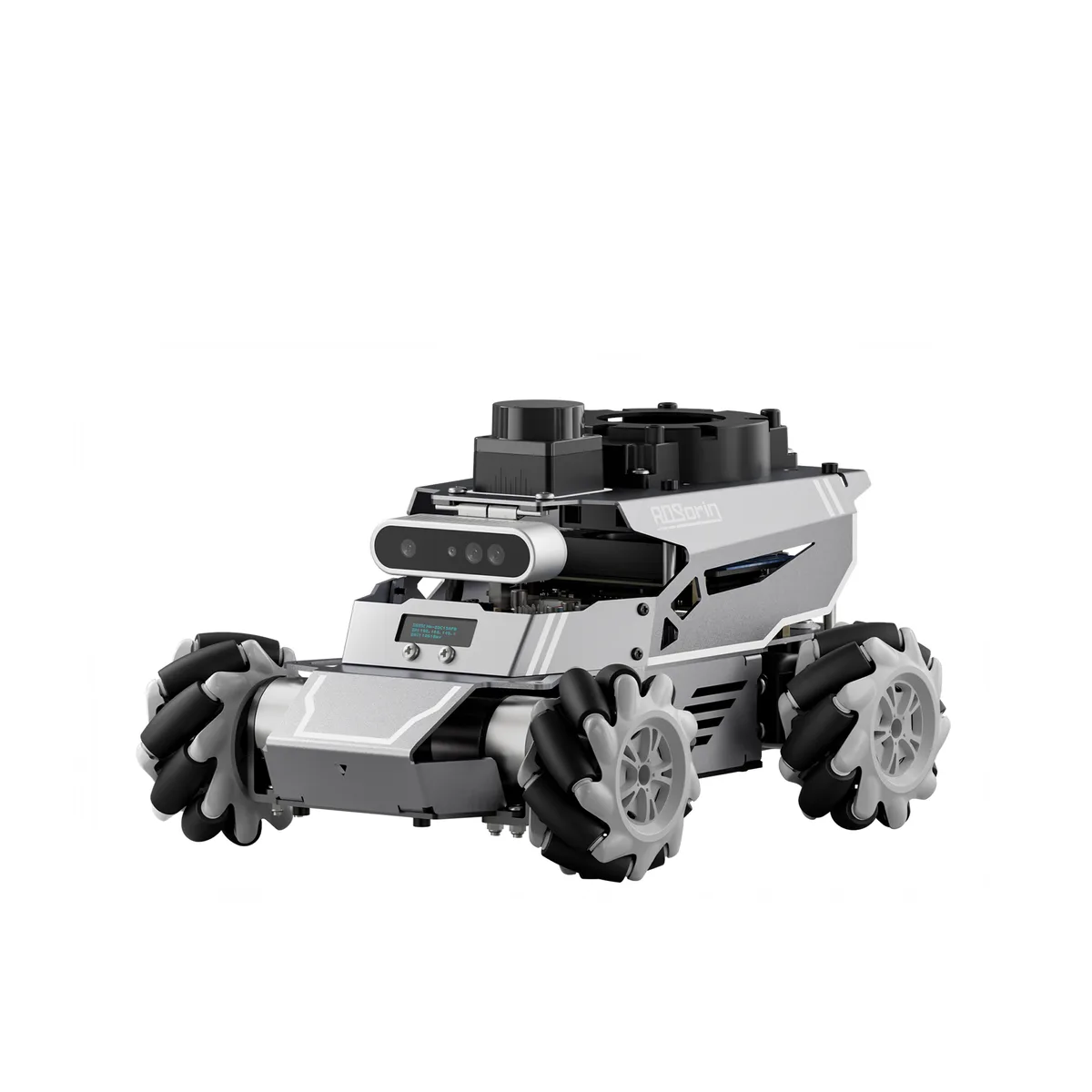
Overview. The Hiwonder ROSOrin is a multimodal robot developed on ROS2. Its modular chassis allows quick switching between Mecanum, Ackermann and differential drive configurations, depending on the application scenario.
Main characteristics. The standard Ackermann chassis measures 277 x 204 x 169 mm for 2.15 kg, the four-wheel differential chassis 277 x 204 x 166 mm for 2.26 kg and the Mecanum chassis 277 x 212 x 166 mm for 2.66 kg. The structure is full-metal anodized aluminum alloy, and the drive uses 520 metal gear reduction motors with high-precision AB quadrature encoders. The battery is an 11.1 V 6000 mAh 3C lithium cell.
Perception and navigation. The robot carries an STL-19P D500 TOF LiDAR and an Aurora 930 Pro 3D depth camera. The camera module outputs depth, IR and RGB images at 640 x 400 and 12 fps with a 74° x 51° field of view, a depth accuracy of ±8 mm at 1 m and a working distance of 15 to 300 cm. These sensors support SLAM mapping and navigation, path planning, fixed-point navigation and dynamic obstacle avoidance.
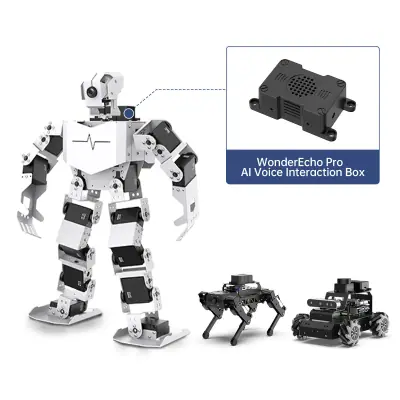
Vision and interaction. OpenCV vision algorithms identify colors and objects, calculate their positions in real time and track them. A 6-microphone array (WonderEcho Pro) supports sound source localization and voice recognition control. The robot integrates multimodal AI models for text, voice and vision, and can be controlled by an iOS or Android app, a wireless controller or PC software.
Controller and connectivity. The ROS controller can be a Jetson Nano, Jetson Orin Nano, Jetson Orin NX or Raspberry Pi 5 board, together with an STM32 ROS robot controller and a Jetson multi-function expansion board. Communication is over WiFi or Ethernet, and firmware is updated by USB OTA. Storage is a 64G TF card or a 128G SSD depending on the compute board.
Power and environment. The camera module runs on 5V ±10%, 1.5A, averages less than 1.6 W of consumption and operates from -10 °C to 55 °C at 0 % to 95 % RH, non-condensing.
Typical uses. The robot suits teaching robot programming with ROS, Ubuntu and Python, C, C++ or JavaScript, developing embodied AI applications, and experimenting with autonomous navigation on the included AI sandbox map with traffic lights and road signs.