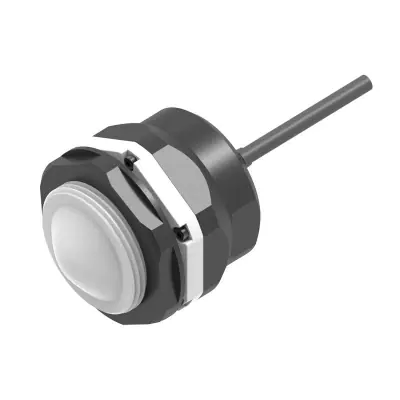
Product overview
Overview. The Lanbao LR12X-B is an M12 inductive proximity sensor designed to detect metal targets in environments subject to high pressure. Its 500 bar pressure rating distinguishes it from standard inductive sensors.
Main characteristics. Rated sensing distance of 1.5 mm with an assured distance of 0 to 1.2 mm, switching frequency of 600 Hz, repeat accuracy of 5 % or less, switch-point drift of ±15 % or less, hysteresis of 1 to 20 %. Flush mounting, standard target Fe 12*12*1t. Stainless steel housing.
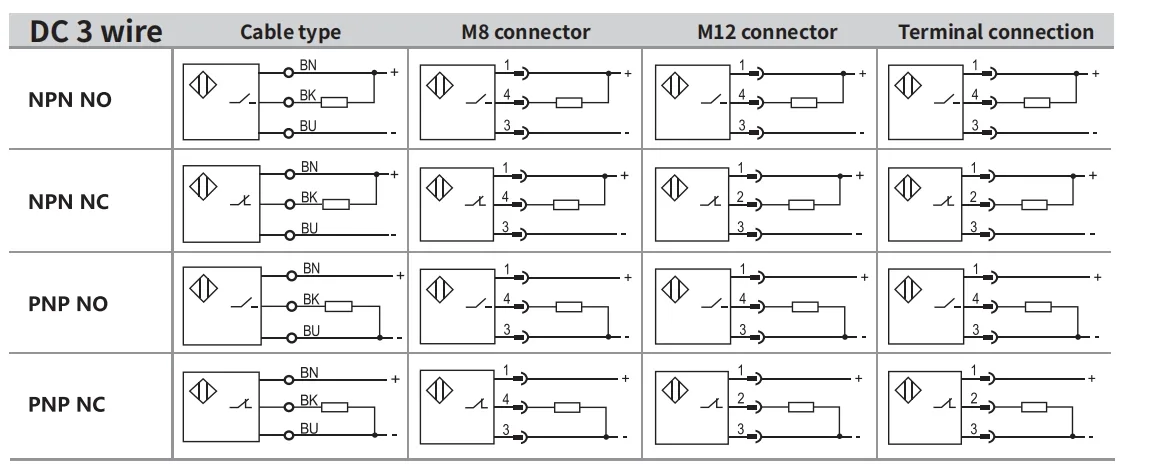
Interfaces and connectivity. NO/NC outputs depending on the part number, PNP (LR12XBF15DPOB) or NPN (LR12XBF15DNCB) versions, 2 m PUR cable or M12 connector. Load current up to 100 mA and residual voltage of 2.5 V or less. Protection against short-circuit, overload and reverse polarity.
Power and environment. Supply voltage of 10 to 30 VDC, consumption of 15 mA or less. Ambient temperature range of -25 °C to 80 °C, IP68 degree of protection, insulation resistance of 50 MΩ or more (500 VDC), voltage withstand of 1000 V AC for 60 s, vibration resistance of 10 to 50 Hz (1.5 mm).
Typical uses. Detection of metal part presence or position on equipment operating under high pressure, in humid environments or exposed to splashes.
Integration. Direct connection to a PLC or discrete input through the PUR cable or M12 connector; check the PNP or NPN version and the NO or NC output type before ordering.