Product overview
Overview. The Lanbao LRLR12A-Y is an M12 inductive proximity sensor, 60 mm long, from the welding immune series. Its PTFE housing limits the adhesion of welding spatter.
Main characteristics. The rated distance Sn is 4 mm, with an assured distance Sa of 0 to 3.06 mm and a switching frequency of 800 Hz. Repeat accuracy is below 5 %, temperature drift below 15 % and hysteresis between 3 and 20 %. The sensor is flush mounted and offers full metal detection, the attenuation coefficient being about 1 for iron, copper, aluminium and stainless steel.
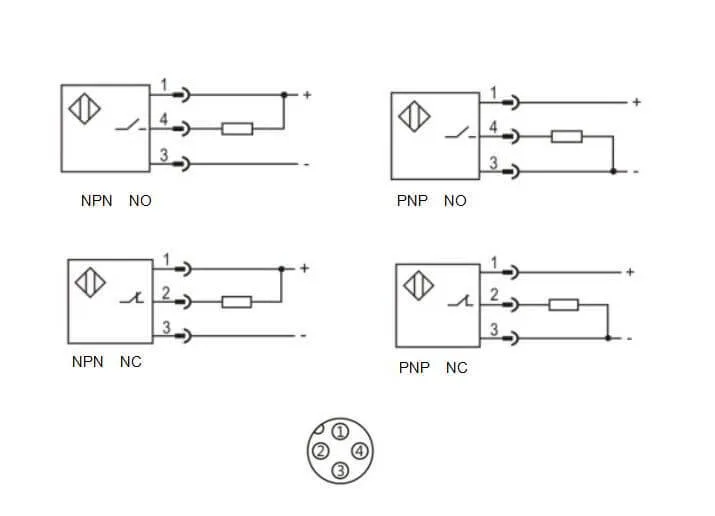
Outputs and connection. The product is available with NPN or PNP outputs, normally open or normally closed depending on the part number, with an M12 connector. A yellow LED indicates the output state. The residual voltage is below 2.5 V and the load current below 100 mA. Short-circuit, overload and reverse polarity protections are built in.
Power and environment. The supply voltage ranges from 10 to 30 VDC, with a consumption of 20 mA or less. The product operates from -40 °C to 70 °C, at an ambient humidity of 35 to 95 % RH, with an IP68 rating and a nickel copper alloy housing. It withstands vibrations from 10 to 50 Hz (1.5 mm) and a voltage withstand of 1000 V AC for 60 s. Its anti magnetic interference rating is below 100 mT.
Integration. The sensor connects directly to PLCs and discrete input modules. The standard target ST45 12×12×1 t serves as the reference for testing.