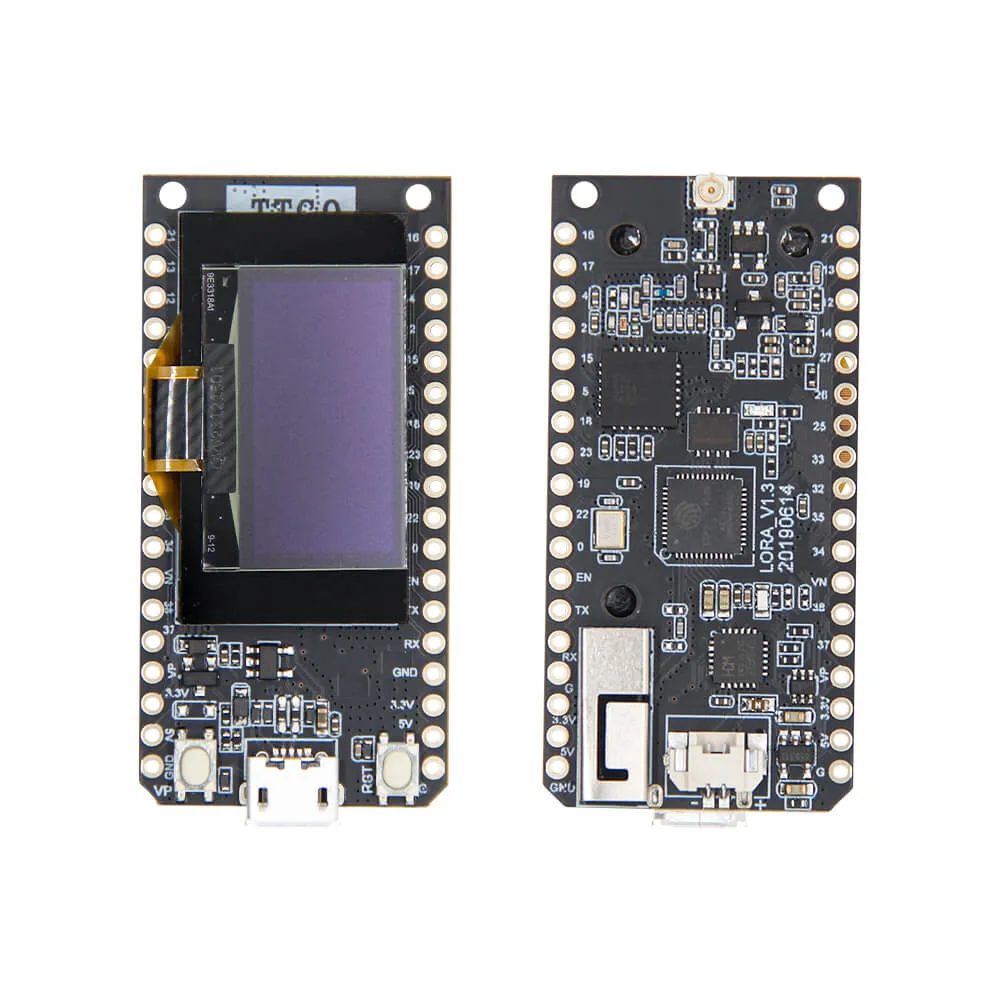
LILYGO Q310 development board combining a dual-core ESP32 microcontroller, an SX1276 LoRa radio module and a 0.96 inch OLED screen, for prototyping wireless IoT applications.
Working Temperature Range-40℃ ~ +85℃
Frequency Range2.4GHz~2.5GHz; (2400M~2483.5M)
Sleep currentAbout 600uA
On-board clock40MHz crystal oscillator
FlashQSPI flash 4MB
SRAM520 kB SRAM
Product overview
Overview. The LILYGO Q310 LoRa V1.3 is a LILYGO development board combining an ESP32 microcontroller (Wi-Fi and Bluetooth) and an SX1276 LoRa radio module, with a built-in 0.96 inch OLED screen.
Main characteristics. The Xtensa® LX6 32-bit microprocessor runs at 240 MHz in single- or dual-core mode, with 520 kB SRAM, 4 MB QSPI flash and a 40 MHz crystal oscillator. AES, RSA, ECC and SHA encryption is supported.
Radio frequency. The stated frequency range is 2.4 GHz to 2.5 GHz (2400 M to 2483.5 M). The SX1276 module provides the LoRa link.
Interfaces and connectivity. Available interfaces are UART, SPI, SDIO, I2C, PWM, I2S, ADC, DAC and capacitive sensor. A CH9102F USB to TTL converter is integrated, and a 2-pin JST connector with 1.25 mm pitch is present. Configuration is possible through the AT instruction set, a cloud server and an Android or iOS app. BOOT and REST buttons are provided.
Power and environment. Power is supplied via USB 5V/1A, with an operating voltage of about 2.7 V to 3.6 V and a sleep current of about 600 uA. The working temperature range is -40 °C to +85 °C.
Typical uses. This board suits prototyping of sensor nodes and long-range LoRa wireless links, with Wi-Fi or Bluetooth connectivity, starting from the sample code published by the manufacturer.
AT + Instruction set, cloud server,; Android/iOSapp
Working Temperature Range
-40℃ ~ +85℃
Working voltage
About 2.7V-3.6V
No specification matches.
Last verification : 2026-11-02
Technical documentation
Official documents and the technical data recorded for Q310. For a missing document or a specific revision, our experts send it to you.
1. Technical overview
LILYGO Q310 development board combining a dual-core ESP32 microcontroller, an SX1276 LoRa radio module and a 0.96 inch OLED screen, for prototyping wireless IoT applications.
AT + Instruction set, cloud server,; Android/iOSapp
Working Temperature Range
-40℃ ~ +85℃
Working voltage
About 2.7V-3.6V
Applications and use cases
Architectures in which Q310 can play a role, derived from its category. This is not a compatibility statement: check the specifications against your requirements.
RAKwireless WisGate gateways run WisGateOS 2 and are managed from WisDM, RAKwireless’ cloud device management platform with a built-in network server, alongside RAK sensor nodes, radio modules and concentrators
To check
WisDM built-in network server, or a third-party one (ChirpStack, TTN/TTS, AWS IoT Core, Actility)
Remote configuration and updates of the gateways from WisDM
Regional frequency plan of the gateways and nodes
Associated system blocks
GatewaysSensors and modulesDevelopment boardsMounting
Seeed SenseCAP sensors connect to Seeed’s SenseCAP cloud platform and app, and Seeed edge computers, camera modules, Grove and XIAO boards complete the chain for custom devices and local processing
To check
SenseCAP cloud platform and app, or the customer’s own network server
Prototype on Grove and XIAO, then move to industrial versions
Local processing on the edge computers or in the cloud
Associated system blocks
SensorsEdge computingDevelopment boards
Need a complete solution?
Send a request for Q310 and the other parts of your project.
Similar parts to answer your needs. Compare the main characteristics. A recorded replacement is a documented relation; a similar product is a similarity only, never a compatibility claim.
Current productLILYGO
Q310
ESP32 LoRa development board with 0.96 inch OLED screen
What is recorded about the regulatory status and the life of this part.
Regulatory compliance
No compliance statement is recorded for this part. Ask the supplier for the RoHS and REACH declarations and, for a radio product, the EU declaration of conformity.
No advertising or analytics cookies. A single, strictly necessary cookie is set only if you sign in to your account. Your quote basket and comparison stay in your browser. Details