Product overview
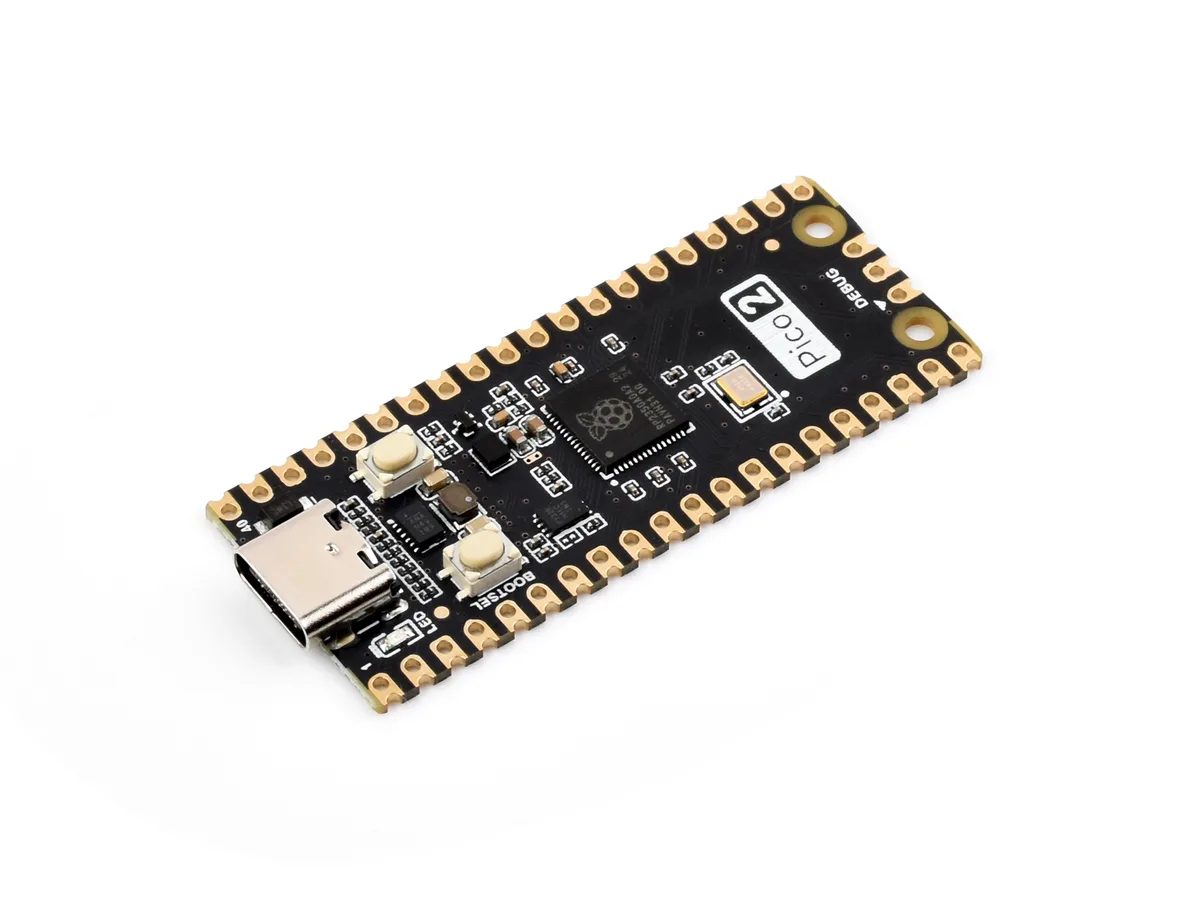
Overview. The Luckfox Pico 2 Micro is a microcontroller development board from Luckfox, built around the RP2350A chip designed by Raspberry Pi in the United Kingdom. It supports two selectable architectures: a pair of ARM Cortex-M33 cores or a pair of open hardware Hazard3 RISC-V cores.
Main characteristics. The processor runs at clock frequencies up to 150MHz. The board provides 520KB of SRAM and 4MB of onboard Flash memory. The chip includes a temperature sensor, an accurate on-chip clock and timer, and accelerated floating-point libraries.
Interfaces and connectivity. The board offers 26 multi-function GPIO pins, 2 SPI, 2 I2C and 2 UART interfaces, 3 12-bit ADC channels, 16 controllable PWM channels and 12 Programmable I/O (PIO) state machines for custom peripheral support. It has a USB Type-C connector and USB 1.1 with device and host support, with drag-and-drop programming over USB mass storage. The castellated module allows direct soldering to carrier boards.
Power. No battery is included. The board has a DC-DC Buck-Boost converter supporting a load current up to 2A, and low-power sleep and dormant modes.
Typical uses. This board suits prototyping and the study of RISC-V architecture in a stable and well supported environment. It can be programmed in C/C++, MicroPython or Arduino, with a comprehensive SDK.
Integration. Pin headers are available without header or with pre-soldered header. Available on quotation from Atlas Electronics.