| Alerts — Valve and battery status over LoRaWAN | Tamper and removal detection; the full alert set |
| Battery | 6,000 mAh, about ten years at two uplinks a day (estimate) |
| Battery — 6,000 mAh Li-SOCl₂ cell; about ten years at two uplinks a day (estimate) | Life at faster schedules |
| Battery claim | Five years average; 15 µA sleep |
| Battery claims | About ten years at two uplinks a day (Macnman estimate) |
| BIS IS 14439 Parts 1 and 2 | The host meter' s standard, not the module' s |
| Choose it when | Domestic gas consumers under a CGD, prepaid or postpaid |
| Command latency | Up to the uplink interval, twelve hours at two a day (our weaker row) |
| Compliance — WPC compliant radio; RoHS | Nothing further is claimed: no metrological or hazardous-area approval for the module |
| Consumer type — What is read — Gateway and placement | Schedule and model |
| Coverage inside kitchens, cabinets and basements | Planned by the utility: an indoor gateway per block or a rooftop gateway per colony, settled by a pilot (our weaker row: coverage is the utility' s job) |
| Data route | Network server to head-end or MDM over MQTT or HTTPS |
| EN 1359:2017 and EN 16314 | Certification of an inline valve sits in that family; none is claimed for MeterLink |
| Enclosure — IP65, mounted on the meter | Operating temperature, dimensions, weight |
| G10 and above, rotary, turbine, ultrasonic | Modbus meters through the MacSync LX1 RS485 converter |
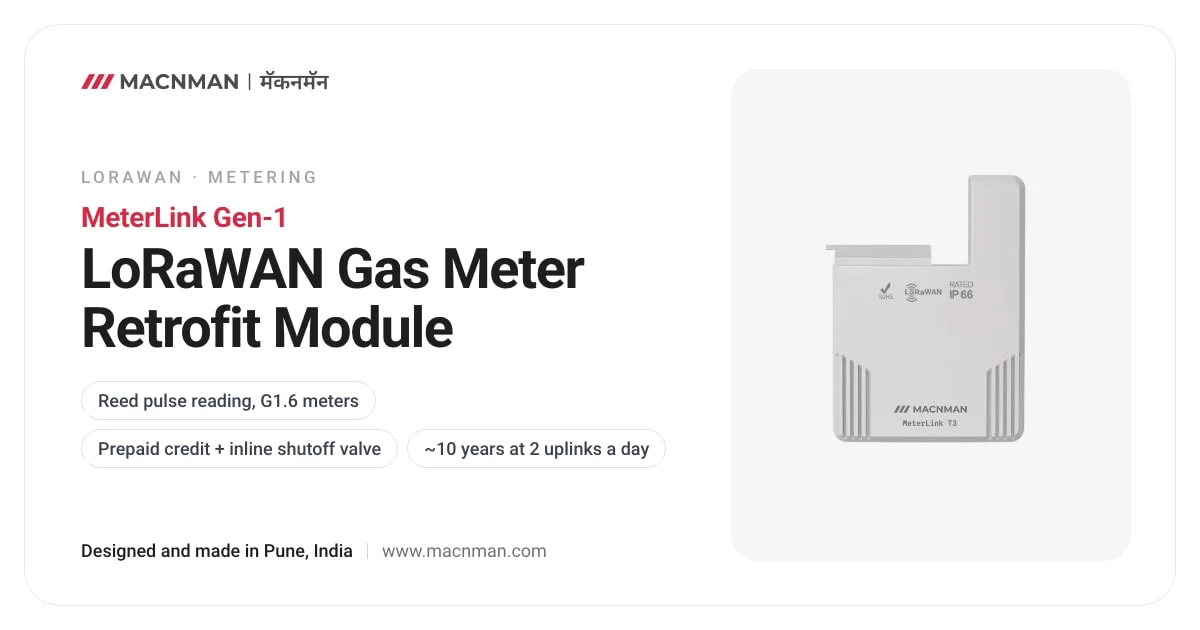
| G1.6 | Supported: reed pulse reading, prepaid, inline valve |
| G2.5 | On request |
| G4 | On request |
| G6 | On request |
| Hostels, hotel and canteen kitchens — G1.6 meters today; larger sizes on request — Setu X1 in the building | Four to twenty-four uplinks a day for analytics |
| Ingress and hazardous-area statements | EN 300220-1; hazardous-area approval described as ongoing |
| Lock-in | Open LoRaWAN; any network server, any gateway maker |
| LoRa Alliance, LoRaWAN for smart utilities | The data-model options a head-end can standardise on; Macnman supplies the decoder |
| Meter change | None: the installed G1.6 meter and its index stay |
| Meter compatibility — G1.6 diaphragm meters | G2.5, G4, G6 and ultrasonic meters |
| Metrology | Stays with the meter; none claimed for the module (our weaker row) |
| OIML R 137-1 and 2 (2012) | The reed pulse the module counts is such an output; the module is the ancillary device |
| Page | This page |
| PNGRB roadmap for smart domestic PNG metering (April 2026) | The module supplies all three on an installed meter; conformity with the roadmap is the tender' s determination |
| PNGRB T4S regulations for CGD networks (2008, consolidated 2025) | A valve added at the meter is part of the CGD' s regulated installation, fitted and audited under its procedure |
| PNGRB third-party audit checklist for T4S | The meter' s approval and seal must stay intact; fitting is confirmed per meter model with the CGD' s metrology team |
| Power | 6,000 mAh cell, about ten years at two uplinks a day |
| Prepaid and remote shutoff | Credit enforced in the module; inline valve on command at the next uplink |
| Prepaid and valve | Credit enforced in the module; inline shutoff valve |
| Prepaid — Credit by downlink, balance enforced in the module | Tariff and top-up integration with the utility' s billing system |
| Prepaid credit — Tops up the balance the module enforces | Head-end by downlink |
| Pulse weight — Matches the count to the meter' s output; checked against the index at commissioning | Commissioning |
| Radio and bands | LoRaWAN 1.0 on the operator' s network |
| Radio — LoRaWAN® Class A, 23 dBm, IN865 and EU868, OTAA, AES encryption | LoRaWAN specification version; other regional plans |
| Reading | Twice a day by design, more if the schedule allows |
| Reading method | Not stated |
| Reading method — Reed pulse output of the meter; mechanical index stays the legal register | Pulse weight per meter model; optical index reading |
| Reads | A G1.6 diaphragm gas meter' s reed pulse output |
| Recurring cost per meter | None on the utility' s own gateways |
| Setting — What it does | Set from |
| Shutoff valve — Inline at the meter, driven by the module; closes on zero credit or secure command | Valve type, pressure rating, re-open procedure as the CGD' s safety rules require |
| Status alerts — Valve state and battery reported with the uplink | Built in |
| Tamper reporting | Removal and magnetic tamper |
| Uplink schedule — Two uplinks a day by design; set per project to the command latency the utility accepts | Provisioning |
| Uplinks a day — Worst-case command latency — Battery | Typical use |
| Villa and row-house colonies — External-wall meters — One MacLink Gen-2 per colony | Two uplinks a day |
| What it is | Retrofit module stated to fit most meters sold in India, on the operator' s LoRaWAN network |
| Where it fits | A sound installed base of G1.6 meters that must become smart and prepaid without replacement |
| Where sold | India |
| Who owns the network | The utility: gateways, network server and data |