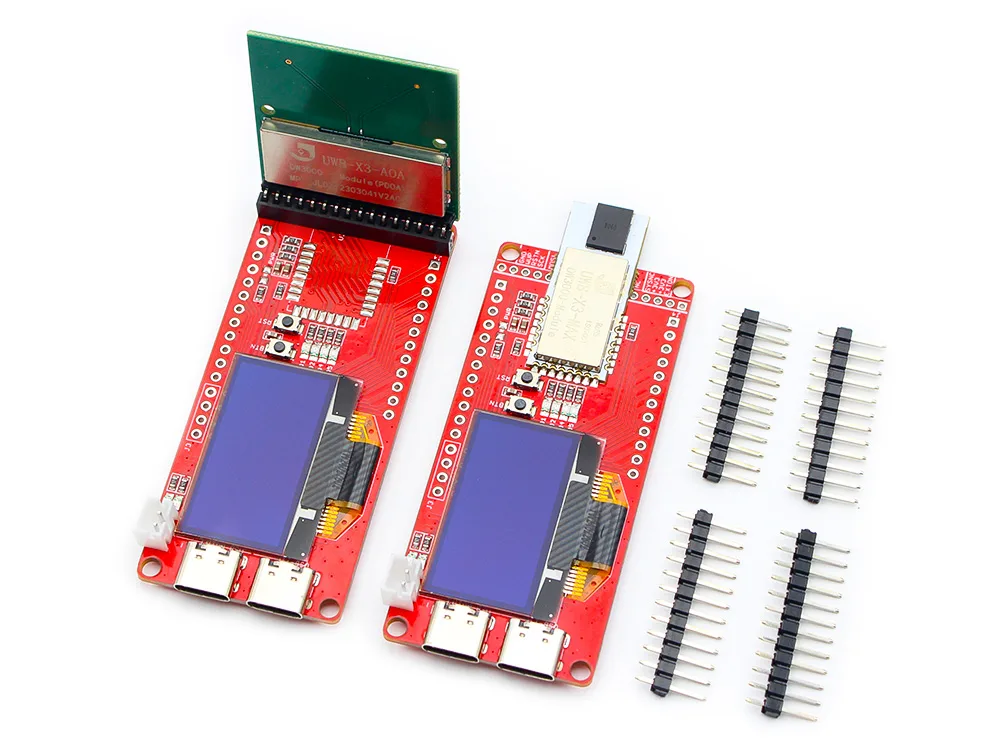
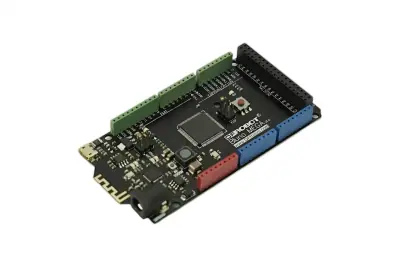
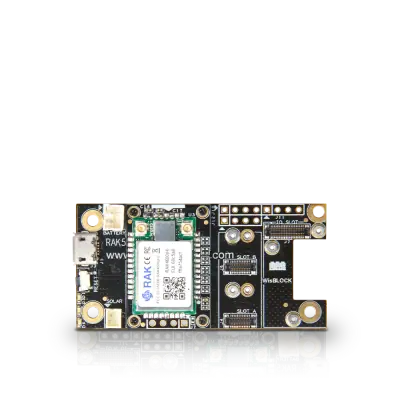
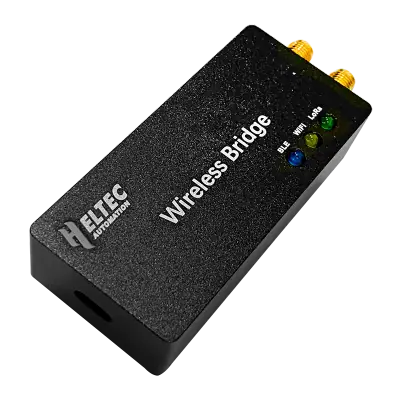
Makerfabs UWB Angle-of-Arrival development kit with anchor and tag, for learning UWB positioning and building projects such as an auto-follow vehicle.
Coverage radius[email protected]
Tag angleBy PDOA, with the follow method:
Tag distanceBy ToF(Time of flight)
Product overview
Overview. The Makerfabs MaUWB STM32 AOA development kit is a UWB Angle-of-Arrival (AOA) kit for precise positioning, made of an anchor and a tag, with open-source firmware.
Main characteristics. The system outputs two positioning values: the tag distance, calculated by ToF (Time of Flight), and the tag angle, calculated by PDOA (Phase Difference of Arrival). The stated coverage radius is [email protected].
Operating principle. The angle of arrival is derived from the phase difference received on the anchor's antennas, converted into a time difference and then into a distance difference, and calculated geometrically from the spacing of the two antennas.
Composition. The MaUWB AOA anchor, based on an STM32F103 and a DW3000 UWB chipset, calculates the tag distance and angle and reports them to another controller such as a PC. The MaUWB AOA tag, normally installed on mobile devices or persons, completes the kit. The firmware of both modules is open source and supports STM32CubeIDE. A Qt usage demo allows quick checking of the results.
Uses. The kit lets you test the range and accuracy of UWB AOA, learn how to implement it in hardware and firmware, and reuse the hardware and firmware directly in a project, for example an auto-follow vehicle.
Advantages over Bluetooth AoA. UWB operates at very high frequencies, typically from 3.1 to 10.6 GHz, and offers robustness in challenging environments, scalability for multi-user environments, power efficiency and enhanced security.
No published question about this part yet. Questions are reviewed before publication.
Complete specifications
Every characteristic recorded for MAUWBAOAST, with where it comes from. Use the filters to find one quickly.
All specifications (3)
Characteristic
Value
Coverage radius
[email protected]
Tag angle
By PDOA, with the follow method:
Tag distance
By ToF(Time of flight)
No specification matches.
Last verification : 2026-11-02
Technical documentation
Official documents and the technical data recorded for MAUWBAOAST. For a missing document or a specific revision, our experts send it to you.
1. Technical overview
Makerfabs UWB Angle-of-Arrival development kit with anchor and tag, for learning UWB positioning and building projects such as an auto-follow vehicle.
Coverage radius[email protected]
Tag angleBy PDOA, with the follow method:
Tag distanceBy ToF(Time of flight)
2. Datasheet extract (recorded values)
Parameter
Value
Coverage radius
[email protected]
Tag angle
By PDOA, with the follow method:
Tag distance
By ToF(Time of flight)
Applications and use cases
Architectures in which MAUWBAOAST can play a role, derived from its category. This is not a compatibility statement: check the specifications against your requirements.
RAKwireless WisGate gateways run WisGateOS 2 and are managed from WisDM, RAKwireless’ cloud device management platform with a built-in network server, alongside RAK sensor nodes, radio modules and concentrators
To check
WisDM built-in network server, or a third-party one (ChirpStack, TTN/TTS, AWS IoT Core, Actility)
Remote configuration and updates of the gateways from WisDM
Regional frequency plan of the gateways and nodes
Associated system blocks
GatewaysSensors and modulesDevelopment boardsMounting
Seeed SenseCAP sensors connect to Seeed’s SenseCAP cloud platform and app, and Seeed edge computers, camera modules, Grove and XIAO boards complete the chain for custom devices and local processing
To check
SenseCAP cloud platform and app, or the customer’s own network server
Prototype on Grove and XIAO, then move to industrial versions
Local processing on the edge computers or in the cloud
Associated system blocks
SensorsEdge computingDevelopment boards
Need a complete solution?
Send a request for MAUWBAOAST and the other parts of your project.
Similar parts to answer your needs. Compare the main characteristics. A recorded replacement is a documented relation; a similar product is a similarity only, never a compatibility claim.
What is recorded about the regulatory status and the life of this part.
Regulatory compliance
No compliance statement is recorded for this part. Ask the supplier for the RoHS and REACH declarations and, for a radio product, the EU declaration of conformity.
With your consent, we use Google cookies to measure the site’s audience and our advertising. Your quote basket and comparison stay in your browser either way. Details