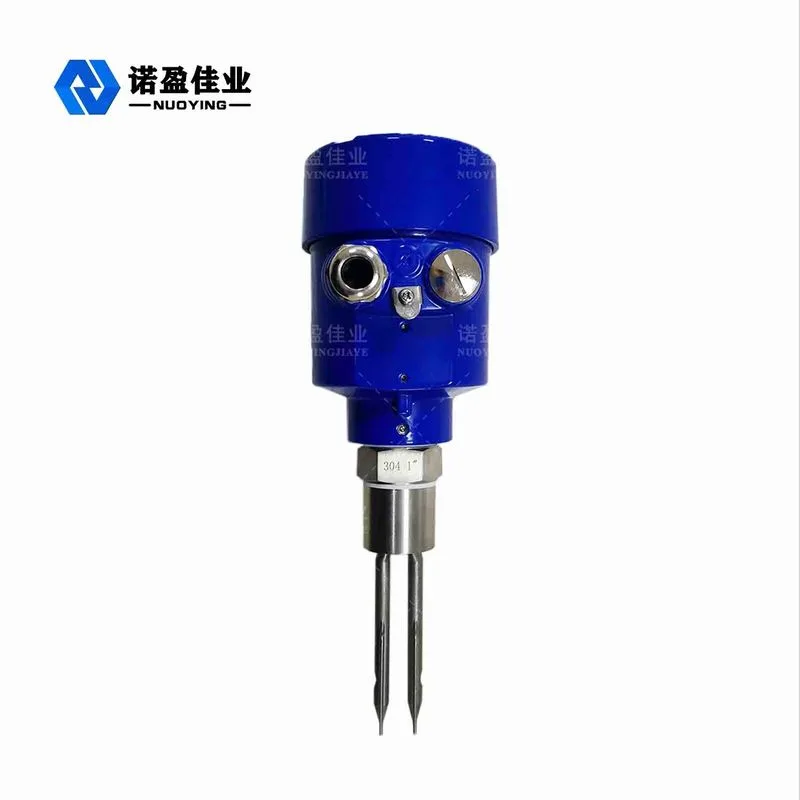
The NYYCUK-B from Nuoying is a vibrating fork level switch for detecting liquid levels, with DPDT relay output and CE, SIL and ATEX certifications.
ApplicationsLiquid
CertificationCE, SIL, ATEX
Customized supportOEM, ODM
Environment Temperature-40~+80℃
Fork length44mm
Fork material304, 316 ( optional)
Product overview
Nuoying NYYCUK-B. vibrating fork level switch for liquids. The NYYCUK-B is a vibrating fork level switch from Nuoying, designed to signal the presence or absence of liquid in a tank.
Working principle. The fork is set into vibration by a piezoelectric chip and the vibration is received by a second piezoelectric chip. When the material contacts the fork, the vibration signal gradually decreases until resonance stops, and the control circuit then delivers an output signal.
Main characteristics. 44 mm fork in stainless steel 304 or 316 (optional), DPDT relay output, 24 VDC or 220 VAC power supply.
Process connection. Thread or flange connection (optional), for a process pressure below 2.0 MPa.
Temperature ranges. Fork body from -40 to +180 ℃; instrument from -40 to +80 ℃.
Certifications. CE, SIL and ATEX.
Typical uses. Liquid level detection in tanks and vessels, including environments subject to ATEX certification.
Integration. The DPDT relay allows direct connection of the switch to a PLC or a level alarm system.
No published question about this part yet. Questions are reviewed before publication.
Complete specifications
Every characteristic recorded for 49798939-00, with where it comes from. Use the filters to find one quickly.
All specifications (16)
Characteristic
Value
Applications
Liquid
Certification
CE, SIL, ATEX
Customized support
OEM, ODM
Environment Temperature
-40~+80℃
Fork length
44mm
Fork material
304, 316 ( optional)
Grade:
Industrial
Model Number
NYYCUK-B
Operating Temperature
Fork Body:-40~+180℃; Instrument: -40~+80℃
Power supply
24VDC, 220VAC
Procedure Linkage:
Thread, Flange (optional)
Process Connection
Flange,thread (optional)
Process pressure
<2.0MPa
Signal Output
DPDT Relay Output
Typical application
Liquid
Working temperature
Fork body:-40~+180℃
No specification matches.
Last verification : 2026-11-02
Technical documentation
Official documents and the technical data recorded for 49798939-00. For a missing document or a specific revision, our experts send it to you.
1. Technical overview
The NYYCUK-B from Nuoying is a vibrating fork level switch for detecting liquid levels, with DPDT relay output and CE, SIL and ATEX certifications.
ApplicationsLiquid
CertificationCE, SIL, ATEX
Customized supportOEM, ODM
Environment Temperature-40~+80℃
Fork length44mm
2. Datasheet extract (recorded values)
Parameter
Value
Applications
Liquid
Certification
CE, SIL, ATEX
Customized support
OEM, ODM
Environment Temperature
-40~+80℃
Fork length
44mm
Fork material
304, 316 ( optional)
Grade:
Industrial
Model Number
NYYCUK-B
Operating Temperature
Fork Body:-40~+180℃; Instrument: -40~+80℃
Power supply
24VDC, 220VAC
Procedure Linkage:
Thread, Flange (optional)
Process Connection
Flange,thread (optional)
Process pressure
<2.0MPa
Signal Output
DPDT Relay Output
Typical application
Liquid
Working temperature
Fork body:-40~+180℃
Integration
Points to check before using 49798939-00 in a design. They are derived from the recorded characteristics, not from the manufacturer's application circuits.
1Thermalrated operating range Fork Body:-40~+180℃; Instrument: -40~+80℃ — check it against the installation environment.
Power and communication
Power supply
24VDC, 220VAC
Check the exact pin assignment and the application circuit in the datasheet, or ask our experts.
Implementation checklist
Thermal : rated operating range Fork Body:-40~+180℃; Instrument: -40~+80℃ — check it against the installation environment.
Applications and use cases
Architectures in which 49798939-00 can play a role, derived from its category. This is not a compatibility statement: check the specifications against your requirements.
Machines stop without warning and repairs are done in a hurry. Vibration and temperature sensors on motors, pumps and fans report their condition through a gateway, so drift can be seen before the failure
To check
Machines to monitor first, by criticality
Vibration frequency range and sampling needed for the defects sought
Battery-powered wireless sensors or wired sensors
Associated system blocks
Condition sensorsGateway
Need a complete solution?
Send a request for 49798939-00 and the other parts of your project.
Similar parts to answer your needs. Compare the main characteristics. A recorded replacement is a documented relation; a similar product is a similarity only, never a compatibility claim.
With your consent, we use Google cookies to measure the site’s audience and our advertising. Your quote basket and comparison stay in your browser either way. Details