
OV680
Four-Channel Stand-Alone MIPI Bridge Controller for HD Multi-Camera
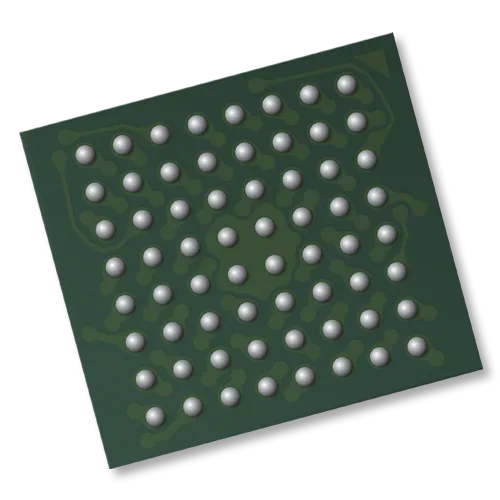
Limited record: this part has neither specifications nor a datasheet in the catalog yet. It is shown for reference and is not indexed.
Four-Channel Stand-Alone MIPI Bridge Controller for HD Multi-Camera
The OV680 is an OmniVision multi-sensor bridge controller that combines images from four sensors into a single data stream for high definition multi-camera applications.
Overview. The OmniVision OV680 is a stand-alone Sensor Bridge controller that merges the video streams of four sensors into a single output stream. It is designed for high definition multi-camera applications.
Main characteristics. Two built-in ISPs, one per input video stream, allow one, two or four streams to be processed simultaneously. Maximum resolution is 1280 x 800, with a maximum frame rate of 720p x 2 at 60 fps. The chip integrates AEC/AGC/AWB, defect pixel correction (DPC) and lens shading correction (LENC).
Interfaces and connectivity. Four 1-lane MIPI inputs for video input, or two 2-lane MIPI inputs, and one 2-lane MIPI output for video. The SCCB bus supports 100 kHz and 400 kHz clocks, with one master to control the sensors and one slave to receive commands from the host. Three GPIO pins and one open-drain CMD_RDY output are available.
Data formats. RAW input, RAW 8/10-bit or YUV422 output.
Power and environment. 1.8 V for DOVDD and 2.8 V for the MIPI and PLL analog parts. An internal regulator generates the 1.2 V digital core supply. The package is a 64-pin BGA. Input clock frequency ranges from 13 MHz to 26 MHz.
Typical uses. The OV680 suits drones, eye tracking and robotics, as well as virtual reality applications requiring multiple cameras or a high resolution main camera.
Integration. An 8-bit microcontroller running at the system clock, with 16 KByte of program memory, manages the operation of the chip. Available on quotation from Atlas Electronics.
No published question about this part yet. Questions are reviewed before publication.
Official documents and the technical data recorded for OV680. For a missing document or a specific revision, our experts send it to you.
The OV680 is an OmniVision multi-sensor bridge controller that combines images from four sensors into a single data stream for high definition multi-camera applications.
Similar parts to answer your needs. Compare the main characteristics. A recorded replacement is a documented relation; a similar product is a similarity only, never a compatibility claim.
Four-Channel Stand-Alone MIPI Bridge Controller for HD Multi-Camera
3-Channel Stand Alone Bridge Chip for Multi-Camera Applications
Describe your application and constraints in a request.
What is recorded about the regulatory status and the life of this part.
No compliance statement is recorded for this part. Ask the supplier for the RoHS and REACH declarations and, for a radio product, the EU declaration of conformity.
| Current status | Status not stated |
| Key dates | Not recorded |
| Manufacturer part number | OV680 |
| Manufacturer | OmniVision |
Video Decoders and Encoders
3-Channel Stand Alone Bridge Chip for Multi-Camera Applications
Price on request
No advertising or analytics cookies. A single, strictly necessary cookie is set only if you sign in to your account. Your quote basket and comparison stay in your browser. Details