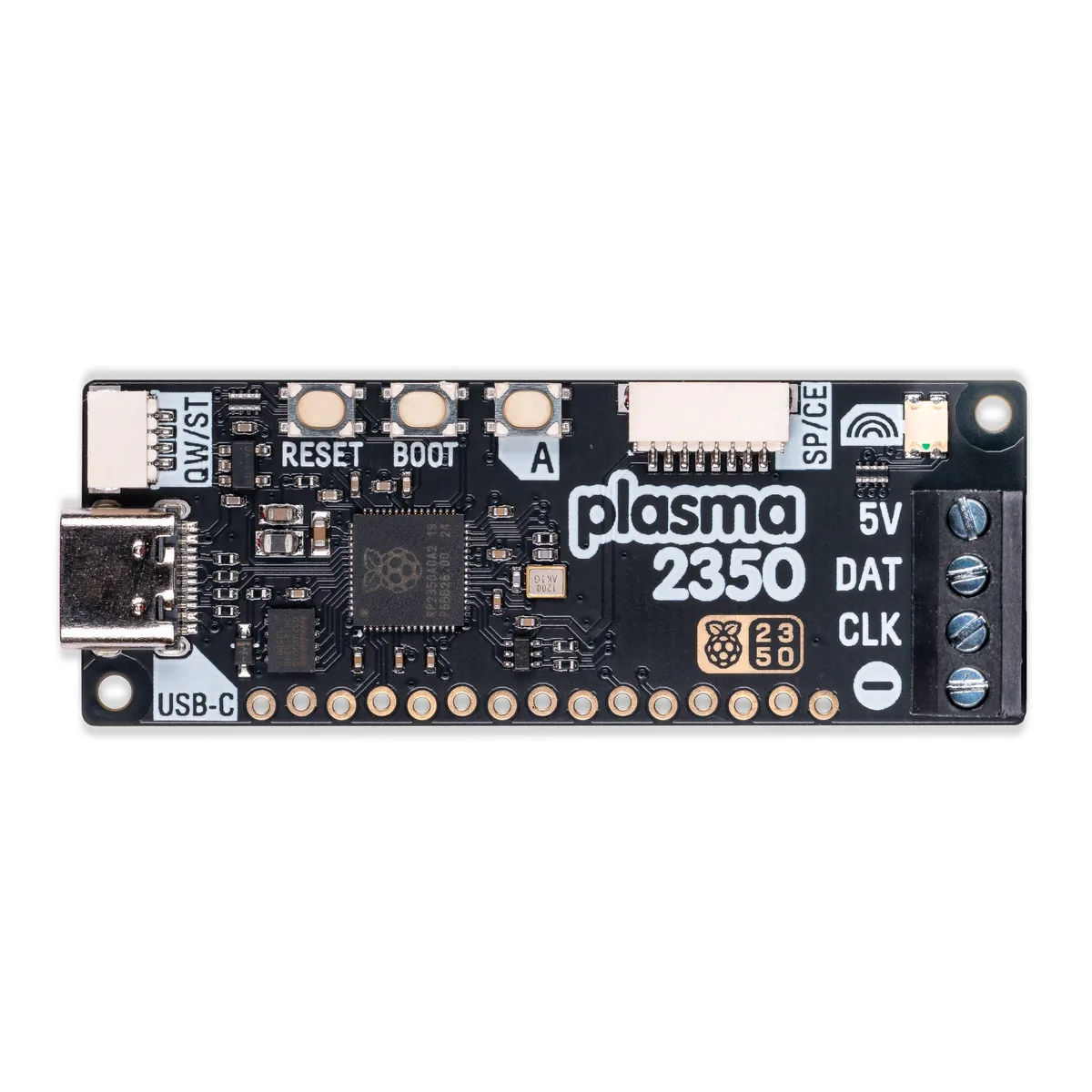
An all-in-one, USB-C powered controller for WS2812/Neopixel and APA102/Dotstar addressable LED strips.
Plasma 2350 is powered and programmable by USB-C and, because USB-C is capable of drawing up to 3A of power, that's enough to power a healthy chunk of LEDs. There's a useful button that you could use to switch between effects, plus a reset button and an onboard RGB LED. We've also popped a QW/ST connector on there, to make it super easy to plug in Qwiic or STEMMA QT breakouts.
You can buy a Plasma 2350 on its own, or in a kit with a USB-C cable and some super-cool LED stars, so you can get started lighting stuff up right away.
Features
Powered by RP2350A (Dual Arm Cortex M33 running at up to 150MHz with 520KB of SRAM)
4MB of QSPI flash supporting XiP
Compatible with 5V WS2812/Neopixel/SK6812 and APA102/Dotstar/SK9822 LEDs
Screw terminals for attaching your LED strip.
USB-C connector for power and programming (3A max)
Qw/ST (Qwiic/STEMMA QT) connector
Intriguing new SP/CE connector
Reset, BOOT and a user button (the BOOT button can also be used as a user button)
RGB LED
Fully-assembled (no soldering required)
Measurements: approx 61 x 22 x 12mm (L x W x H, including connectors)
Programmable with C/C++ or MicroPython
STARter Kit contains
Plasma 2350
USB-C cable for power and programming
10m RGB LED Star Wire
Pinout and Schematic
Download a printable PDF version
Schematic
Mechanical diagram
Getting Started
Plasma MicroPython firmware and examples
Download CircuitPython for Plasma 2350
Connecting Breakouts
If your breakout has a QW/ST connector on board, you can plug it straight in with a JST-SH to JST-SH cable, or you can easily connect any of our I2C breakouts with a JST-SH to JST-SH cable coupled with a Qw/ST to Breakout Garden adaptor.
Breakouts currently compatible with our C++/MicroPython build
We've also broken out the I2C, analog, UART and debug pins so you can solder things like breakouts or analog potentiometers directly to them (or solder on a strip of header and plug the whole shebang into a breadboard).
About RP2350
The RP2350 chip is the Double Quarter Pounder & Fries to the RP2040's Double Cheeseburger and can have one or more RISC-V burgers instead of either of the M33 ARMs, to stretch the metaphor.
In addition to the modern M33 ARM cores, there are sides of: more PIO capability, a variety of low power states for sipping electrons, a whole security system and some sprinklings of specialist digital video circuits to offload DVI/HDMI output.
You can expect a tasty boost in performance - our "real world" MicroPython tests are running up to 2x faster compared to RP2040, and floating point number crunching in C/C++ is up to 20x faster. The extra on-chip RAM will make a big difference when performing memory intensive operations (such as working with higher resolution displays) and even more can be added thanks to external PSRAM support.
RP2350 comes in two flavours - A (standard) and B (all the pins). The B chip has a stonking 48 usable GPIO pins, including 8 ADCs and 24 PWMs, and features on some of our new products.