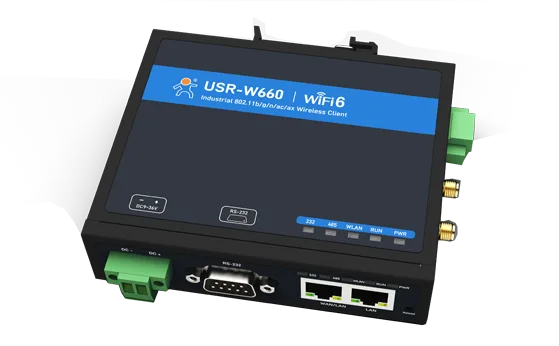
Overview. The PUSR USR-W660 serial to Wi-Fi 6 converter is a dual-band Wi-Fi device server that provides data communication between serial equipment and Ethernet or Wi-Fi networks. It is fitted with two Gigabit RJ45 ports, an RS232 interface on a DB9 male connector and an RS485 interface on a 3-pin block terminal.
Main characteristics. The product supports IEEE 802.11b/g/n/ac/ax on 2.4 GHz and 5.8 GHz, with a data speed of 1201 Mbps on 5.8 GHz and 573.5 Mbps on 2.4 GHz. It has 2 SMA-female antenna connectors, 2 x 2 MU-MIMO and OFDMA. It supports more than 60 Wi-Fi users and offers AP, STA, AP+STA and Bridge working modes, as well as Wi-Fi roaming.
Connectivity. The RJ45 port supports 10/100/1000 Mbps, complies with IEEE 802.3, offers automatic MDI/MDIX and 1.5 kV network isolation. RS232 baud rates range from 1200 to 115200 bps and RS485 baud rates from 1200 to 230400 bps. Data bits (7 or 8), stop bits (1 or 2) and parity (none, odd or even) are configurable. The product handles TCP, UDP, HTTP, TLS, MQTT, DHCP, PPPoE, SNMP and NTP.
Modbus gateway and MQTT. The Modbus gateway converts Modbus RTU and Modbus TCP protocols and supports Modbus multi-host polling. Standard MQTT communication provides 16 subscription topics and 16 publish topics. Compatible IoT platforms are AWS IoT, Alibaba Cloud and PUSR Cloud.
Power and environment. DC power input ranges from 9 to 36 V, on 2-pin terminal blocks, with reverse polarity and surge protection. Average consumption is 700 mA at 12 V, with a maximum of 2 A at 12 V. The metal casing provides IP30 protection. The operating temperature range is -25 °C to +70 °C and the operating humidity 5% to 95% RH, non-condensing. EMC protection covers surge, ESD and EFT at level 3 according to IEC61000.
Installation and configuration. The product can be wall-mounted, mounted on a DIN rail or placed on a desktop. Configuration is done through an HTTP web console, with a pinhole reset button. Dimensions are 115 x 94 x 29 mm, excluding antenna, pedestal, terminal block and DIN rail. Regulatory approvals include CCC, CE/RED, RoHS, WEEE and FCC.
Typical uses. This converter suits wireless links for serial equipment, in particular to PLCs via RS485 and Modbus, and to cloud platforms via MQTT.