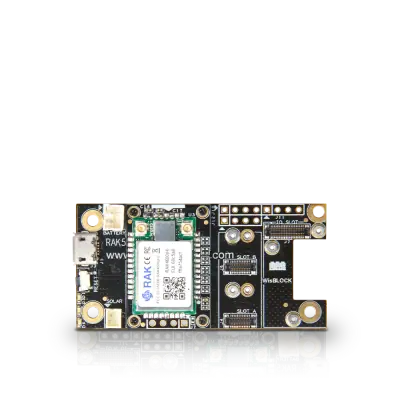
RAKwireless WisBlock starter kit combining the RAK19007 base board and the RAK11722 LoRaWAN core module, AS923 version, for modular IoT prototyping and connectivity testing.
Charging current350 mA
Discharge currentAt least 500 mA
Idle current, with MCU and sensors in sleep modeCurrent: 10; Unit: µA
Leakage current, without any module on RAK19007Current: 2; Unit: µA
Working current, with LoRa module transmittingCurrent: 130; Unit: mA
Frequency bandAS923
Product overview
RAKwireless RAK11722. The WisBlock RAK19007+RAK11722 starter kit is a modular IoT prototyping kit, AS923 version, combining the RAK19007 base board with the RAK11722 core module (LoRaWAN, Ambiq Apollo 3, RUI3 firmware).
Features. The RAK11722 core combines LoRaWAN with the Ambiq Apollo 3 microcontroller and runs the RUI3 firmware. The core is removable, so the connectivity path can change without replacing the base.
Connectivity. The kit supports LoRa and Bluetooth 5. The WisBlock connector exposes UART0, UART1, I2C1, I2C2, SPI, analog inputs AIN0 and AIN1, general purpose IOs, a BOOT pin and a RESET pin.
Power. The RAK19007 is powered by USB, a 3.7 V battery or a solar panel. It charges the battery at 4.5 – 5.5 V and 350 mA, with a discharge current of at least 500 mA. Idle current with MCU and sensors in sleep mode is 10 µA. A non-rechargeable battery must be unplugged before connecting the USB cable.
Environment. Operational temperature range from -35 to +75 °C, storage temperature range from -40 to +80 °C. CE certified.
Typical uses. Prototyping of LoRaWAN sensor nodes, connectivity testing and sensor integration through the I2C and SPI buses or the UART ports.
No published question about this part yet. Questions are reviewed before publication.
Complete specifications
Every characteristic recorded for 119036, with where it comes from. Use the filters to find one quickly.
All specifications (40)
Characteristic
Value
Frequency band
AS923
3V3
Pin Number: 5; Pin Number: 6; Function Name of WisBlock Base: 3V3
AIN0
Pin Number: 21; Pin Number: 22; Function Name of WisBlock Base: AIN1
Battery voltage ( VBAT )
Maximum Value: –0.3 to 4.3; Unit: V
BOOT0
Pin Number: 23; Pin Number: 24; Function Name of WisBlock Base: IO7
Capacity
As required
Certifications
CE
Charging current
350 mA
Charging voltage
4.5 – 5.5 V
Discharge current
At least 500 mA
ESD
Maximum Value: 2000; Unit: V
Extended Temperature Range
Minimum: –40 ºC; Typical: +25 ºC; Maximum: +80 ºC
GND
Pin Number: 3; Pin Number: 4; Function Name of WisBlock Base: GND
I2C1_SDA
Pin Number: 19; Pin Number: 20; Function Name of WisBlock Base: I2C1_SCL
I2C2_SDA
Pin Number: 35; Pin Number: 36; Function Name of WisBlock Base: I2C2_SCL
Idle current, with MCU and sensors in sleep mode
Current: 10; Unit: µA
IO1
Pin Number: 29; Pin Number: 30; Function Name of WisBlock Base: IO2
IO3
Pin Number: 31; Pin Number: 32; Function Name of WisBlock Base: IO4
IO5
Pin Number: 37; Pin Number: 38; Function Name of WisBlock Base: IO6
IOs of WisBlock connector
Maximum Value: –0.3 to VDD+0.3; Unit: V
Leakage current, without any module on RAK19007
Current: 2; Unit: µA
LED2
Pin Number: 15; Pin Number: 16; Function Name of WisBlock Base: LED3
Model
RAK19007
Operational Temperature Range
Minimum: –35 ºC; Typical: +25 ºC; Maximum: +75 ºC
Power supply on the USB port ( VBUS )
Maximum Value: –0.3 to 5.5; Unit: V
Product
RAK19007+RAK11722 LoRaWAN Ambiq Apollo 3 Core with RUI3
Reset
Pin Number: 13; Pin Number: 14; Function Name of WisBlock Base: LED1
Solar panel voltage ( CONN_S )
Maximum Value: –0.3 to 5.5; Unit: V
SPI_CS
Pin Number: 25; Pin Number: 26; Function Name of WisBlock Base: SPI_CLK
SPI_MIS0
Pin Number: 27; Pin Number: 28; Function Name of WisBlock Base: SPI_MOSI
Standard voltage
3.7 V
Storage Temperature Range
Minimum: –40 ºC; Typical: +25 ºC; Maximum: +80 ºC
TXD0
Pin Number: 11; Pin Number: 12; Function Name of WisBlock Base: RXD0
TXD1
Pin Number: 33; Pin Number: 34; Function Name of WisBlock Base: RXD1
USB
Pin Number: 7; Pin Number: 8; Function Name of WisBlock Base: USB–
VBAT
Pin Number: 1; Pin Number: 2; Function Name of WisBlock Base: VBAT
VBUS
Pin Number: 9; Pin Number: 10; Function Name of WisBlock Base: SW1
VDD
Pin Number: 17; Pin Number: 18; Function Name of WisBlock Base: VDD
Wireless technologies
Bluetooth 5, LoRa
Working current, with LoRa module transmitting
Current: 130; Unit: mA
No specification matches.
Last verification : 2026-10-31
Technical documentation
Official documents and the technical data recorded for 119036. For a missing document or a specific revision, our experts send it to you.
1. Technical overview
RAKwireless WisBlock starter kit combining the RAK19007 base board and the RAK11722 LoRaWAN core module, AS923 version, for modular IoT prototyping and connectivity testing.
Charging current350 mA
Discharge currentAt least 500 mA
Idle current, with MCU and sensors in sleep modeCurrent: 10; Unit: µA
Leakage current, without any module on RAK19007Current: 2; Unit: µA
Working current, with LoRa module transmittingCurrent: 130; Unit: mA
2. Datasheet extract (recorded values)
Parameter
Value
Frequency band
AS923
3V3
Pin Number: 5; Pin Number: 6; Function Name of WisBlock Base: 3V3
AIN0
Pin Number: 21; Pin Number: 22; Function Name of WisBlock Base: AIN1
Battery voltage ( VBAT )
Maximum Value: –0.3 to 4.3; Unit: V
BOOT0
Pin Number: 23; Pin Number: 24; Function Name of WisBlock Base: IO7
Capacity
As required
Certifications
CE
Charging current
350 mA
Charging voltage
4.5 – 5.5 V
Discharge current
At least 500 mA
ESD
Maximum Value: 2000; Unit: V
Extended Temperature Range
Minimum: –40 ºC; Typical: +25 ºC; Maximum: +80 ºC
GND
Pin Number: 3; Pin Number: 4; Function Name of WisBlock Base: GND
I2C1_SDA
Pin Number: 19; Pin Number: 20; Function Name of WisBlock Base: I2C1_SCL
I2C2_SDA
Pin Number: 35; Pin Number: 36; Function Name of WisBlock Base: I2C2_SCL
Idle current, with MCU and sensors in sleep mode
Current: 10; Unit: µA
IO1
Pin Number: 29; Pin Number: 30; Function Name of WisBlock Base: IO2
IO3
Pin Number: 31; Pin Number: 32; Function Name of WisBlock Base: IO4
IO5
Pin Number: 37; Pin Number: 38; Function Name of WisBlock Base: IO6
IOs of WisBlock connector
Maximum Value: –0.3 to VDD+0.3; Unit: V
Leakage current, without any module on RAK19007
Current: 2; Unit: µA
LED2
Pin Number: 15; Pin Number: 16; Function Name of WisBlock Base: LED3
Model
RAK19007
Operational Temperature Range
Minimum: –35 ºC; Typical: +25 ºC; Maximum: +75 ºC
Power supply on the USB port ( VBUS )
Maximum Value: –0.3 to 5.5; Unit: V
Product
RAK19007+RAK11722 LoRaWAN Ambiq Apollo 3 Core with RUI3
Reset
Pin Number: 13; Pin Number: 14; Function Name of WisBlock Base: LED1
Solar panel voltage ( CONN_S )
Maximum Value: –0.3 to 5.5; Unit: V
SPI_CS
Pin Number: 25; Pin Number: 26; Function Name of WisBlock Base: SPI_CLK
SPI_MIS0
Pin Number: 27; Pin Number: 28; Function Name of WisBlock Base: SPI_MOSI
Standard voltage
3.7 V
Storage Temperature Range
Minimum: –40 ºC; Typical: +25 ºC; Maximum: +80 ºC
TXD0
Pin Number: 11; Pin Number: 12; Function Name of WisBlock Base: RXD0
TXD1
Pin Number: 33; Pin Number: 34; Function Name of WisBlock Base: RXD1
USB
Pin Number: 7; Pin Number: 8; Function Name of WisBlock Base: USB–
VBAT
Pin Number: 1; Pin Number: 2; Function Name of WisBlock Base: VBAT
VBUS
Pin Number: 9; Pin Number: 10; Function Name of WisBlock Base: SW1
VDD
Pin Number: 17; Pin Number: 18; Function Name of WisBlock Base: VDD
Wireless technologies
Bluetooth 5, LoRa
Working current, with LoRa module transmitting
Current: 130; Unit: mA
Applications and use cases
Architectures in which 119036 can play a role, derived from its category. This is not a compatibility statement: check the specifications against your requirements.
RAKwireless WisGate gateways run WisGateOS 2 and are managed from WisDM, RAKwireless’ cloud device management platform with a built-in network server, alongside RAK sensor nodes, radio modules and concentrators
To check
WisDM built-in network server, or a third-party one (ChirpStack, TTN/TTS, AWS IoT Core, Actility)
Remote configuration and updates of the gateways from WisDM
Regional frequency plan of the gateways and nodes
Associated system blocks
GatewaysSensors and modulesDevelopment boardsMounting
Seeed SenseCAP sensors connect to Seeed’s SenseCAP cloud platform and app, and Seeed edge computers, camera modules, Grove and XIAO boards complete the chain for custom devices and local processing
To check
SenseCAP cloud platform and app, or the customer’s own network server
Prototype on Grove and XIAO, then move to industrial versions
Local processing on the edge computers or in the cloud
Associated system blocks
SensorsEdge computingDevelopment boards
Need a complete solution?
Send a request for 119036 and the other parts of your project.
Similar parts to answer your needs. Compare the main characteristics. A recorded replacement is a documented relation; a similar product is a similarity only, never a compatibility claim.
Current productRAKwireless
119036
WisBlock LoRaWAN Starter Kit with Apollo 3 Core and RAK19007 Base
No advertising or analytics cookies. A single, strictly necessary cookie is set only if you sign in to your account. Your quote basket and comparison stay in your browser. Details