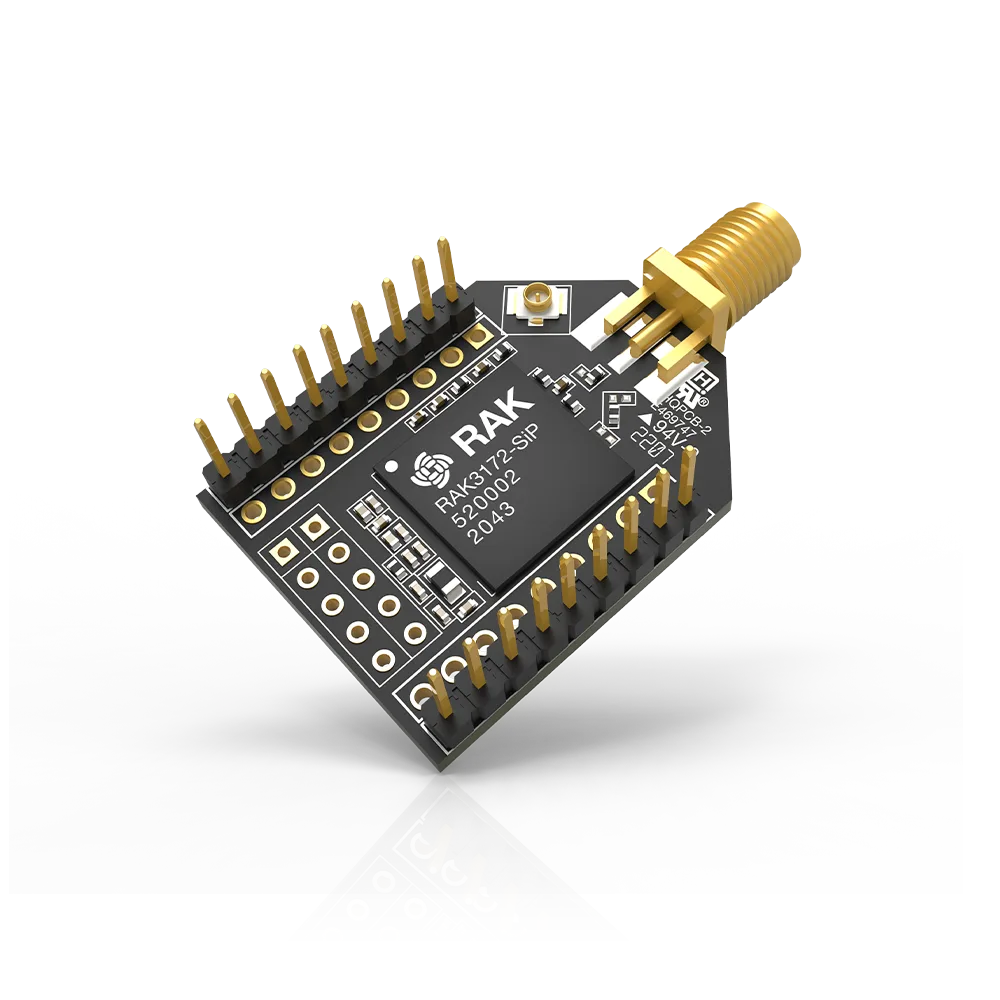
RAKwireless evaluation board for the RAK3272LP-SiP LoRa LPWAN module, with all pins accessible on 2.54 mm pin headers, for developing and testing LoRaWAN applications.
Temperature range-40° C ~ 85° C
Supply voltage2.0 V ~ 3.6 V
Frequency band9XXMHz for US915/AU915/KR920/AS923
3V33.3 V
GNDGround
ModelRAK3272
Product overview
Overview. The RAKwireless RAK3272LP-SiP evaluation board lets you evaluate the RAK3272LP-SiP LPWAN module, based on the STM32WLE5, in the 9XX MHz version for US915, AU915, KR920 and AS923. All module pins are accessible on six rows of pin headers at a standard 2.54 mm pitch.
Main characteristics. The module is a low-power long-range transceiver compliant with Class A, B and C of LoRaWAN 1.0.4. Its TX power reaches 15 dBm in this low-power version. Typical current consumption is 1.69 uA in sleep and 6.14 mA in RX mode. The module measures 25.4 x 32.3 mm.
Interfaces and connectivity. Configuration is done with AT commands over the UART2/LPUART1 interface, which also handles firmware updates. The I2C2 pins (SDA and SCL), the SWD debug pins (SWDIO and SWCLK) and the RST reset pin are available. The module supports LoRa Point-to-Point (P2P) mode and connects to platforms such as TheThingsNetwork (TTN), Chirpstack or Actility.
Power and environment. The supply voltage ranges from 2.0 V to 3.6 V, and the board provides a 3V3 output. The operating temperature range is -40 °C to 85 °C.
Typical uses. This board suits prototyping of LoRaWAN sensors and nodes and evaluation of LoRa point-to-point links in the 9XX MHz bands.
Integration. Custom firmware is integrated through the RUI3 APIs, with .bin and .hex files available for download for RUI3.
Version: RUI3 (Bootloader and App); Source: Download
RAK3272LP-SiP (.bin)
Version: RUI3 (App only); Source: Download
RAK3272LP-SiP (.hex)
Version: RUI3 (Bootloader and App); Source: Download
RX mode
Current Consumption (Typical): 6.14 mA
Sleep mode
Current Consumption (Typical): 1.69 uA
Supported bands
IN865, EU868, AU915, US915, KR920, RU864, and AS923
Temperature range
-40° C ~ 85° C
TX mode
Condition: 20 dBm; Current Consumption (Typical): 87 mA
Variant
RAK3272LP-SiP
VBAT
Minimum: 1.55; Maximum: 3.6; Unit: Volts (V)
VCC
Minimum: 2.0; Maximum: 3.6; Unit: Volts (V)
VDD and GPIO
Minimum: -0.3 V; Maximum: 3.9; Unit: Volts (V)
VDDA (ADC, COMP or VREFBUF not used)
Minimum: 0; Maximum: 3.6; Unit: Volts (V)
VDDA (ADC or COMP used)
Minimum: 1.71; Maximum: 3.6; Unit: Volts (V)
VDDA (VREFBUF used)
Minimum: 2.4; Maximum: 3.6; Unit: Volts (V)
VDDPA
Minimum: 2.0; Maximum: 3.6; Unit: Volts (V)
VDDRF
Minimum: 2.0; Maximum: 3.6; Unit: Volts (V)
VDDSMPS
Minimum: 2.0; Maximum: 3.6; Unit: Volts (V)
VREF+
Minimum: 2.0; Maximum: VDDA; Unit: Volts (V)
VREF+ (VDDA < 2V)
Minimum: VDDA; Maximum: VDDA; Unit: Volts (V)
Wireless technologies
LoRa
No specification matches.
Last verification : 2026-10-31
Technical documentation
Official documents and the technical data recorded for 316050. For a missing document or a specific revision, our experts send it to you.
1. Technical overview
RAKwireless evaluation board for the RAK3272LP-SiP LoRa LPWAN module, with all pins accessible on 2.54 mm pin headers, for developing and testing LoRaWAN applications.
Version: RUI3 (Bootloader and App); Source: Download
RAK3272LP-SiP (.bin)
Version: RUI3 (App only); Source: Download
RAK3272LP-SiP (.hex)
Version: RUI3 (Bootloader and App); Source: Download
RX mode
Condition: -; Current Consumption (Typical): 6.14 mA
Sleep mode
Condition: -; Current Consumption (Typical): 1.69 uA
Supported bands
IN865, EU868, AU915, US915, KR920, RU864, and AS923
Temperature range
-40° C ~ 85° C
TX mode
Condition: 20 dBm; Current Consumption (Typical): 87 mA
Variant
RAK3272LP-SiP
VBAT
Minimum: 1.55; Maximum: 3.6; Unit: Volts (V)
VCC
Minimum: 2.0; Maximum: 3.6; Unit: Volts (V)
VDD and GPIO
Minimum: -0.3 V; Maximum: 3.9; Unit: Volts (V)
VDDA (ADC, COMP or VREFBUF not used)
Minimum: 0; Maximum: 3.6; Unit: Volts (V)
VDDA (ADC or COMP used)
Minimum: 1.71; Maximum: 3.6; Unit: Volts (V)
VDDA (VREFBUF used)
Minimum: 2.4; Maximum: 3.6; Unit: Volts (V)
VDDPA
Minimum: 2.0; Maximum: 3.6; Unit: Volts (V)
VDDRF
Minimum: 2.0; Maximum: 3.6; Unit: Volts (V)
VDDSMPS
Minimum: 2.0; Maximum: 3.6; Unit: Volts (V)
VREF+
Minimum: 2.0; Maximum: VDDA; Unit: Volts (V)
VREF+ (VDDA < 2V)
Minimum: VDDA; Maximum: VDDA; Unit: Volts (V)
Wireless technologies
LoRa
Integration
Points to check before using 316050 in a design. They are derived from the recorded characteristics, not from the manufacturer's application circuits.
1Powerplan for a supply compatible with 2.0 V ~ 3.6 V.
Power and communication
Supply voltage
2.0 V ~ 3.6 V
Check the exact pin assignment and the application circuit in the datasheet, or ask our experts.
Implementation checklist
Power : plan for a supply compatible with 2.0 V ~ 3.6 V.
Applications and use cases
Architectures in which 316050 can play a role, derived from its category. This is not a compatibility statement: check the specifications against your requirements.
RAKwireless WisGate gateways run WisGateOS 2 and are managed from WisDM, RAKwireless’ cloud device management platform with a built-in network server, alongside RAK sensor nodes, radio modules and concentrators
To check
WisDM built-in network server, or a third-party one (ChirpStack, TTN/TTS, AWS IoT Core, Actility)
Remote configuration and updates of the gateways from WisDM
Regional frequency plan of the gateways and nodes
Associated system blocks
GatewaysSensors and modulesDevelopment boardsMounting
Seeed SenseCAP sensors connect to Seeed’s SenseCAP cloud platform and app, and Seeed edge computers, camera modules, Grove and XIAO boards complete the chain for custom devices and local processing
To check
SenseCAP cloud platform and app, or the customer’s own network server
Prototype on Grove and XIAO, then move to industrial versions
Local processing on the edge computers or in the cloud
Associated system blocks
SensorsEdge computingDevelopment boards
Need a complete solution?
Send a request for 316050 and the other parts of your project.
Similar parts to answer your needs. Compare the main characteristics. A recorded replacement is a documented relation; a similar product is a similarity only, never a compatibility claim.
What is recorded about the regulatory status and the life of this part.
Regulatory compliance
No compliance statement is recorded for this part. Ask the supplier for the RoHS and REACH declarations and, for a radio product, the EU declaration of conformity.
No advertising or analytics cookies. A single, strictly necessary cookie is set only if you sign in to your account. Your quote basket and comparison stay in your browser. Details