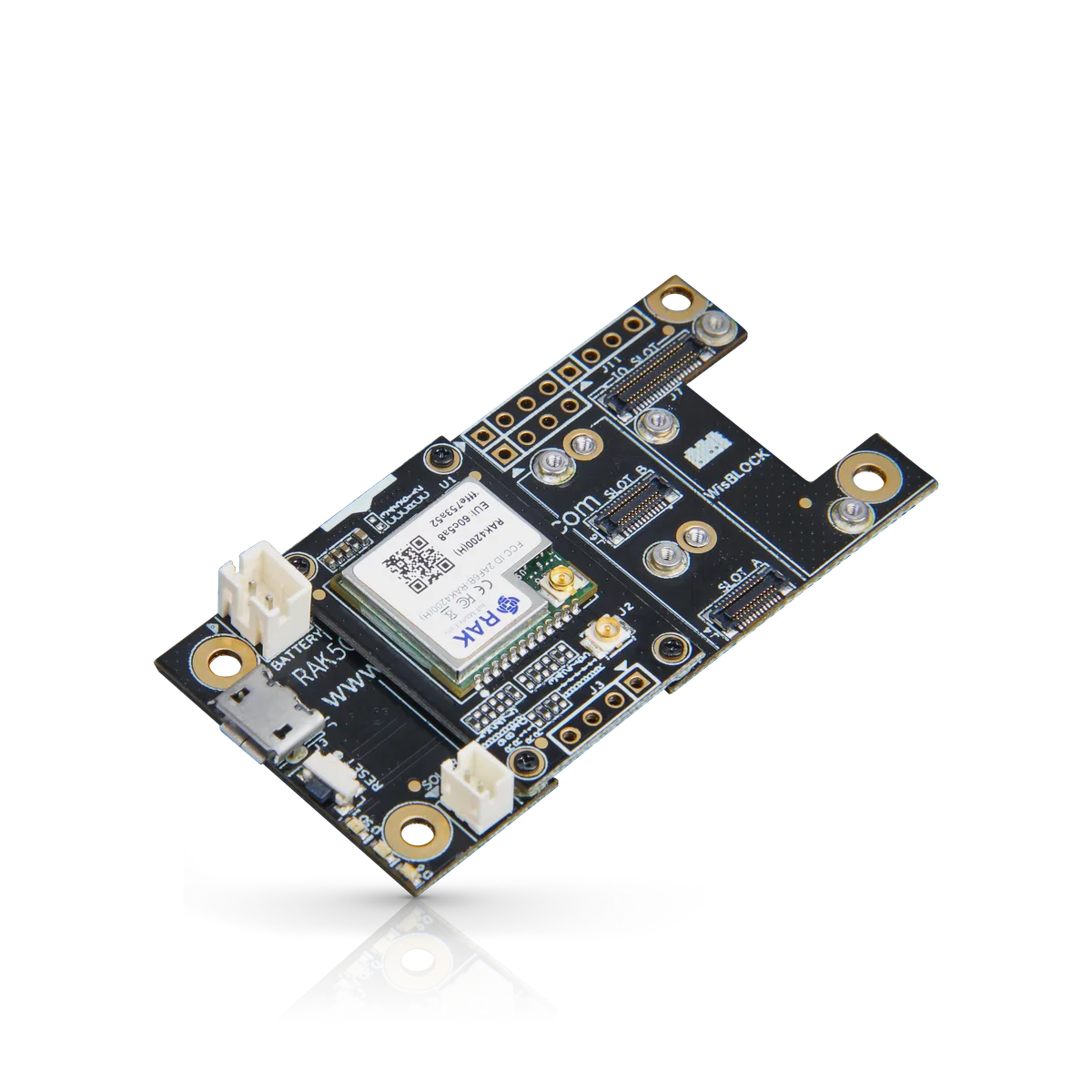
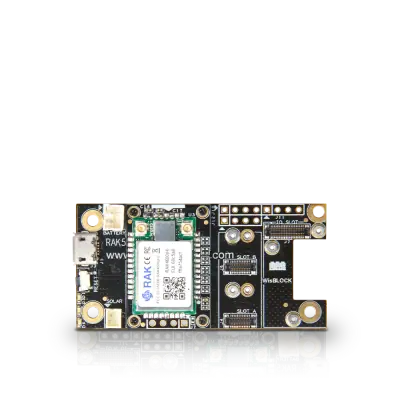
The RAKwireless RAK4200 AS923 evaluation board gives access to the serial and GPIO ports of the RAK4200 LoRa module, built around an STM32L071 MCU and an SX1276 chip, for developing LPWAN applications.
Temperature range-40°C to +85°C
Frequency bandAS923
CertificationsCE, FCC
CoreARM 32-bit Cortex M0+ with MPU
I/O portsUART/I2C/GPIO
ModelRAK4200
Product overview
Overview. The RAKwireless RAK4200 AS923 evaluation board (reference 319005) combines the RAK4200 LPWAN module with the RAK5005 WisBlock base. It gives access to all serial and GPIO ports for easy configuration. The module combines an STM32L071 MCU with an ARM Cortex M0+ core and MPU and an SX1276 LoRa chip compliant with the LoRaWAN 1.0.2 protocols. This version is set for AS923 and uses the H type module.
Main characteristics. Frequency range 433 to 470 MHz and 863 to 923 MHz, covering the entire LoRa spectrum. LoRa wireless technology at 37.5 kbps. Operating temperature range -40 °C to +85 °C. CE and FCC certified.
Power consumption. Receive mode LoRa at 37.5 kbps, 15 mA. Transmit mode LoRa at 17 dBm, 87 mA, and at 19 dBm, 120 mA, with PA_BOOST and BT sleep. Typical consumption measured at 3.3 V is 8.66 µA in EU868 and 9.40 µA in US915.
Interfaces and connectivity. UART2 port for AT commands (STM32L071 pins PA2 and PA3), I2C bus with SCL and SDA signals, GPIO pins, and SWDIO and SWCLK programming pins.
Typical uses. Prototyping LoRaWAN nodes, configuring the module with AT commands over UART2, and developing applications on the STM32L071 MCU.
Integration. The I2C and UART pins allow connection of sensors or a host microcontroller. Available on quotation from Atlas Electronics.
433 to 470 MHz; 863 to 923 MHz (entire LoRa® spectrum)
I/O ports
UART/I2C/GPIO
Model
RAK4200
RAK4200
Version: v3.2.0.16; Source: Download
RAK4200(H)
Region: Russia; Frequency (MHz): RU864; Region: India; Frequency (MHz): IN865; Region: Europe; Frequency (MHz): EU868; Region: North America; Frequency (MHz): US915; Region: Australia; Frequency (MHz): AU915; Region: Korea; Frequency (MHz): KR920; Region: Asia; Frequency (MHz): AS923
RAK4200(L)
Region: Europe; Frequency (MHz): EU433; Region: China; Frequency (MHz): CN470
Official documents and the technical data recorded for 319005. For a missing document or a specific revision, our experts send it to you.
1. Technical overview
The RAKwireless RAK4200 AS923 evaluation board gives access to the serial and GPIO ports of the RAK4200 LoRa module, built around an STM32L071 MCU and an SX1276 chip, for developing LPWAN applications.
433 to 470 MHz; 863 to 923 MHz (entire LoRa® spectrum)
I/O ports
UART/I2C/GPIO
Model
RAK4200
RAK4200
Version: v3.2.0.16; Source: Download
RAK4200(H)
Region: Russia; Frequency (MHz): RU864; Region: India; Frequency (MHz): IN865; Region: Europe; Frequency (MHz): EU868; Region: North America; Frequency (MHz): US915; Region: Australia; Frequency (MHz): AU915; Region: Korea; Frequency (MHz): KR920; Region: Asia; Frequency (MHz): AS923
RAK4200(L)
Region: Europe; Frequency (MHz): EU433; Region: China; Frequency (MHz): CN470
Architectures in which 319005 can play a role, derived from its category. This is not a compatibility statement: check the specifications against your requirements.
RAKwireless WisGate gateways run WisGateOS 2 and are managed from WisDM, RAKwireless’ cloud device management platform with a built-in network server, alongside RAK sensor nodes, radio modules and concentrators
To check
WisDM built-in network server, or a third-party one (ChirpStack, TTN/TTS, AWS IoT Core, Actility)
Remote configuration and updates of the gateways from WisDM
Regional frequency plan of the gateways and nodes
Associated system blocks
GatewaysSensors and modulesDevelopment boardsMounting
Seeed SenseCAP sensors connect to Seeed’s SenseCAP cloud platform and app, and Seeed edge computers, camera modules, Grove and XIAO boards complete the chain for custom devices and local processing
To check
SenseCAP cloud platform and app, or the customer’s own network server
Prototype on Grove and XIAO, then move to industrial versions
Local processing on the edge computers or in the cloud
Associated system blocks
SensorsEdge computingDevelopment boards
Need a complete solution?
Send a request for 319005 and the other parts of your project.
Similar parts to answer your needs. Compare the main characteristics. A recorded replacement is a documented relation; a similar product is a similarity only, never a compatibility claim.
Current productRAKwireless
319005
RAK4200 LoRa AS923 evaluation board with STM32L071
No advertising or analytics cookies. A single, strictly necessary cookie is set only if you sign in to your account. Your quote basket and comparison stay in your browser. Details