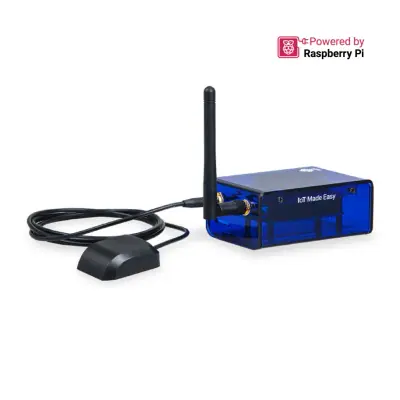
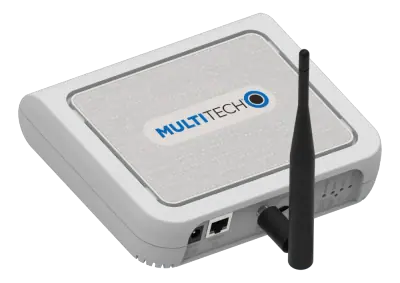
Overview. The RAK Hotspot V2 from RAKwireless is an outdoor LoRaWAN gateway operating in the AS923 band, between 863 MHz and 870 MHz. This outdoor bundle includes an 8 dBi fiberglass antenna, with a stated peak gain of 2.8 dBi, and a field tester to optimise site placement.
Main characteristics. The supported modulation techniques are FSK/LoRa. Sensitivity is specified at -139 dBm for spreading factor 12 with a 125 bandwidth, -136 dBm for 250 and -134 dBm for 500. Transmit power is specified at 8 dBm at power level setting 1. The voltage standing wave ratio (VSWR) is specified at 1.5 or less with a feed impedance of 50 ohms.
Interfaces and connectivity. The unit provides a Gigabit Ethernet port for wired network connectivity, a LoRa antenna connector for the external antenna, a TF card slot holding the system image and device data, and a pairing button. LEDs indicate the operating status.
Power and environment. Power is supplied through a USB-C port, with a UK standard power plug. Standby consumption is typically 550 mA. The operating temperature range is -10 ºC to +55 ºC, the storage temperature range is -40 ºC to +85 ºC, and the working temperature and humidity range is -35 to +75 ºC at 5 to 95 %RH.
Typical uses. This gateway suits the deployment of an outdoor LoRaWAN network, in particular for covering connected sensors in the AS923 band.
Architectures in which A19025 can play a role, derived from its category. This is not a compatibility statement: check the specifications against your requirements.
Energy bills give one total for the whole site. Submetering places meters and current sensors on each circuit or usage and collects their readings through a gateway, so consumption can be followed per building, floor or machine
To check
Number of circuits and phases to meter, and the current range of each
Wired Modbus bus or wireless LoRaWAN, depending on cabling access in the switchboards
Accuracy class required for internal allocation or for billing
Offices and classrooms get stuffy without anyone measuring why. Indoor air quality monitoring places CO2, VOC and particle sensors in the rooms and reports their values through a gateway, so ventilation can be adjusted to real occupancy
To check
Parameters to measure (CO2 alone or CO2, VOC and particles)
Battery-powered sensors or mains-powered sensors with display
Integration with the ventilation control or building management system
A leak under a sink or in a technical room is often found days later. Leak detection places wireless sensors where water can appear and sends an alert through a gateway as soon as one of them gets wet
To check
Locations at risk: kitchens, bathrooms, plant rooms, server rooms
Alert path (SMS, e-mail, application) and who receives it
Battery life and the way a low battery is reported
A fridge that drifts at night can ruin a whole stock. Temperature loggers in cold rooms and trucks report through a gateway or a tracker and raise an alert when a threshold is crossed
To check
Temperature range and accuracy required by the product
Record keeping required by the applicable regulations
A LoRaWAN project needs sensors, gateways, a network server and an application that work together. Sensor nodes report to indoor or outdoor gateways, which forward the data to the network server and the customer’s platform
To check
Regional frequency plan (EU868, US915 and others)
Network server: public, private or embedded in the gateway
A building’s energy, comfort and occupancy data sit in separate systems. Sensors, meters and gateways feed one model of the building, room by room, to compare scenarios and steer the installations
Milesight sensors, LoRaWAN gateways and cellular routers can be brought together on the Milesight Development Platform, which manages the devices and passes their data to other applications through an API and webhooks
To check
Development Platform for device management, API and webhooks, or another network server and application
Devices provisioned through Milesight RPS must have that provisioning removed before being added to the Development Platform
Data flows to the customer’s own application through webhooks
RAKwireless WisGate gateways run WisGateOS 2 and are managed from WisDM, RAKwireless’ cloud device management platform with a built-in network server, alongside RAK sensor nodes, radio modules and concentrators
To check
WisDM built-in network server, or a third-party one (ChirpStack, TTN/TTS, AWS IoT Core, Actility)
Remote configuration and updates of the gateways from WisDM
Regional frequency plan of the gateways and nodes
Associated system blocks
GatewaysSensors and modulesDevelopment boardsMounting
Need a complete solution?
Send a request for A19025 and the other parts of your project.
Similar parts to answer your needs. Compare the main characteristics. A recorded replacement is a documented relation; a similar product is a similarity only, never a compatibility claim.
What is recorded about the regulatory status and the life of this part.
Regulatory compliance
No compliance statement is recorded for this part. Ask the supplier for the RoHS and REACH declarations and, for a radio product, the EU declaration of conformity.
No advertising or analytics cookies. A single, strictly necessary cookie is set only if you sign in to your account. Your quote basket and comparison stay in your browser. Details