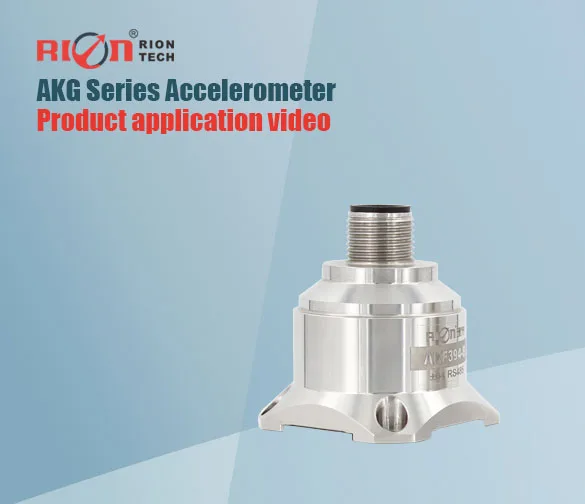
The Rion AKF392T triaxial accelerometer is a digital vibration sensor with RS232, RS485 or TTL outputs, intended for machine condition monitoring and shock and vibration measurement.
Output InterfaceRS232/RS485/TTL
Current consumption<60mA @ 12 VDC
Resonance frequency — 2.4 — 5.5kHz
AKF392T — PARAMETERUNIT
Bandwidth (3DB) — 500Hz
ConnectorIndustry standard M12 connector
Product overview
Rion AKF392T triaxial accelerometer. The Rion AKF392T is a digital MEMS triaxial accelerometer measuring the X, Y and Z axes, used for vibration monitoring and shock testing. Main characteristics — Measuring ranges of ±2, ±4, ±8, ±10, ±20 and ±40 g, 3 dB bandwidth of 500 Hz, resolution below 1 mg at 1 Hz, noise density of 21 to 86.6 μg/√Hz and nonlinearity below 1 % FS at highest. Interfaces and communication — RS232, RS485 and TTL outputs, industry standard M12 connector, Rion Standard Protocol and Modbus RTU protocol with automatic Modbus output rates of 10 Hz, 25 Hz and 50 Hz. Power and environment — Supply of 9 to 36 VDC, consumption below 60 mA at 12 VDC, shock resistance of 100 g for 11 ms in three axial directions and vibration of 20 g RMS between 20 and 2000 Hz. Reliability — MIL-HDBK-217, grade 2. Dimensions and mounting — Housing of 34.3 × 34.3 × 38.5 mm, magnetic adsorption base and L-shaped adapter plate for fixing, net weight of 82 g for the sensor alone. Typical uses — Vibration monitoring on machinery and engines and crash recording or fatigue monitoring, with RS485 and Modbus RTU outputs compatible with PLCs and supervision systems.
No published question about this part yet. Questions are reviewed before publication.
Complete specifications
Every characteristic recorded for TRIAXIAL_ACCELEROMETER, with where it comes from. Use the filters to find one quickly.
All specifications (25)
Characteristic
Value
Current consumption
<60mA @ 12 VDC
AKF392T — PARAMETER
UNIT
Bandwidth (3DB) — 500
Hz
Connector
Industry standard M12 connector
Cross-axis sensitivity — 1 — 2
%
Deviation calibration — <1
mg
Deviation Temp. Coefficient — 0.01
%/℃(Typical value)
Dimension
Product size: 34.3*34.3*38.5mm; Magnetic adsorption base size: 34.23*34.23*6mm; L-shaped adapter plate size: 36*44*15mm
Input (VDD _ VSS)
9-36 VDC
Lateral vibration sensitivity ratio — 1 — 2 — 5
%
Measuring Axial — X,Y,Z
Axial
MODBUS automatic output rate
10Hz、25Hz、50Hz
Noise density — 21 — 86.6
μg/√Hz
Nonlinearity — <0.5 — <0.8 — <1
% FS(highest)
Output Interface
RS232/RS485/TTL
Protocol
Rion Standard Protocol And Modbus Rtu Protocol
Range — ±2 — ±4 — ±8 — ±10 — ±20 — ±40
g
Recovery Time
<1ms(1000g, 1/2 Sin 1ms,Shock Acting On The i Axis)
Reliability
MIL-HDBK-217,Grade 2
Resolution/Threshold (@ 1Hz) — < 1
mg(highest)
Resonance frequency — 2.4 — 5.5
kHz
Shock Resistance
100g@11ms、3 Axial Direction (Half Sinusoid)
Up/Off Power Repeatability — <2
mg(highest)
Vibrate
20g Rms,20~2000Hz (Random Noise,o,p,i Per Axis For Action 30 Minutes )
Weight
Product net weight: 82g, magnetic base: 48g, L-shaped adapter plate 20g
No specification matches.
Last verification : 2026-11-03
Technical documentation
Official documents and the technical data recorded for TRIAXIAL_ACCELEROMETER. For a missing document or a specific revision, our experts send it to you.
1. Technical overview
The Rion AKF392T triaxial accelerometer is a digital vibration sensor with RS232, RS485 or TTL outputs, intended for machine condition monitoring and shock and vibration measurement.
Output InterfaceRS232/RS485/TTL
Current consumption<60mA @ 12 VDC
Resonance frequency — 2.4 — 5.5kHz
AKF392T — PARAMETERUNIT
Bandwidth (3DB) — 500Hz
2. Datasheet extract (recorded values)
Parameter
Value
Current consumption
<60mA @ 12 VDC
AKF392T — PARAMETER
UNIT
Bandwidth (3DB) — 500
Hz
Connector
Industry standard M12 connector
Cross-axis sensitivity — 1 — 2
%
Deviation calibration — <1
mg
Deviation Temp. Coefficient — 0.01
%/℃(Typical value)
Dimension
Product size: 34.3*34.3*38.5mm; Magnetic adsorption base size: 34.23*34.23*6mm; L-shaped adapter plate size: 36*44*15mm
Input (VDD _ VSS)
9-36 VDC
Lateral vibration sensitivity ratio — 1 — 2 — 5
%
Measuring Axial — X,Y,Z
Axial
MODBUS automatic output rate
10Hz、25Hz、50Hz
Noise density — 21 — 86.6
μg/√Hz
Nonlinearity — <0.5 — <0.8 — <1
% FS(highest)
Output Interface
RS232/RS485/TTL
Protocol
Rion Standard Protocol And Modbus Rtu Protocol
Range — ±2 — ±4 — ±8 — ±10 — ±20 — ±40
g
Recovery Time
<1ms(1000g, 1/2 Sin 1ms,Shock Acting On The i Axis)
Reliability
MIL-HDBK-217,Grade 2
Resolution/Threshold (@ 1Hz) — < 1
mg(highest)
Resonance frequency — 2.4 — 5.5
kHz
Shock Resistance
100g@11ms、3 Axial Direction (Half Sinusoid)
Up/Off Power Repeatability — <2
mg(highest)
Vibrate
20g Rms,20~2000Hz (Random Noise,o,p,i Per Axis For Action 30 Minutes )
Weight
Product net weight: 82g, magnetic base: 48g, L-shaped adapter plate 20g
Applications and use cases
Architectures in which TRIAXIAL_ACCELEROMETER can play a role, derived from its category. This is not a compatibility statement: check the specifications against your requirements.
Machines stop without warning and repairs are done in a hurry. Vibration and temperature sensors on motors, pumps and fans report their condition through a gateway, so drift can be seen before the failure
To check
Machines to monitor first, by criticality
Vibration frequency range and sampling needed for the defects sought
Battery-powered wireless sensors or wired sensors
Associated system blocks
Condition sensorsGateway
Need a complete solution?
Send a request for TRIAXIAL_ACCELEROMETER and the other parts of your project.
Answers to the questions that the recorded characteristics of TRIAXIAL_ACCELEROMETER can answer. A question is not asked when nothing is recorded to answer it.
1Does it support RS-485?
Yes — recorded under "Output Interface": RS232/RS485/TTL.
2Does it support RS-232?
Yes — recorded under "Output Interface": RS232/RS485/TTL.
3Does it support Modbus?
Yes — recorded under "MODBUS automatic output rate": 10Hz、25Hz、50Hz.
Similar parts to answer your needs. Compare the main characteristics. A recorded replacement is a documented relation; a similar product is a similarity only, never a compatibility claim.
Current productRion
TRIAXIAL_ACCELEROMETER
Digital MEMS triaxial accelerometer with RS485 Modbus
What is recorded about the regulatory status and the life of this part.
Regulatory compliance
No compliance statement is recorded for this part. Ask the supplier for the RoHS and REACH declarations and, for a radio product, the EU declaration of conformity.
No advertising or analytics cookies. A single, strictly necessary cookie is set only if you sign in to your account. Your quote basket and comparison stay in your browser. Details