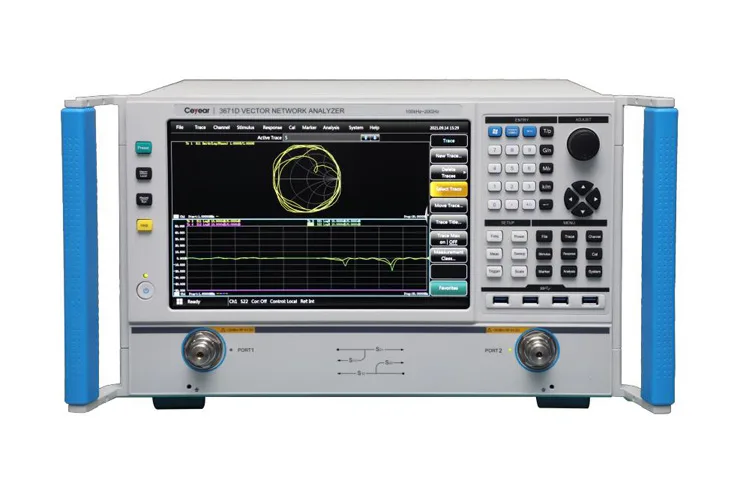
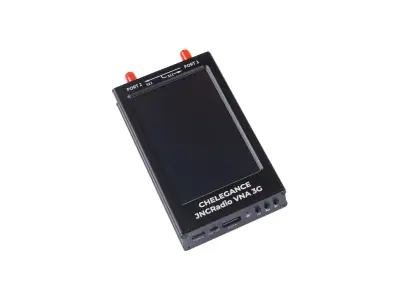
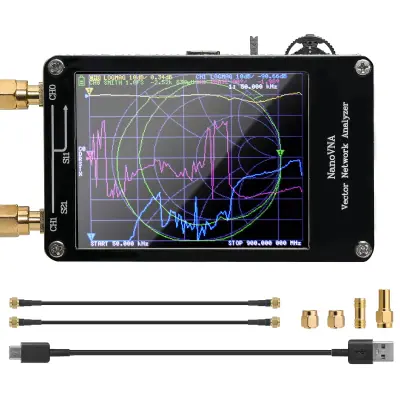
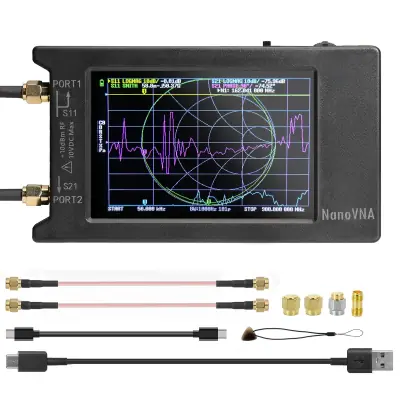
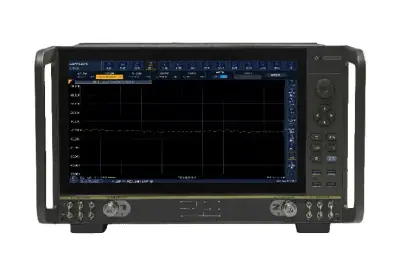
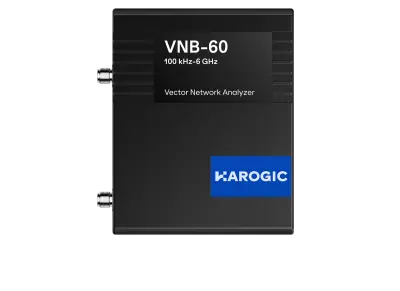
Overview. The Saluki 3671 Series vector network analyzer measures the amplitude-frequency, phase-frequency and group delay characteristics of microwave networks. It provides frequency response, response isolation, enhanced response, full two-port measurement and electronic calibration.
Main characteristics. Frequency range from 100 kHz to 26.5 GHz for the 3671E version (3671C covers up to 14 GHz, 3671D up to 20 GHz), with 2 measuring ports standard and 4 ports optional. Frequency resolution of 0.1 Hz. 12.1-inch 16:10 capacitive touch screen. Display formats include logarithmic and linear amplitude, phase, group delay, Smith chart and polar coordinates. Up to 64 channels and 32 measuring windows, each window displaying up to 16 traces.
Calibration. Automated, guided and electronic calibration (E-cal). Compatible with multiple mechanical calibration kits, supporting through response, through response and isolation, single port, enhanced response, full two-port SOLT and TRL calibrations.
Dynamic range and accuracy. Dynamic range of 132 dB between 10 MHz and 4 GHz in 2-port configuration. Effective directivity of 48 dB up to 2 GHz and 44 dB from 2 GHz to 26.5 GHz. Reflection tracking of ±0.04 dB to ±0.05 dB and transmission tracking of ±0.08 dB to ±0.10 dB depending on the band. Maximum output power of +15 dBm between 10 MHz and 10 GHz in 2-port configuration.
Connectivity. USB, GPIB, VGA, LAN and HDMI interfaces. 3.5 mm (male) port connectors.
Power and dimensions. Maximum power consumption of 300 W. Dimensions of 426 × 266 × 400 mm without soles and handles, and maximum weight of 25 kg for the 3671C, D and E versions.
Typical uses. Measurement of microwave devices in radar, communication and navigation applications, as well as in defence and university research.