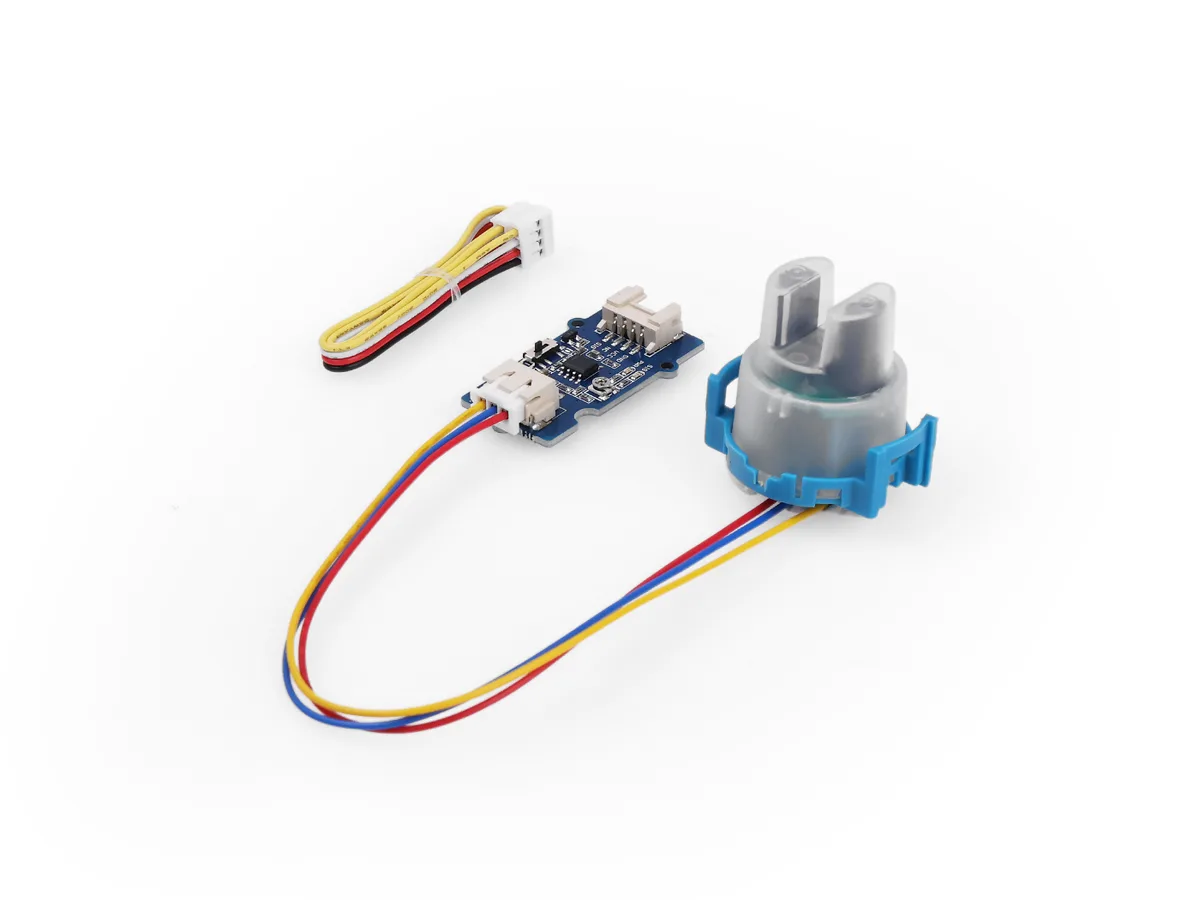
Seeed Studio Grove optical water turbidity sensor with analog or digital output, designed to measure the number of suspended particles in water.
Output InterfaceAnalog/Digital
Dimensions20*40mm
BatteryExclude
LEDs1 power LED, 1 signal LED
Operating Voltage3.3V/5V DC
Switch1 A-D toggle switch
Product overview
Seeed Studio Grove Turbidity Sensor (Meter) V1.0 — The Grove Turbidity Sensor V1.0 from Seeed Studio is a water turbidity sensor, that is, a sensor measuring the number of suspended particles in water, intended for use with Arduino.
Measuring principle. The TSW-10 module is an optical sensor that measures the density of turbid water and the concentration of extraneous matter using the refraction of light between a phototransistor and a diode. A light source and a light receiver measure the amount of light passing through the water in order to calculate its turbidity.
Main characteristics. Adjustable sensitivity via the on-board knob, making the sensor suitable for different application scenarios. Dimensions 20 x 40 mm. One power LED and one signal LED.
Interfaces and power. Analog or digital output, selected with the A-D toggle switch on the board. Operating voltage 3.3V or 5V DC. Grove unified socket for Plug and Play operation. Battery not included.
Typical uses. Measuring the water pollution degree in washing machines such as dishwashers to determine the optimal washing time and rinsing times; industrial site control; environmental wastewater treatment.
Integration. The sensor connects directly to an Arduino board through a Grove connector, without soldering.
No published question about this part yet. Questions are reviewed before publication.
Complete specifications
Every characteristic recorded for 101020752, with where it comes from. Use the filters to find one quickly.
All specifications (6)
Characteristic
Value
Dimensions
20*40mm
Battery
Exclude
LEDs
1 power LED, 1 signal LED
Operating Voltage
3.3V/5V DC
Output Interface
Analog/Digital
Switch
1 A-D toggle switch
No specification matches.
Last verification : 2026-11-02
Technical documentation
Official documents and the technical data recorded for 101020752. For a missing document or a specific revision, our experts send it to you.
1. Technical overview
Seeed Studio Grove optical water turbidity sensor with analog or digital output, designed to measure the number of suspended particles in water.
Output InterfaceAnalog/Digital
Dimensions20*40mm
BatteryExclude
LEDs1 power LED, 1 signal LED
Operating Voltage3.3V/5V DC
2. Datasheet extract (recorded values)
Parameter
Value
Dimensions
20*40mm
Battery
Exclude
LEDs
1 power LED, 1 signal LED
Operating Voltage
3.3V/5V DC
Output Interface
Analog/Digital
Switch
1 A-D toggle switch
Applications and use cases
Architectures in which 101020752 can play a role, derived from its category. This is not a compatibility statement: check the specifications against your requirements.
Seeed SenseCAP sensors connect to Seeed’s SenseCAP cloud platform and app, and Seeed edge computers, camera modules, Grove and XIAO boards complete the chain for custom devices and local processing
To check
SenseCAP cloud platform and app, or the customer’s own network server
Prototype on Grove and XIAO, then move to industrial versions
Local processing on the edge computers or in the cloud
Associated system blocks
SensorsEdge computingDevelopment boards
Need a complete solution?
Send a request for 101020752 and the other parts of your project.
Similar parts to answer your needs. Compare the main characteristics. A recorded replacement is a documented relation; a similar product is a similarity only, never a compatibility claim.
Current productSeeed Studio
101020752
Water Turbidity Sensor with Analog and Digital Output for Arduino
What is recorded about the regulatory status and the life of this part.
Regulatory compliance
No compliance statement is recorded for this part. Ask the supplier for the RoHS and REACH declarations and, for a radio product, the EU declaration of conformity.
No advertising or analytics cookies. A single, strictly necessary cookie is set only if you sign in to your account. Your quote basket and comparison stay in your browser. Details