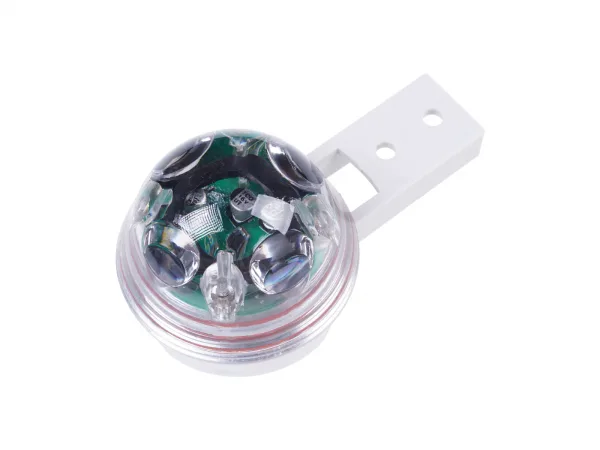
Overview. The Seeed Studio RG-9, reference 101990760, is an industrial-grade optical rain sensor designed to replace conventional tipping bucket rain gauges. It uses infrared light beams within a plastic lens and determines rainfall status and raindrop size from changes in light intensity.
Main characteristics. Four sensitivity levels are selectable: rain drops, very light, medium and heavy, set through DIP switches. Tipping bucket accuracy is ±10% in the manufacturer's controlled environment. Current drain is 110 uA nominal when no outputs are on and it is not raining, and 2-4 mA when raining. The round lens discourages the collection of debris and dirt, and the sensor has no moving parts or water pathways that can clog.
Interfaces and connectivity. The sensor provides an NPN open collector output rated 500 mA, 80 V, 300 mW maximum, which emulates a conventional tipping bucket. A 3.3 V RS232 port offers command-based bidirectional serial communication for detailed data and configuration, at baud rates of 1200, 2400, 4800, 9600, 19200, 38400 and 57600.
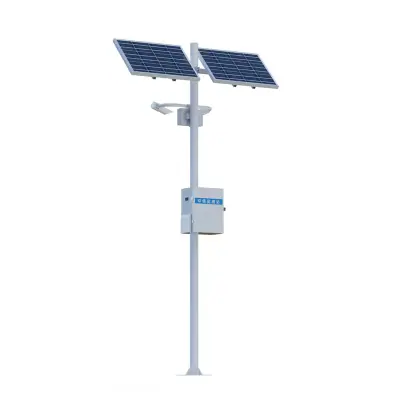
Power and environment. Input voltage ranges from 5 to 15 VDC on J1, reverse polarity protected to 50 V, or 3.3 VDC through pin 8 on J2. The operating temperature range is -40°C to +60°C, but the sensor will not detect rain when freezing. Its low power consumption makes it suitable for solar-powered applications.
Typical uses. The RG-9 suits smart agriculture, where precipitation data supports irrigation scheduling, weather station monitoring and smart city infrastructure. A built-in mounting arm allows fixing to weather station masts, buildings and other infrastructure.
Integration. The RS232 port and NPN output allow connection to a data acquisition system or a controller. For rainfall volume and intensity measurement, the manufacturer offers the RG-15 model.