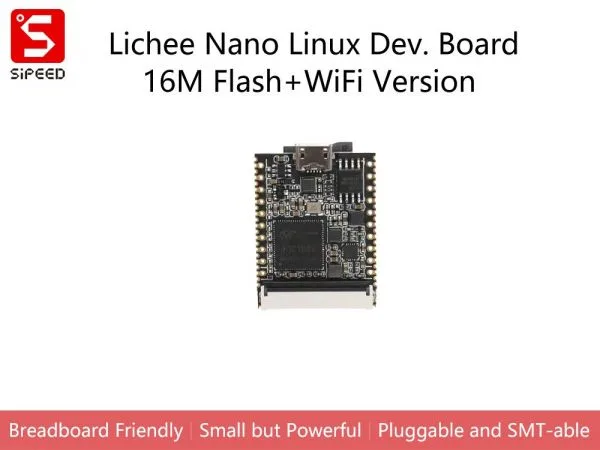
Overview. Seeed Studio Lichee Nano is an SD card sized Linux development board based on the Allwinner F1C100s ARM 926EJS processor, running at up to 900MHz. It is designed for projects that exceed the capabilities of a common microcontroller.
Main characteristics. The SoC integrates 32MB of DDR and the board carries 16MB of SPI Flash. An onboard TF slot allows booting from a TF card.
Display and video. A 40-pin RGB LCD FPC connector supports resistive displays at 272×480, 480×800, 1024×600 and other resolutions, with capacitive displays supported through an adapter board. The board provides 720P video output and video stream decoding such as H.264 and MPEG.
Interfaces and connectivity. An SDIO interface connects a Wi-Fi module. The board provides two SPI ports, three TWI ports, three UART ports, one OTG USB port, a TV output, two PWM outputs, one LRADC, two headphone outputs and one microphone input.
Power and environment. Power is supplied at 5V via the micro USB port, or at 3.3 to 5V via pins. The output is 3.3V, with a selectable RTC input voltage. Consumption is 54mA idle with Linux and 250mA with display. Storage temperature ranges from -40 to 125°C, and operating temperature from -20 to 70°C.
Software and development environment. The board supports 3.10 BSP Linux, 4.19 mainline Linux, the xboot bare metal development environment and RT-Thread.
Typical uses. This board suits IoT devices using complex communication interfaces and protocols, human-machine interfaces with advanced logic, and applications requiring more processing than a common MCU. It also suits rapid prototyping under open source Linux.
Note. For commercial and industrial needs, Seeed offers BeagleBone series boards, including the BeagleBone Green and BeagleBone Green Wireless, along with a customization service.