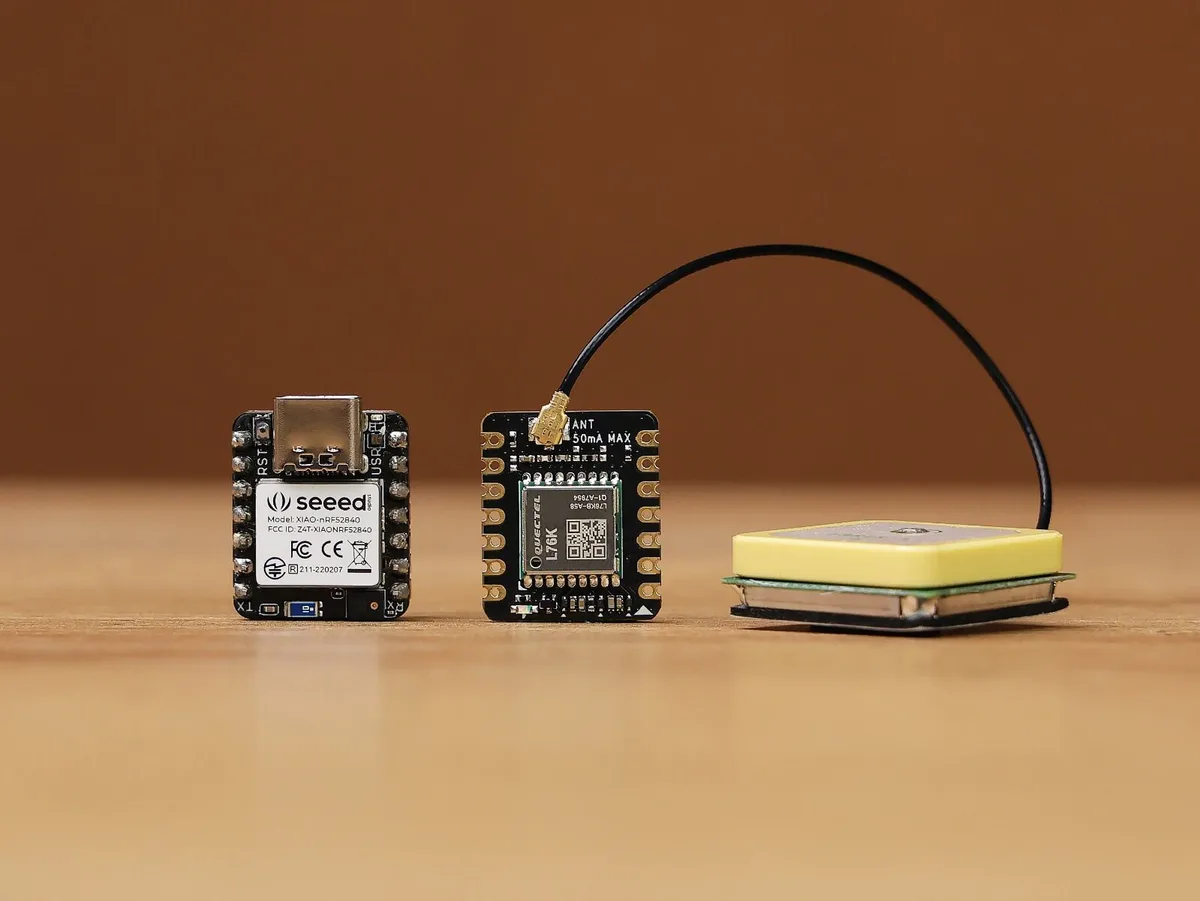
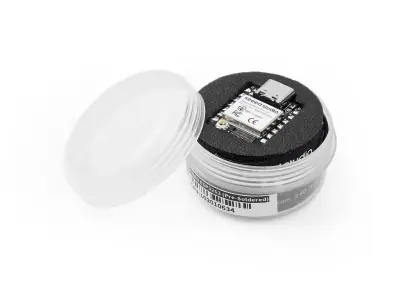
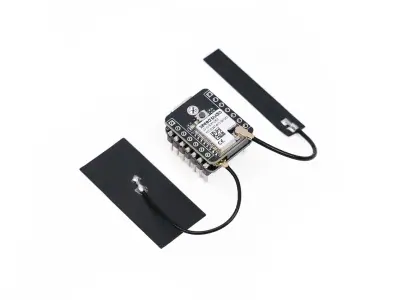
Multi-constellation GNSS receiver in XIAO form factor, with active antenna and UART interface, for positioning and tracking in projects built on XIAO boards.
Operating Frequency1559–1606MHz
Channels32 tracking ch/72 acquisition ch
Acceleration0.1m/s²
Auto-acquisition-148dBm
Auto-aquisition41mA
Baud rate9600~115200bps(9600bps default)
Product overview
The Seeed Studio L76K GNSS module is a multi-constellation receiver designed to connect to XIAO development boards. It receives GPS L1 C/A, BeiDou B1 and GLONASS L1 signals and can compute a position either by combining these systems or by using a single one.
Reception and sensitivity. The module integrates a low-noise amplifier and a surface acoustic wave filter to improve reception in difficult environments. It provides 32 tracking channels and 72 acquisition channels, with a tracking sensitivity of -162 dBm and a re-acquisition sensitivity of -160 dBm. A 10 cm active ceramic antenna, connected through an RF1.13 coaxial cable and a U.FL connector, is included.
Accuracy and time to first fix. The stated position accuracy is 2.0 m CEP, with a velocity accuracy of 0.1 m/s. Time to first fix is 30 s cold without AGNSS and 5.5 s with GNSS, and 5.5 s hot without AGNSS or 2 s with AGNSS. The default update rate is 1 Hz, up to 5 Hz maximum.
Interface and protocols. Communication runs over a UART link at 9600 to 115200 bps, 9600 bps by default. Output sentences follow NMEA 0183, alongside the CASIC proprietary protocol.
Power consumption. The module draws 41 mA while tracking or acquiring and 360 µA in standby, which suits battery-powered embedded designs. Its dimensions are 18 mm x 21 mm.
Official documents and the technical data recorded for 109100021. For a missing document or a specific revision, our experts send it to you.
1. Technical overview
Multi-constellation GNSS receiver in XIAO form factor, with active antenna and UART interface, for positioning and tracking in projects built on XIAO boards.
Architectures in which 109100021 can play a role, derived from its category. This is not a compatibility statement: check the specifications against your requirements.
Seeed SenseCAP sensors connect to Seeed’s SenseCAP cloud platform and app, and Seeed edge computers, camera modules, Grove and XIAO boards complete the chain for custom devices and local processing
To check
SenseCAP cloud platform and app, or the customer’s own network server
Prototype on Grove and XIAO, then move to industrial versions
Local processing on the edge computers or in the cloud
Associated system blocks
SensorsEdge computingDevelopment boards
Need a complete solution?
Send a request for 109100021 and the other parts of your project.
Similar parts to answer your needs. Compare the main characteristics. A recorded replacement is a documented relation; a similar product is a similarity only, never a compatibility claim.
Current productSeeed Studio
109100021
Multi-GNSS receiver module for XIAO boards, GPS BeiDou GLONASS
What is recorded about the regulatory status and the life of this part.
Regulatory compliance
No compliance statement is recorded for this part. Ask the supplier for the RoHS and REACH declarations and, for a radio product, the EU declaration of conformity.
No advertising or analytics cookies. A single, strictly necessary cookie is set only if you sign in to your account. Your quote basket and comparison stay in your browser. Details